Department of Neonatal Paediatrics, Fiona Stanley hospital, Perth, Australia.
Department of Neonatal Paediatrics, Perth Children's Hospital, Perth, Australia.
BMC Pediatr. 2021 Dec 2;21(1):540. doi: 10.1186/s12887-021-03027-x.
Poor weight gain in the first few weeks of life has been studied as a predictor of retinopathy of prematurity (ROP). Our aim was to assess whether time taken to regain birthweight (BW) be used as an additional marker to identify infants with type 1 ROP.
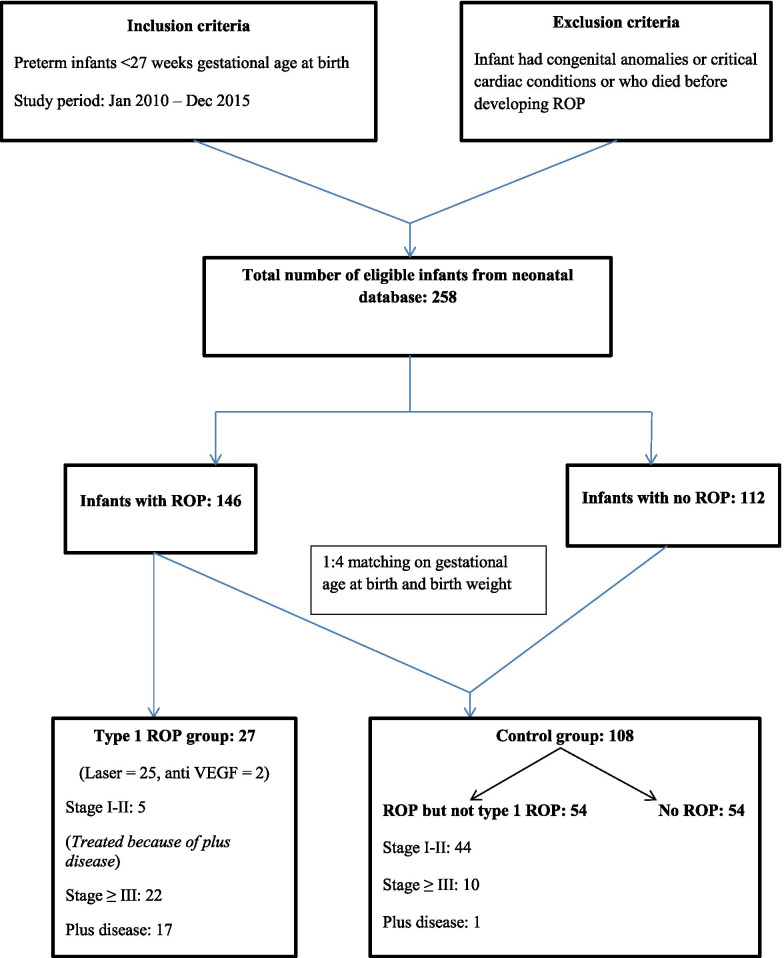
In this retrospective study, preterm infants (< 27 weeks gestational age at birth) born during the period from 1/1/2010-31/12/2015 at a tertiary neonatal intensive care unit in Australia were included. Twenty-seven preterm infants with Type 1 ROP were identified. Controls (No ROP or ROP other than type 1) were matched with cases on gestational age at birth and BW (1:4 ratio). Data were collected from the database and medical records.
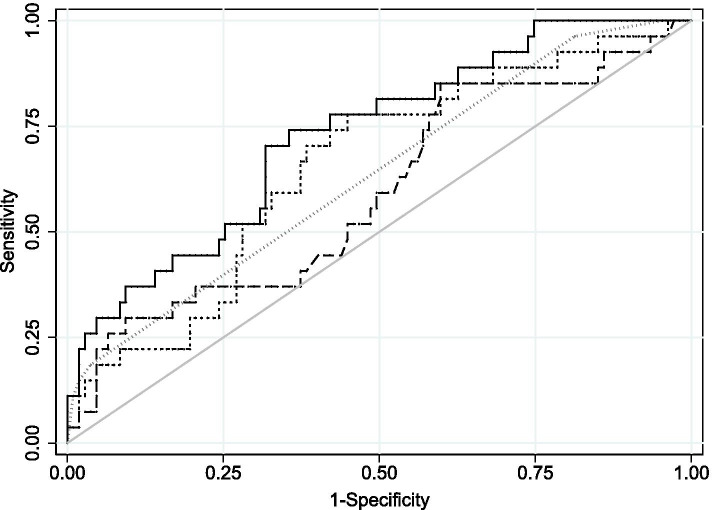
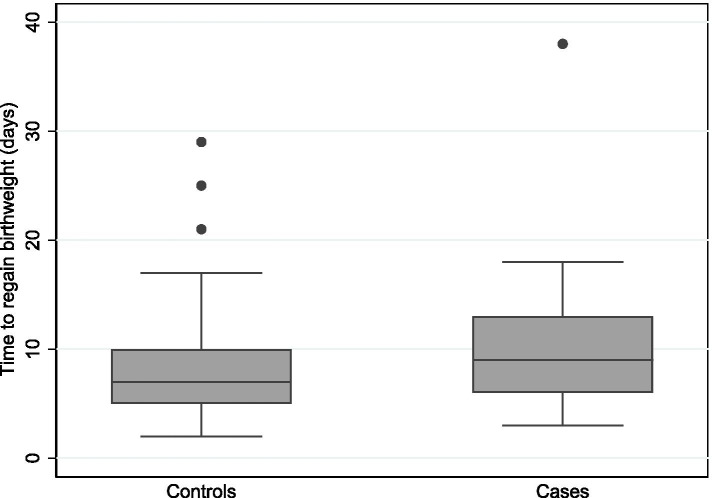
The median (IQR) gestational age for Type 1 ROP and control groups were 24 (24-26) and 25 (24-26) weeks respectively and median (IQR) BW for Type 1 ROP and control groups were 675 (635-810) and 773 (666-884) grams respectively. Preterm infants with Type 1 ROP were more likely to be small for gestational age (SGA) (18.5% vs 3.7%, p = 0.015) and had increased weeks on oxygen therapy (median 11.9 vs 9.1, p = 0.028). Time to regain BW was longer in preterm infants with type 1 ROP than controls but did not reach statistical significance (median 9 vs 7 days, OR 1.08, 95% CI 1.00-1.17, p = 0.059) adjusted for SGA and duration of oxygen therapy. The area under the curve from the time to regain BW model with adjustment for SGA and duration of oxygen therapy was 0.73 (95% CI 0.62-0.83).
We hypothesize that time to regain BW has potential to aid prediction of Type 1 ROP and this warrants further investigation in a larger prospective study.
生命最初几周体重增长不良已被研究作为早产儿视网膜病变(ROP)的预测指标。我们的目的是评估体重恢复时间(BW)是否可作为识别 1 型 ROP 婴儿的附加标志物。
在这项回顾性研究中,纳入了 2010 年 1 月 1 日至 2015 年 12 月 31 日期间在澳大利亚一家三级新生儿重症监护病房出生的极早产儿(出生时胎龄<27 周)。共确定了 27 例 1 型 ROP 早产儿。将病例与对照组(无 ROP 或除 1 型以外的 ROP)按出生时胎龄和 BW(1:4 比例)进行匹配。数据从数据库和病历中收集。
1 型 ROP 组和对照组的中位(IQR)胎龄分别为 24(24-26)周和 25(24-26)周,中位(IQR)BW 分别为 675(635-810)g 和 773(666-884)g。1 型 ROP 早产儿更可能为小于胎龄儿(SGA)(18.5% vs 3.7%,p=0.015),且吸氧时间更长(中位时间 11.9 周 vs 9.1 周,p=0.028)。1 型 ROP 早产儿体重恢复时间长于对照组,但无统计学意义(中位数 9 天 vs 7 天,OR 1.08,95%CI 1.00-1.17,p=0.059),校正 SGA 和吸氧时间后。调整 SGA 和吸氧时间后,体重恢复时间模型的曲线下面积为 0.73(95%CI 0.62-0.83)。
我们假设体重恢复时间可能有助于预测 1 型 ROP,这需要在更大的前瞻性研究中进一步研究。