Song Xiaopeng, Ma Tianwen, Hu Hailong, Zhao Mingchao, Bai Hui, Wang Xinyu, Liu Lin, Li Ting, Sheng Xuanbo, Xu Xinyu, Zhang Xinmin, Gao Li
Heilongjiang Key Laboratory for Laboratory Animals and Comparative Medicine, College of Veterinary Medicine, Northeast Agriculture University, Harbin, China.
College of Veterinary Medicine, Northeast Agricultural University, Harbin, China.
Front Pharmacol. 2021 Nov 11;12:760988. doi: 10.3389/fphar.2021.760988. eCollection 2021.
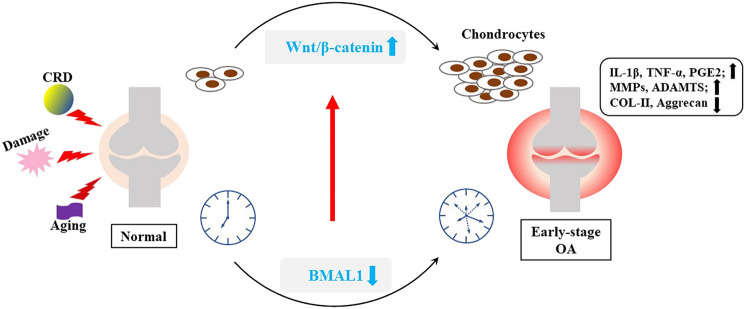
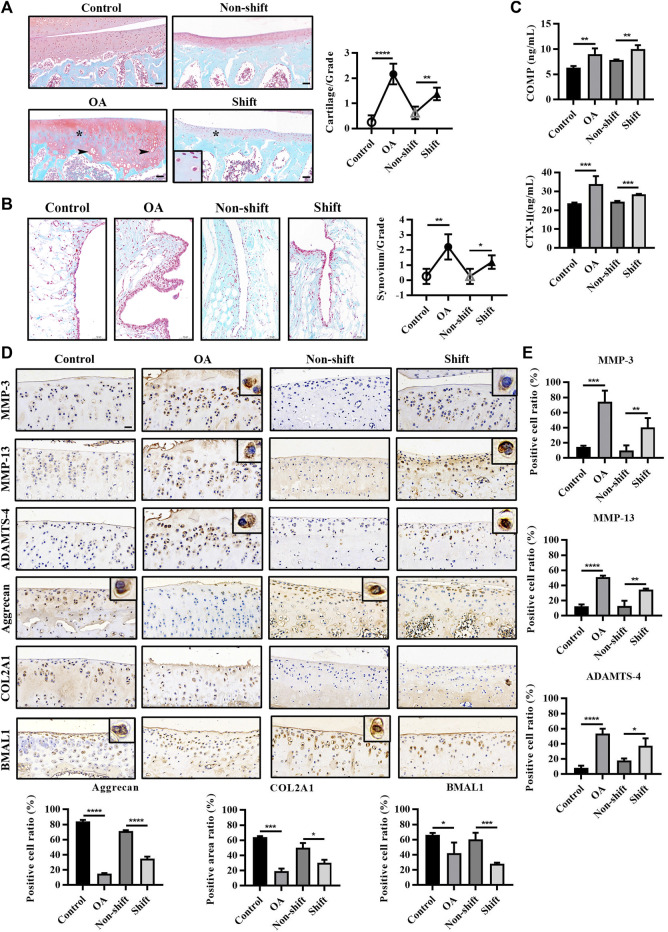
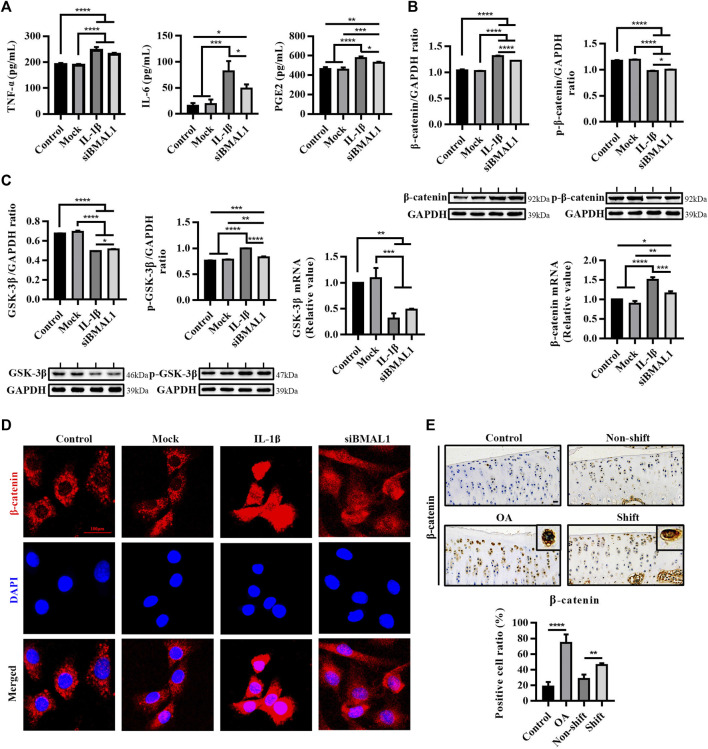
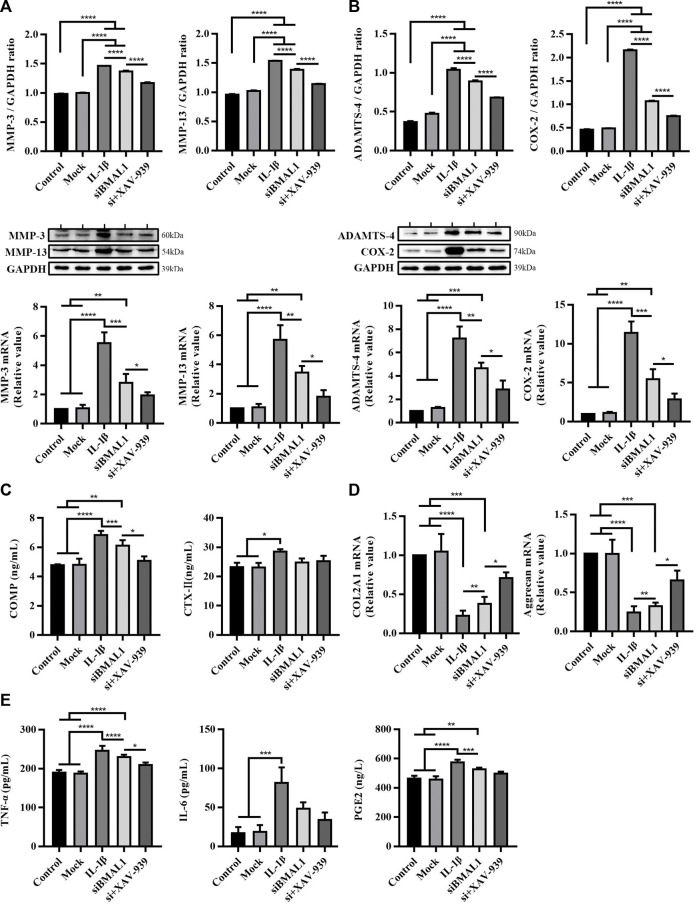
With the gradual deepening of understanding of systemic health and quality of life, the factors affecting osteoarthritis (OA) are not limited to mechanical injury, metabolic abnormality, age and obesity, etc., but circadian rhythm, which plays a non-negligible role in human daily life. The purpose of this study was to explore the molecular mechanism of chronic circadian rhythm disturbance (CRD) inducing cartilage OA-like degeneration. Rats with the anterior cruciate ligament excision transection (ACLT) were used to establish the early-stage OA model (6-week). The light/dark (LD) cycle shifted 12 h per week for 22 weeks in order to establish a chronic CRD model. knockdown (KD) and Wnt/β-catenin pathway inhibition were performed in chondrocytes. The contents of proinflammatory factors and OA biomarkers in serum and chondrocyte secretions were detected by ELISA. Pathological and immunohistochemical staining of articular cartilage indicated the deterioration of cartilage. WB and qPCR were used to evaluate the relationship between matrix degradation and the activation of Wnt/β-catenin signaling pathway in chondrocytes. We found that chronic CRD could cause OA-like pathological changes in knee cartilage of rats, accelerating cartilage matrix degradation and synovial inflammation. The expression of MMP-3, MMP-13, ADAMTS-4, and β-catenin increased significantly; BMAL1, Aggrecan, and COL2A1 decreased significantly in either LD-shifted cartilage or -KD chondrocytes. The expression of β-catenin and p-GSK-3β elevated, while p-β-catenin and GSK-3β diminished. The inhibitor XAV-939 was able to mitigated the increased inflammation produced by transfected . Our study demonstrates that chronic CRD disrupts the balance of matrix synthesis and catabolic metabolism in cartilage and chondrocytes, and it is related to the activation of the canonical Wnt/β-catenin signaling pathway.
随着对全身健康和生活质量认识的逐渐深入,影响骨关节炎(OA)的因素不仅限于机械损伤、代谢异常、年龄和肥胖等,昼夜节律在人类日常生活中也起着不可忽视的作用。本研究旨在探讨慢性昼夜节律紊乱(CRD)诱导软骨OA样退变的分子机制。采用前交叉韧带切除横断(ACLT)大鼠建立早期OA模型(6周)。每周将光/暗(LD)周期提前12小时,持续22周,以建立慢性CRD模型。在软骨细胞中进行基因敲低(KD)和Wnt/β-连环蛋白通路抑制。通过ELISA检测血清和软骨细胞分泌物中促炎因子和OA生物标志物的含量。关节软骨的病理和免疫组化染色显示软骨退变。采用WB和qPCR评估软骨细胞中基质降解与Wnt/β-连环蛋白信号通路激活之间的关系。我们发现慢性CRD可导致大鼠膝关节软骨出现OA样病理变化,加速软骨基质降解和滑膜炎症。MMP-3、MMP-13、ADAMTS-4和β-连环蛋白的表达显著增加;在LD周期改变的软骨或KD软骨细胞中,BMAL1、聚集蛋白聚糖和COL2A1显著降低。β-连环蛋白和p-GSK-3β的表达升高,而p-β-连环蛋白和GSK-3β降低。抑制剂XAV-939能够减轻转染产生的炎症增加。我们的研究表明,慢性CRD破坏了软骨和软骨细胞中基质合成与分解代谢的平衡,并且与经典Wnt/β-连环蛋白信号通路的激活有关。