Zhang Anyi, Shi Le, Yan Wei, Xiao Han, Bao Yanping, Wang Zhe, Deng Jiahui, Ravindran Arun, Yuan Kai, Mei Hong, Shi Jie, Liu Zhisheng, Liu Jiajia, Lu Lin
National Health Commission Key Laboratory of Mental Health (Peking University), National Clinical Research Center for Mental Disorders (Peking University Sixth Hospital), Peking University Institute of Mental Health, Peking University Sixth Hospital, Peking University, Beijing, China.
Institute of Maternal and Child Health, Tongji Medical College, Wuhan Children's Hospital, Huazhong University of Science and Technology, Wuhan, China.
Front Psychiatry. 2021 Nov 11;12:759449. doi: 10.3389/fpsyt.2021.759449. eCollection 2021.
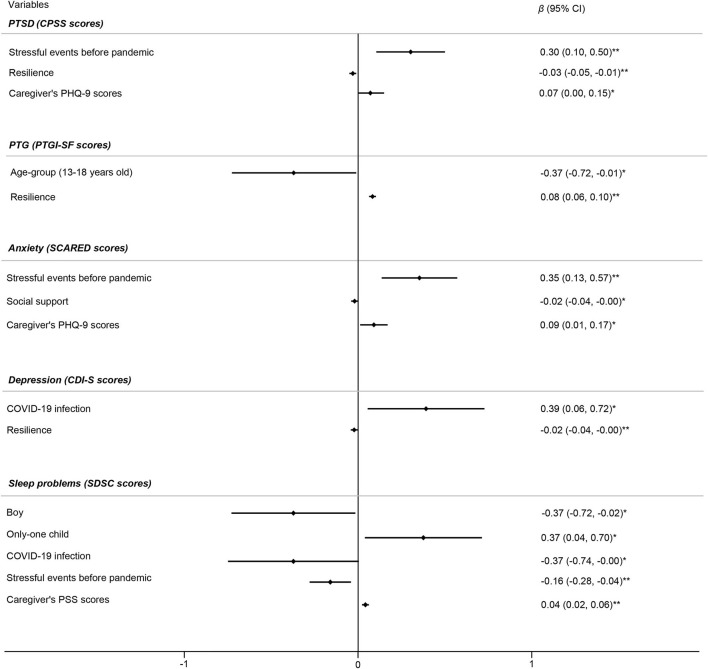
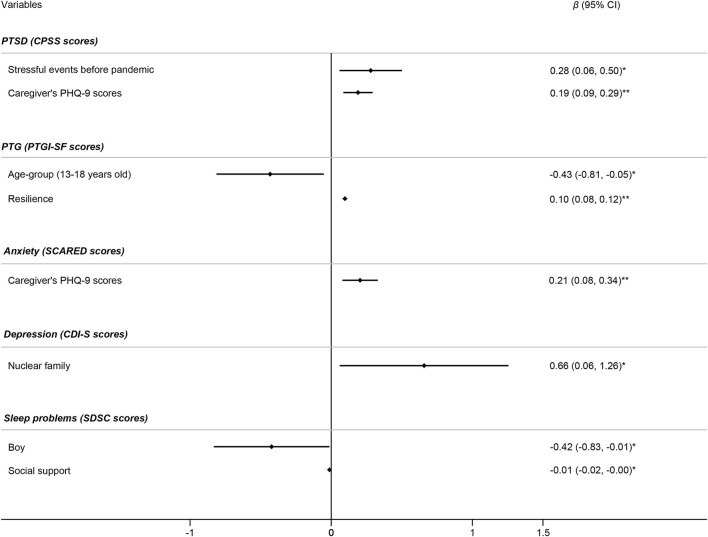
To date, the mental health consequences of children hospitalized with COVID-19 remain unclear. We aimed to assess mental health status in children in the context of COVID-19, with a focus on discharged children. We recruited discharged children who recovered from COVID-19 and healthy controls between July and September 2020 in Wuhan Children's Hospital. Post-traumatic stress disorder (PTSD), anxiety, depression, and sleep problems were assessed in these children using questionnaires. Univariable and multivariable logistic and linear regressions were conducted to identify risk factors. Totally, there were 152 children (61 discharged children and 91 healthy controls) aged 7-18 years old in our study. An increasing trend in the prevalence of PTSD, anxiety, and depression was observed in the discharged children compared with healthy controls (PTSD: 8.20 vs. 2.20%, anxiety: 22.95 vs. 13.19%; depression: 47.54 vs. 32.97%). Discharged children tended to report more depressive symptoms (β = 0.39) and less sleep problems (β = -0.37). Discharged children who lived in nuclear families and had longer hospital stays were more likely to report depression [odds ratio (OR) = 3.68 and 1.14, respectively]. Anxiety symptoms and the severity of sleep problems of discharged children were positively associated with caregivers' depression and PTSD symptoms (OR = 21.88 and 31.09, respectively). In conclusion, PTSD, anxiety, and depression symptoms were common among recovered children 4 months after COVID-19 hospitalization. Children from nuclear family and those had longer hospital stays need special attention. In addition, parental mental health had a significant impact on their children's mental resilience and recovery.
迄今为止,因新冠肺炎住院儿童的心理健康后果仍不明确。我们旨在评估新冠肺炎背景下儿童的心理健康状况,重点关注出院儿童。2020年7月至9月,我们在武汉市儿童医院招募了从新冠肺炎中康复的出院儿童和健康对照。使用问卷对这些儿童的创伤后应激障碍(PTSD)、焦虑、抑郁和睡眠问题进行评估。进行单变量和多变量逻辑回归及线性回归以确定风险因素。本研究共纳入152名7 - 18岁儿童(61名出院儿童和91名健康对照)。与健康对照相比,出院儿童中PTSD、焦虑和抑郁的患病率呈上升趋势(PTSD:8.20%对2.20%;焦虑:22.95%对13.19%;抑郁:47.54%对32.97%)。出院儿童往往报告更多抑郁症状(β = 0.39)和更少睡眠问题(β = -0.37)。生活在核心家庭且住院时间较长的出院儿童更有可能报告抑郁[比值比(OR)分别为3.68和1.14]。出院儿童的焦虑症状和睡眠问题严重程度与照顾者的抑郁和PTSD症状呈正相关(OR分别为21.88和31.09)。总之,新冠肺炎住院4个月后康复儿童中PTSD、焦虑和抑郁症状很常见。来自核心家庭和住院时间较长的儿童需要特别关注。此外,父母的心理健康对其子女的心理恢复力和康复有重大影响。