Chen Ruifei, Liu Ziyi, Xu Poshi, Qi Xinkun, Qin Shangshang, Wang Zhiqiang, Li Ruichao
Department of Clinical Laboratory, Henan Provincial People's Hospital, Department of Clinical Laboratory of Central China Fuwai Hospital, Central China Fuwai Hospital of Zhengzhou University, Zhengzhou, China.
Jiangsu Co-innovation Center for Prevention and Control of Important Animal Infectious Diseases and Zoonoses, College of Veterinary Medicine, Yangzhou University, Yangzhou, China.
Front Microbiol. 2021 Nov 10;12:741093. doi: 10.3389/fmicb.2021.741093. eCollection 2021.
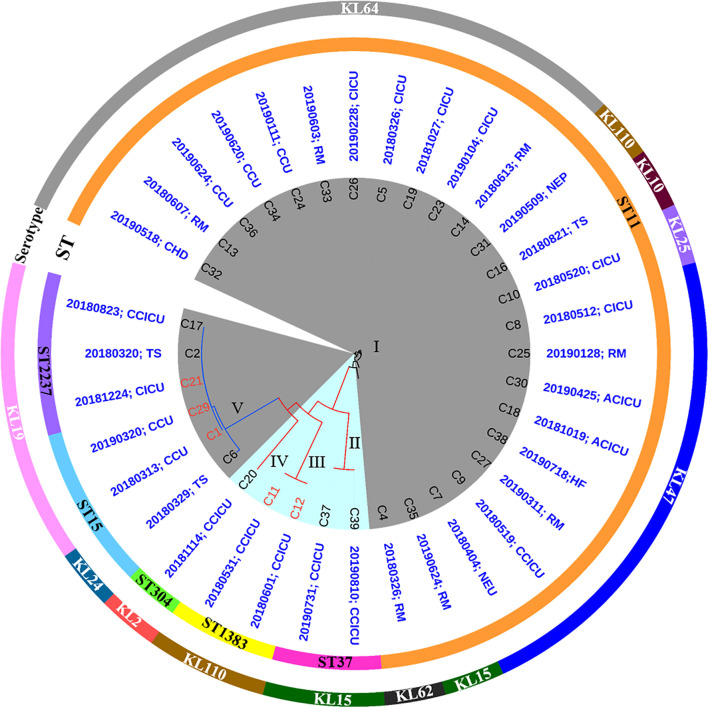
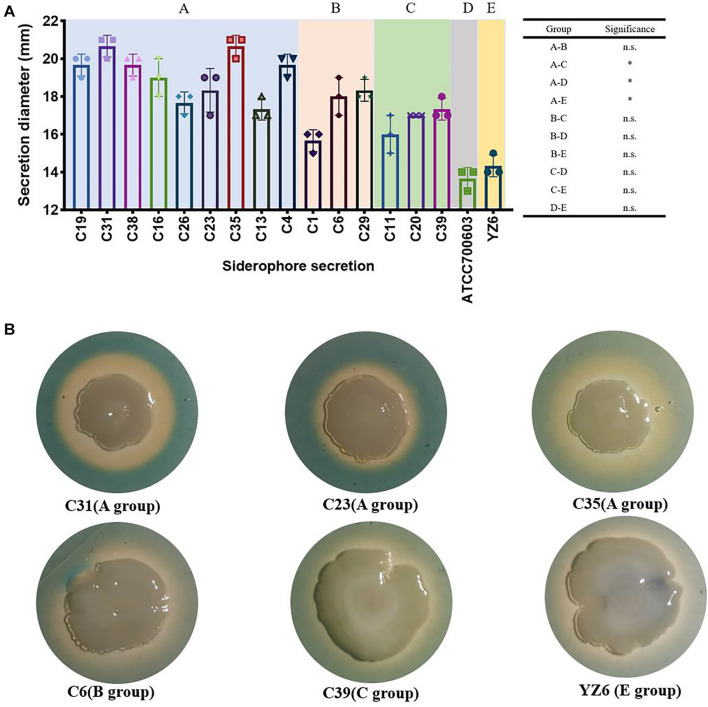
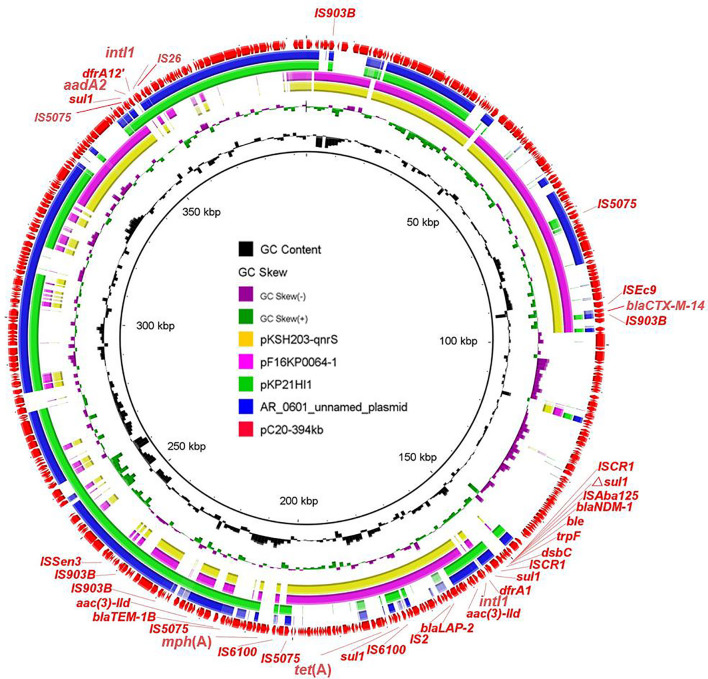
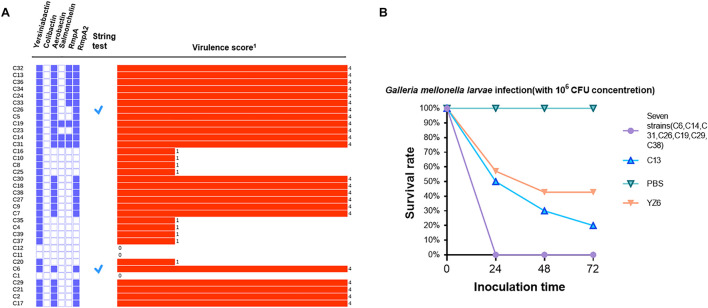
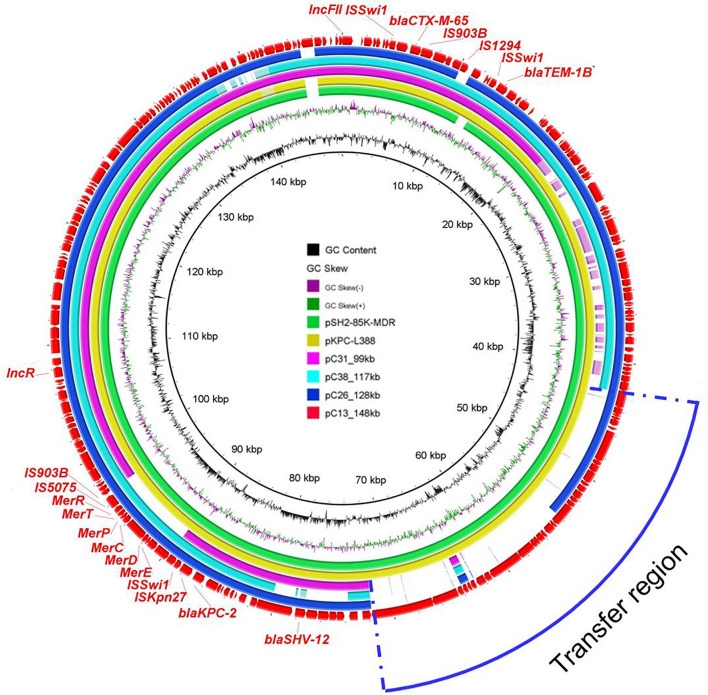
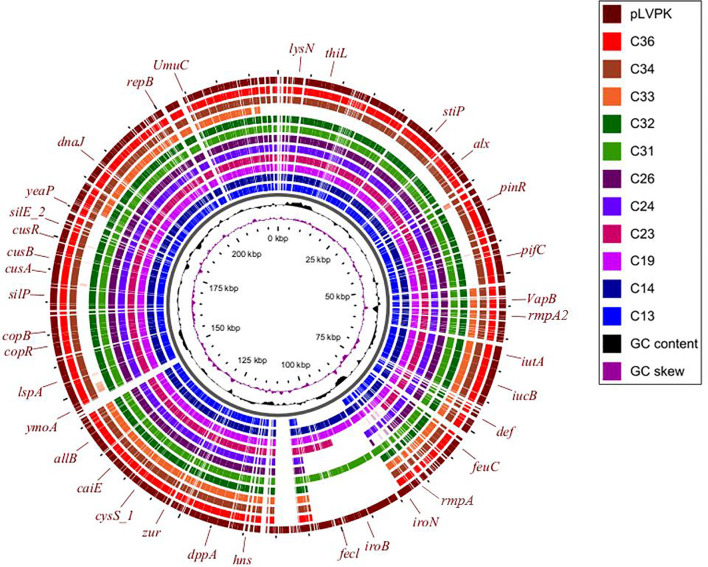
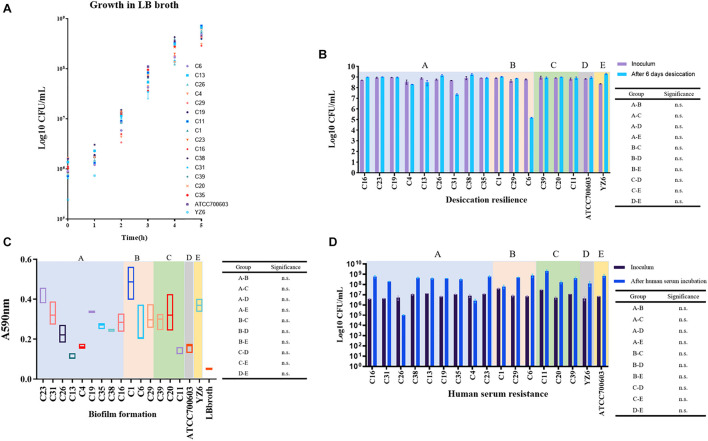
The emergence of hypervirulent carbapenem-resistant (hv-CRKP) was regarded as an emerging threat in clinical settings. Here, we investigated the prevalence of CRKP strains among inpatients in a new hospital over 1 year since its inception with various techniques, and carried out a WGS-based phylogenetic study to dissect the genomic background of these isolates. The genomes of three representative -positive strains and the plasmids of four -positive strains were selected for Nanopore long-read sequencing to resolve the complicated MDR structures. Thirty-five CRKP strains were identified from 193 isolates, among which 30 strains (85.7%) harbored , whereas the remaining five strains (14.3%) were positive for . The antimicrobial resistance profiles of -positive isolates were narrower than that of -positive isolates. Five isolates including two -positive isolates and three -positive strains could successfully transfer the carbapenem resistance phenotype by conjugation. All CRKP strains were categorized into six known multilocus sequence types, with ST11 being the most prevalent type. Phylogenetic analysis demonstrated that the clonal spread of ST11 -positive isolates and local polyclonal spread of -positive isolates have existed in the hospital. The gene was located on IncX3, IncFIB/IncHI1B, and IncHI5-like plasmids, of which IncFIB/IncHI1B plasmid has a novel structure. By contrast, all ST11 isolates shared the similar -bearing plasmid backbone, and 11 of them possessed pLVPK-like plasmids. In addition, virulome analysis, larvae infection assay, and siderophore secretion revealed the hypervirulence potential of most -positive strains. Given that these isolates also had remarkable environmental adaptability, targeted measures should be implemented to prevent the grave consequences caused by hv-CRKP strains in nosocomial settings.
高毒力碳青霉烯耐药肺炎克雷伯菌(hv-CRKP)的出现被视为临床环境中的一种新威胁。在此,我们采用多种技术调查了一家新医院自开业以来1年多时间里住院患者中CRKP菌株的流行情况,并开展了一项基于全基因组测序(WGS)的系统发育研究,以剖析这些分离株的基因组背景。选择了三株具有代表性的阳性菌株的基因组和四株阳性菌株的质粒进行纳米孔长读长测序,以解析复杂的多重耐药结构。从193株分离株中鉴定出35株CRKP菌株,其中30株(85.7%)携带,而其余5株(14.3%)呈阳性。阳性分离株的抗菌药物耐药谱比阳性分离株窄。包括两株阳性分离株和三株阳性菌株在内的五株分离株可通过接合成功转移碳青霉烯耐药表型。所有CRKP菌株被分为六种已知的多位点序列类型,其中ST11是最常见的类型。系统发育分析表明,医院中存在ST11阳性分离株的克隆传播和阳性分离株的局部多克隆传播。基因位于IncX3、IncFIB/IncHI1B和IncHI5样质粒上,其中IncFIB/IncHI1B质粒具有新结构。相比之下,所有ST11分离株共享相似的携带质粒骨架,其中11株拥有pLVPK样质粒。此外,毒力组分析、幼虫感染试验和铁载体分泌揭示了大多数阳性菌株的高毒力潜力。鉴于这些分离株也具有显著的环境适应性,应采取针对性措施以防止hv-CRKP菌株在医院环境中造成严重后果。