Ranard Benjamin L, Megjhani Murad, Terilli Kalijah, Doyle Kevin, Claassen Jan, Pinsky Michael R, Clermont Gilles, Vodovotz Yoram, Asgari Shadnaz, Park Soojin
Division of Pulmonary, Allergy, and Critical Care Medicine, Department of Medicine, NewYork-Presbyterian Hospital/Columbia University Irving Medical Center, New York, NY, United States.
Program for Hospital and Intensive Care Informatics, Department of Neurology, Columbia University Irving Medical Center, New York, NY, United States.
Front Med (Lausanne). 2021 Nov 11;8:770343. doi: 10.3389/fmed.2021.770343. eCollection 2021.
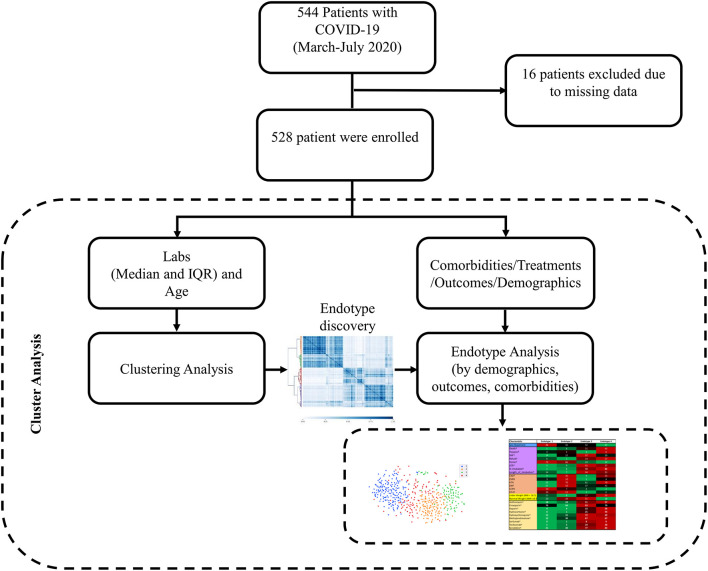
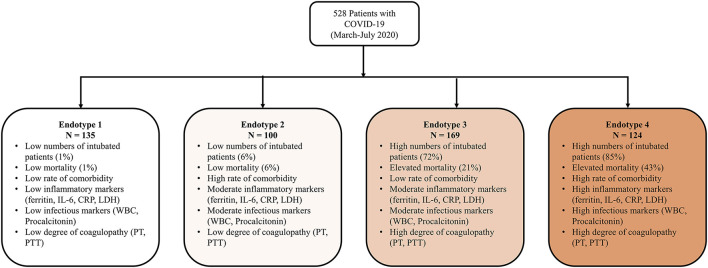
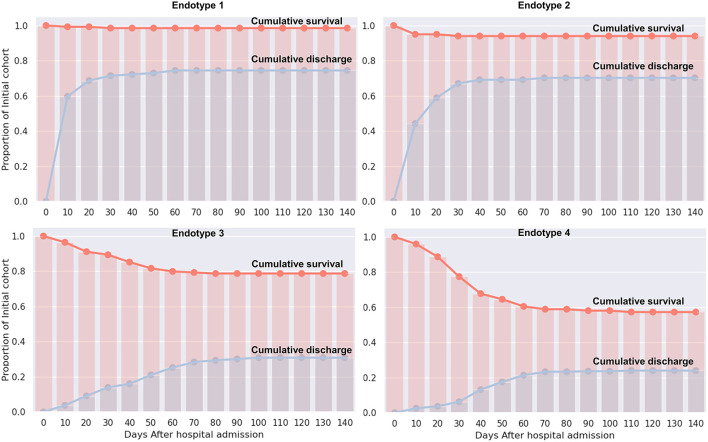
Characterization of coronavirus disease 2019 (COVID-19) endotypes may help explain variable clinical presentations and response to treatments. While risk factors for COVID-19 have been described, COVID-19 endotypes have not been elucidated. We sought to identify and describe COVID-19 endotypes of hospitalized patients. Consensus clustering (using the ensemble method) of patient age and laboratory values during admission identified endotypes. We analyzed data from 528 patients with COVID-19 who were admitted to telemetry capable beds at Columbia University Irving Medical Center and discharged between March 12 to July 15, 2020. Four unique endotypes were identified and described by laboratory values, demographics, outcomes, and treatments. Endotypes 1 and 2 were comprised of low numbers of intubated patients (1 and 6%) and exhibited low mortality (1 and 6%), whereas endotypes 3 and 4 included high numbers of intubated patients (72 and 85%) with elevated mortality (21 and 43%). Endotypes 2 and 4 had the most comorbidities. Endotype 1 patients had low levels of inflammatory markers (ferritin, IL-6, CRP, LDH), low infectious markers (WBC, procalcitonin), and low degree of coagulopathy (PTT, PT), while endotype 4 had higher levels of those markers. Four unique endotypes of hospitalized patients with COVID-19 were identified, which segregated patients based on inflammatory markers, infectious markers, evidence of end-organ dysfunction, comorbidities, and outcomes. High comorbidities did not associate with poor outcome endotypes. Further work is needed to validate these endotypes in other cohorts and to study endotype differences to treatment responses.
2019冠状病毒病(COVID-19)内型的特征描述可能有助于解释其临床表现的差异以及对治疗的反应。虽然已经描述了COVID-19的危险因素,但尚未阐明COVID-19的内型。我们试图识别和描述住院患者的COVID-19内型。通过对患者年龄和入院期间实验室值进行共识聚类(采用集成方法)来确定内型。我们分析了2020年3月12日至7月15日期间入住哥伦比亚大学欧文医学中心有遥测功能床位并出院的528例COVID-19患者的数据。通过实验室值、人口统计学、结局和治疗方法确定并描述了四种独特的内型。内型1和2插管患者数量较少(分别为1%和6%),死亡率较低(分别为1%和6%),而内型3和4插管患者数量较多(分别为72%和8%)且死亡率较高(分别为21%和43%)。内型2和4合并症最多。内型1患者炎症标志物(铁蛋白、IL-6、CRP、LDH)、感染标志物(白细胞、降钙素原)水平较低,凝血病程度较低(PTT、PT),而内型4这些标志物水平较高。识别出了住院COVID-19患者的四种独特内型,这些内型根据炎症标志物、感染标志物、终末器官功能障碍证据、合并症和结局对患者进行了分类。高合并症与不良结局内型无关。需要进一步开展工作,在其他队列中验证这些内型,并研究内型差异对治疗反应的影响。