Department of Orthopedics, Beijing Chaoyang Hospital, Capital Medical University, China.
Department of Orthopedics, The Third Hospital of Shijiazhuang, China.
Biomed Res Int. 2021 Nov 23;2021:5911868. doi: 10.1155/2021/5911868. eCollection 2021.
To analyze the effect of PFNA-II internal fixation on hip joint recovery and quality of life (QOL) in patients with lateral-wall dangerous type of intertrochanteric fracture.
One hundred and twelve patients with lateral-wall dangerous type of intertrochanteric fracture who underwent surgical treatment in our hospital from May 2017 to May 2019 were selected as the participants of the study. Based on the treatment method, all the enrolled patients were divided into two groups: proximal femoral nail antirotation (PFNA group; = 59) who received closed reduction and minimally invasive PFNA internal fixation and dynamic hip screw group (DHS; = 53) who received internal fixation. The clinical indicators, curative effect, hip function score, pain degree, postoperative QOL score, and complications were compared between the two groups.
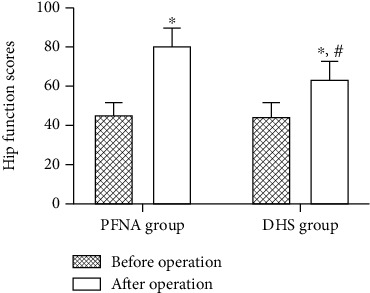
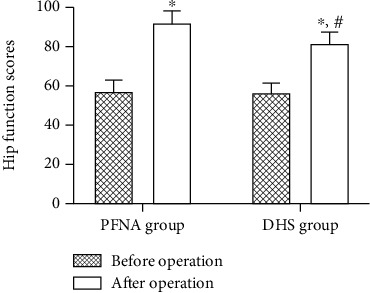
The operation time, intraoperative blood loss, postoperative drainage volume, and the incidence of postoperative complications in PFNA group were statistically lower than those in DHS group ( < 0.05). The curative effect in PFNA group was notably better than that in DHS group. There were no significant differences in scores of hip function, visual analogue scale (VAS), and QOL between the two groups before operation ( > 0.05). However, the hip function score and QOL score increased in both groups after surgery, and the increase was more significant in the PFNA group, while the VAS score decreased in both groups, and the decrease in PFNA group was more significant ( < 0.05).
PFNA internal fixation for the treatment of lateral-wall dangerous type of intertrochanteric fracture has the advantages of short operation time, less intraoperative blood loss, effective improvement of hip joint function, and fewer postoperative complications, which is worthy of clinical application.
分析股骨近端防旋髓内钉-II(PFNA-II)内固定对髋外侧壁危险型股骨转子间骨折患者髋关节恢复和生活质量(QOL)的影响。
选取 2017 年 5 月至 2019 年 5 月在我院接受手术治疗的 112 例髋外侧壁危险型股骨转子间骨折患者作为研究对象。根据治疗方法将纳入患者分为两组:接受闭合复位微创股骨近端防旋髓内钉内固定的股骨近端髓内钉抗旋组(PFNA 组;n=59)和接受动力髋螺钉内固定的动力髋螺钉组(DHS 组;n=53)。比较两组患者的临床指标、疗效、髋关节功能评分、疼痛程度、术后 QOL 评分和并发症发生情况。
PFNA 组的手术时间、术中出血量、术后引流量及术后并发症发生率均明显低于 DHS 组(<0.05)。PFNA 组的疗效明显优于 DHS 组。两组患者术前髋关节功能评分、视觉模拟评分(VAS)和 QOL 评分比较差异均无统计学意义(>0.05)。术后两组髋关节功能评分和 QOL 评分均升高,且 PFNA 组升高更明显,VAS 评分均降低,且 PFNA 组降低更明显(<0.05)。
PFNA 内固定治疗髋外侧壁危险型股骨转子间骨折具有手术时间短、术中出血量少、有效改善髋关节功能和术后并发症少的优点,值得临床推广应用。