Li Bin, Zhang Xiaotan, Wang Tingting, He Zhangxing, Lu Bingan, Liang Shuquan, Zhou Jiang
School of Chemical Engineering, North China University of Science and Technology, Tangshan, 063009, People's Republic of China.
School of Materials Science and Engineering, Key Laboratory of Electronic Packaging and Advanced Functional Materials of Hunan Province, Central South University, Changsha, 410083, People's Republic of China.
Nanomicro Lett. 2021 Dec 2;14(1):6. doi: 10.1007/s40820-021-00764-7.
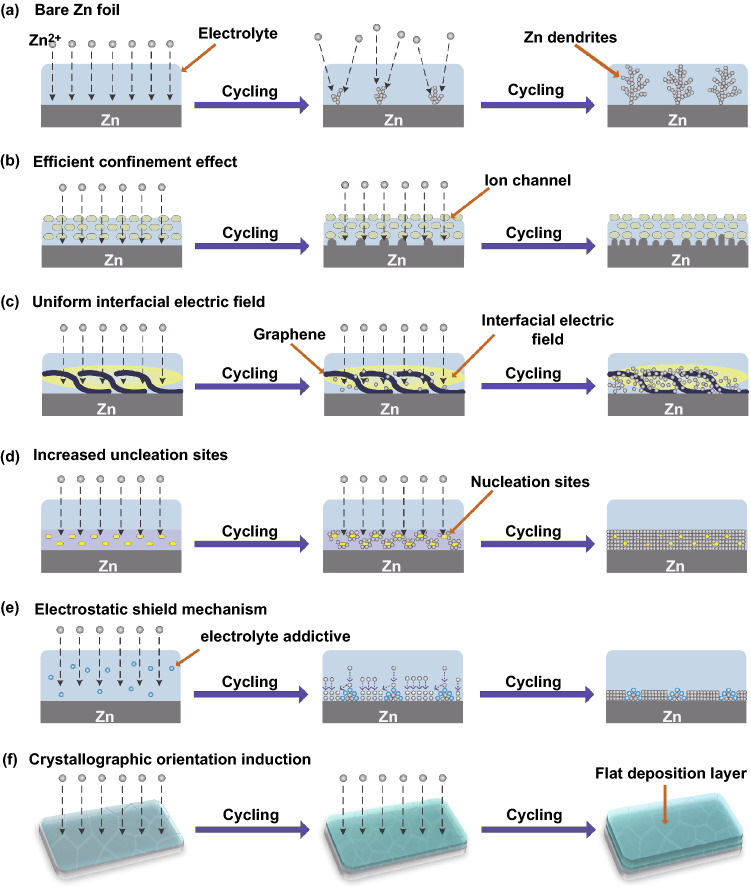
Due to their high safety and low cost, rechargeable aqueous Zn-ion batteries (RAZIBs) have been receiving increased attention and are expected to be the next generation of energy storage systems. However, metal Zn anodes exhibit a limited-service life and inferior reversibility owing to the issues of Zn dendrites and side reactions, which severely hinder the further development of RAZIBs. Researchers have attempted to design high-performance Zn anodes by interfacial engineering, including surface modification and the addition of electrolyte additives, to stabilize Zn anodes. The purpose is to achieve uniform Zn nucleation and flat Zn deposition by regulating the deposition behavior of Zn ions, which effectively improves the cycling stability of the Zn anode. This review comprehensively summarizes the reaction mechanisms of interfacial modification for inhibiting the growth of Zn dendrites and the occurrence of side reactions. In addition, the research progress of interfacial engineering strategies for RAZIBs is summarized and classified. Finally, prospects and suggestions are provided for the design of highly reversible Zn anodes.
由于其高安全性和低成本,可充电水系锌离子电池(RAZIBs)受到了越来越多的关注,并有望成为下一代储能系统。然而,由于锌枝晶和副反应问题,金属锌阳极的使用寿命有限且可逆性较差,这严重阻碍了RAZIBs的进一步发展。研究人员试图通过界面工程设计高性能锌阳极,包括表面改性和添加电解质添加剂,以稳定锌阳极。目的是通过调节锌离子的沉积行为来实现均匀的锌成核和平坦的锌沉积,从而有效提高锌阳极的循环稳定性。本文综述全面总结了抑制锌枝晶生长和副反应发生的界面改性反应机理。此外,还对RAZIBs的界面工程策略研究进展进行了总结和分类。最后,对高可逆性锌阳极的设计提出了展望和建议。