Department of Epidemiology, Human Genetics, and Environmental Sciences, University of Texas Health Science Center at Houston, Houston, TX, USA.
Nicotine Tob Res. 2022 Feb 14;24(3):388-394. doi: 10.1093/ntr/ntab181.
Early-onset of Electronic Nicotine Delivering Systems (ENDS) use puts users at higher risk of developing a regular ENDS use pattern and/or transitioning to combusted tobacco products. Previous studies on ENDS use among adolescents have not considered sexual orientation as a fluid trait that can change over time. Our objective was to evaluate whether ENDS initiation differed by sexual orientation in a longitudinal, population-based cohort of adolescents transitioning into young adulthood in Texas.
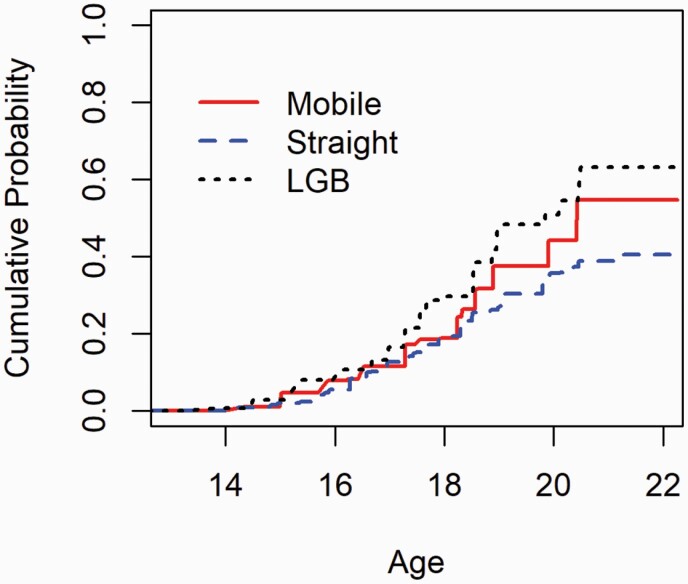
Sample (n = 1712) was drawn from the Texas Adolescent Tobacco and Marketing Surveillance System (waves 5-11) and stratified into three groups, representing sexual orientation: (1) respondents who reported being heterosexuals at each wave (straight), (2) those who consistently self-identified as lesbian, gay or bisexual individuals (LGB), and (3) subjects who reported sexual orientation mobility across waves (mobile). Nonparametric models for interval-censored data were used to estimate the cumulative distribution of age at ENDS initiation by sexual orientation group. Cox models for interval-censored data were used to evaluate whether ENDS initiation varied by sexual orientation group after adjusting for sex assigned at birth, race/ethnicity, cohort, and socioeconomic status.
Compared to Straight adolescents, the risk of earlier-onset of ENDS use was higher among mobile individuals (HR = 1.43, 95% CI: 1.12 to 1.83) and LGB individuals (HR = 1.49, 95% CI: 1.13 to 1.98), respectively, after adjusting for sociodemographic risk factors. Differences between Straight adolescents and LGB/mobile individuals became more pronounced with increasing age.
Analyzing sexual mobility overtime is necessary for understanding the risk associated with youth ENDS initiation and subsequent use.
Future research should use more accurate sexual orientation assessments to explore further the relationship between sexual orientation mobility and early-onset Electronic Nicotine Delivering Systems (ENDS) use. Understanding the implications of sexual orientation mobility on ENDS initiation will be critical for developing inclusive public health programs aimed at preventing or delaying ENDS use and for providing practical recommendations at state and local levels.
早期使用电子烟(ENDS)会使使用者更有可能养成常规使用 ENDS 的习惯,或转而使用可燃烟草产品。此前关于青少年使用 ENDS 的研究并未将性取向视为一种随时间变化的流动特征。我们的目的是评估在德克萨斯州一个向成年早期过渡的青少年的纵向、基于人群的队列中,性取向是否会影响 ENDS 的使用起始。
样本(n=1712)取自德克萨斯州青少年烟草和营销监测系统(第 5-11 波),并分为三组,代表性取向:(1)在每一波都报告自己是异性恋者的受访者(直);(2)一直自我认同为女同性恋、男同性恋或双性恋者的个体(LGB);(3)在波次之间报告性取向流动的个体(流动)。使用区间删失数据的非参数模型来估计按性取向组划分的年龄在电子烟使用起始时的累积分布。使用区间删失数据的 Cox 模型来评估在调整出生时的性别、种族/民族、队列和社会经济地位后,电子烟使用起始是否因性取向组而异。
与直性取向的青少年相比,流动个体(HR=1.43,95%CI:1.12-1.83)和 LGB 个体(HR=1.49,95%CI:1.13-1.98)更早开始使用 ENDS 的风险更高,在调整了社会人口学危险因素后。直性取向的青少年和 LGB/流动个体之间的差异随着年龄的增长而变得更加明显。
分析随时间变化的性取向移动对于理解与青少年使用 ENDS 起始相关的风险以及随后的使用至关重要。
未来的研究应该使用更准确的性取向评估方法,进一步探索性取向移动与早期使用电子烟之间的关系。了解性取向移动对 ENDS 使用起始的影响对于制定旨在预防或延迟使用 ENDS 并提供州和地方各级实际建议的包容性公共卫生计划将至关重要。