Gruß Inga, McCreary Gretchen M, Ivlev Ilya, Houlihan Mary Ellen, Yawn Barbara P, Pasquale Cara, Clark William, Mularski Richard A
Kaiser Permanente Center for Health Research, 3800 N. Interstate Ave, Portland, OR, 97227, USA.
COPD Foundation, 3300 Ponce de Leon Blvd, Miami, FL, 33134, USA.
J Patient Rep Outcomes. 2021 Dec 4;5(1):126. doi: 10.1186/s41687-021-00399-7.
To document a generalizable process for developing a patient-prioritized chronic obstructive pulmonary disease (COPD) research agenda and to provide an overview of domains that were developed in response to people living with COPD and caregivers' suggestions for research.
Adults with COPD and caregivers who are members of the COPD Patient-Powered Research Network (PPRN) provided suggestions for COPD-related research through a self-administered, online survey. These responses were analyzed with a content analysis approach: domains for categorizing all survey responses were created, then all responses were categorized independently by a group of researchers, then these categorizations were adjudicated, and finally a density map was created that represented the number of responses in each of the domains.
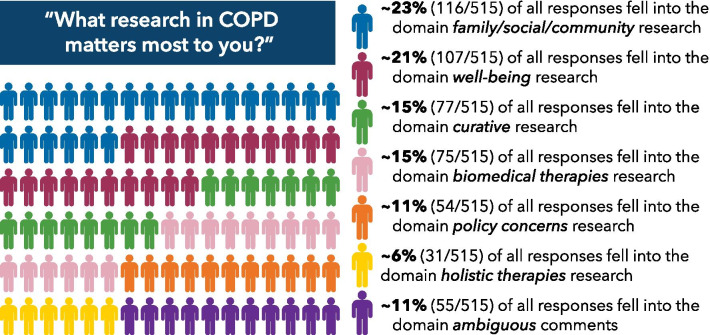
At the time of analysis, 6157 adults had fully completed the baseline survey. Survey responses were categorized across seven domains as follows: 22.5% of all responses fell into the domain family/social/community research, 20.8% of all responses fell into the domain well-being, 15% of all responses fell into the domain curative research, 14.6% of all responses fell into the domain biomedical therapies, 10.5% of all responses fell into the domain policy concerns, 6% of all responses fell into the domain holistic therapies and 10.7% of all responses fell into the domain ambiguous comments that could not be translated into concrete research topics.
Using qualitative open-ended survey responses from the COPD PPRN registrants, we were able to identify six key domains of research about COPD that are considered most important by patients. These domains differ in content from prior scientist-led efforts to develop priorities for COPD research, demonstrating the ongoing importance of involving patients and their caregivers in determining research priorities. The results suggest the field can more closely align research efforts to patient priorities by considering the identified domains.
记录制定以患者为优先的慢性阻塞性肺疾病(COPD)研究议程的可推广流程,并概述根据慢性阻塞性肺疾病患者及护理人员的研究建议所确定的领域。
慢性阻塞性肺疾病患者动力研究网络(PPRN)的成年慢性阻塞性肺疾病患者及护理人员通过自行填写的在线调查问卷,提供与慢性阻塞性肺疾病相关的研究建议。采用内容分析法对这些回答进行分析:创建用于对所有调查回答进行分类的领域,然后由一组研究人员对所有回答进行独立分类,接着对这些分类进行裁定,最后创建一个密度图,展示每个领域的回答数量。
在分析时,6157名成年人已完全完成基线调查。调查回答按以下七个领域分类:所有回答的22.5%属于家庭/社会/社区研究领域,20.8%属于幸福感领域,15%属于治疗性研究领域,14.6%属于生物医学疗法领域,10.5%属于政策关注领域,6%属于整体疗法领域,10.7%属于无法转化为具体研究主题的模糊评论领域。
通过对慢性阻塞性肺疾病患者动力研究网络登记参与者的定性开放式调查回答进行分析,我们能够确定慢性阻塞性肺疾病研究的六个关键领域,这些领域被患者认为是最重要的。这些领域的内容与先前由科学家主导的确定慢性阻塞性肺疾病研究重点的工作不同,这表明让患者及其护理人员参与确定研究重点具有持续的重要性。结果表明,该领域可以通过考虑所确定的领域,使研究工作更紧密地与患者的优先事项保持一致。