Division of Pulmonary and Critical Care Medicine, Department of Internal Medicine, Seoul National University Hospital, Seoul National University College of Medicine, Seoul, Korea.
Division of Pulmonary, Allergy and Critical Care Medicine, Department of Internal Medicine, Konkuk University School of Medicine, Seoul, Korea.
Korean J Intern Med. 2022 Mar;37(2):387-397. doi: 10.3904/kjim.2021.025. Epub 2021 Dec 7.
BACKGROUND/AIMS: The prevalence and effects of airway diseases, including asthma, eosinophilic bronchitis (EB), chronic obstructive pulmonary disease (COPD), and asthma-COPD overlap (ACO) have not been thoroughly studied in patients with idiopathic pulmonary fibrosis (IPF). This study aimed to evaluate the prevalence of airway diseases in patients with IPF and to identify the differences in symptoms based on the presence of airway diseases.
This single-institution prospective cohort study was conducted from June 2017 to September 2018, at the Seoul National University Hospital. Spirometry with bronchodilator, methacholine bronchial provocation test, induced sputum with eosinophil stain, and exhaled nitric oxide were performed to confirm the presence of airway disease. The modified Medical Research Council (mMRC) dyspnea scale, COPD assessment test (CAT), St. George's Respiratory Questionnaire (SGRQ), EuroQol-5 dimension (EQ-5D) index, and cough-specific quality of life questionnaire (CQLQ) data were collected to assess symptom severity.
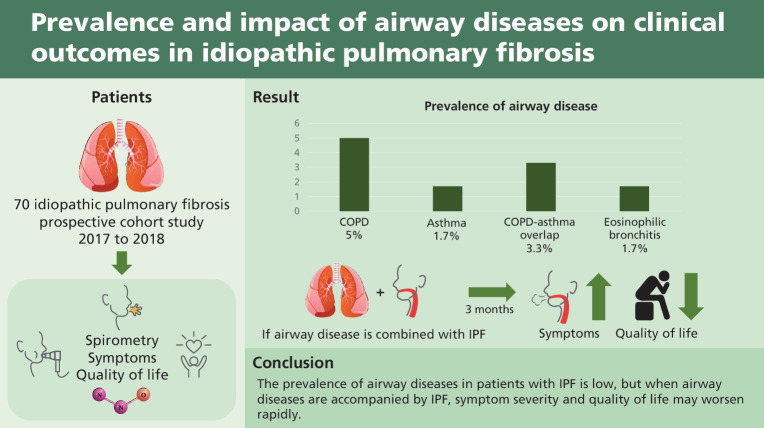
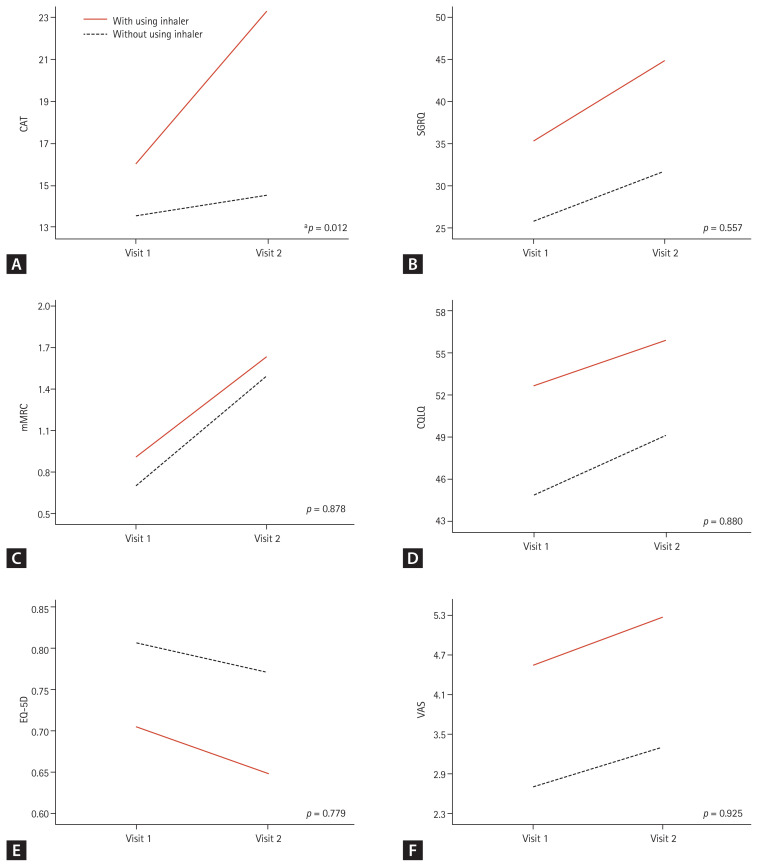
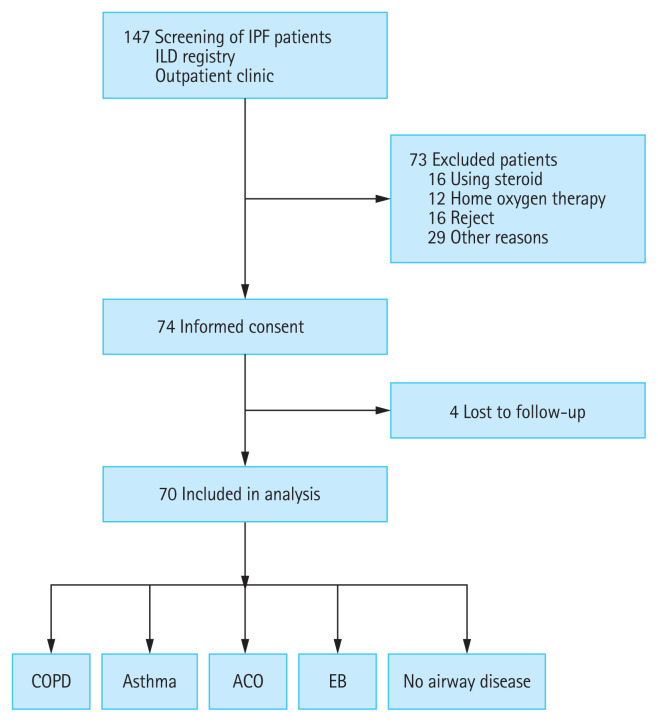
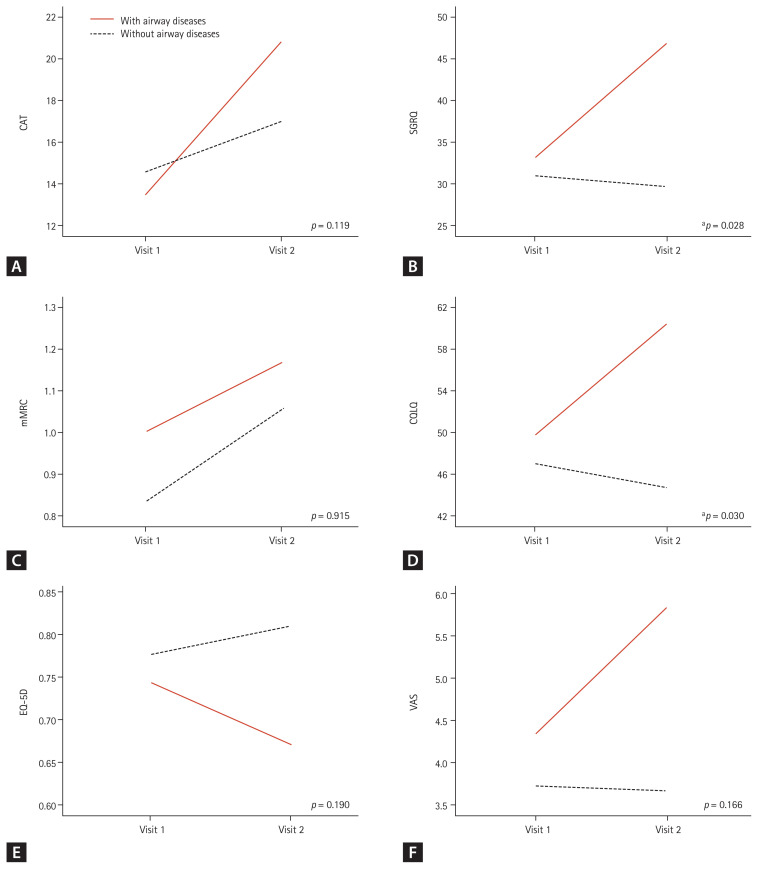
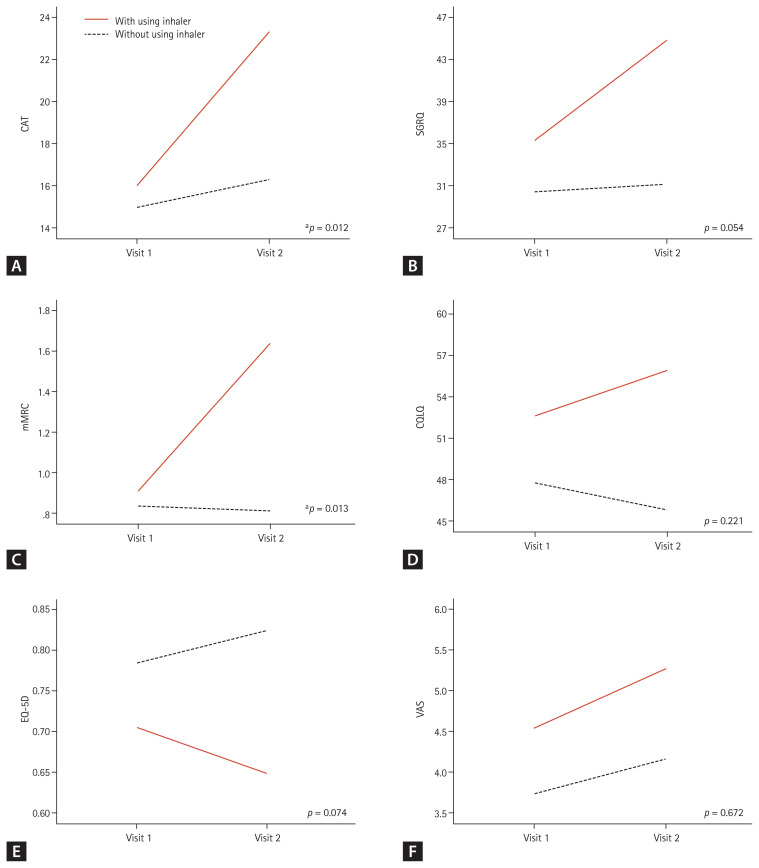
Total 147 patients with IPF were screened, and 70 patients were analyzed. The prevalence of airway diseases in the participants was as follows: 5.0% had COPD, 1.7% had asthma, 3.3% had ACO, and 1.7% had EB. The mMRC, CAT, SGRQ, EQ-5D, and CQLQ scores did not differ regardless of combined airway disease. After 3 months, the SGRQ (p = 0.028) and CQLQ (p = 0.030) scores were significantly higher in patients with airway disease than in those without.
The prevalence of airway diseases in patients with IPF is low, but when airway diseases are accompanied by IPF, symptom severity and quality of life may worsen rapidly.
背景/目的:特发性肺纤维化(IPF)患者的气道疾病(包括哮喘、嗜酸性支气管炎(EB)、慢性阻塞性肺疾病(COPD)和哮喘-COPD 重叠(ACO))的流行情况和影响尚未得到充分研究。本研究旨在评估 IPF 患者气道疾病的患病率,并根据气道疾病的存在情况确定症状差异。
这是一项单中心前瞻性队列研究,于 2017 年 6 月至 2018 年 9 月在首尔国立大学医院进行。进行了支气管扩张剂后肺量测定、乙酰甲胆碱支气管激发试验、诱导痰嗜酸性粒细胞染色和呼出气一氧化氮检测,以确认气道疾病的存在。收集改良的医学研究委员会(mMRC)呼吸困难量表、COPD 评估测试(CAT)、圣乔治呼吸问卷(SGRQ)、欧洲五维健康量表(EQ-5D)指数和咳嗽特异性生活质量问卷(CQLQ)数据,以评估症状严重程度。
共筛选了 147 例 IPF 患者,其中 70 例进行了分析。参与者中气道疾病的患病率如下:5.0%为 COPD,1.7%为哮喘,3.3%为 ACO,1.7%为 EB。无论是否合并气道疾病,mMRC、CAT、SGRQ、EQ-5D 和 CQLQ 评分均无差异。3 个月后,气道疾病患者的 SGRQ(p = 0.028)和 CQLQ(p = 0.030)评分明显高于无气道疾病患者。
IPF 患者气道疾病的患病率较低,但当气道疾病伴有 IPF 时,症状严重程度和生活质量可能会迅速恶化。