Niu Peng, Li Haibo, Liu Dejun, Zhang Yan Feng, Liu YongXi, Liang Cheng
Department of Spine and Joint Surgery, Second General Hospital of Nanyang, Nanyang City, 473009, Henan Province, People's Republic of China.
China Department of Orthopaedics, People's Hospital of Xuecheng, Zaozhuang City, 277000, Shandong Province, People's Republic of China.
Int J Gen Med. 2021 Nov 26;14:8863-8872. doi: 10.2147/IJGM.S334972. eCollection 2021.
Dyslipidemia has been found to contribute to increased risk of osteoporosis and its association with bone mineral density (BMD) remains controversial. We determined whether blood lipid levels are linked with change of BMD.
In a large sample from the MIDUS II study, we sought to evaluate the relationship between blood lipid levels and BMD. Multivariate linear regression models and smooth curve analysis were constructed by controlling a great range of confounding factors.
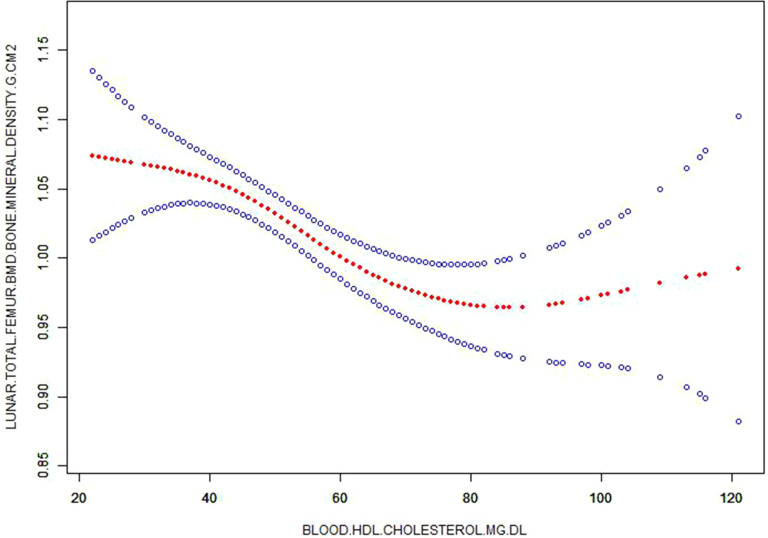
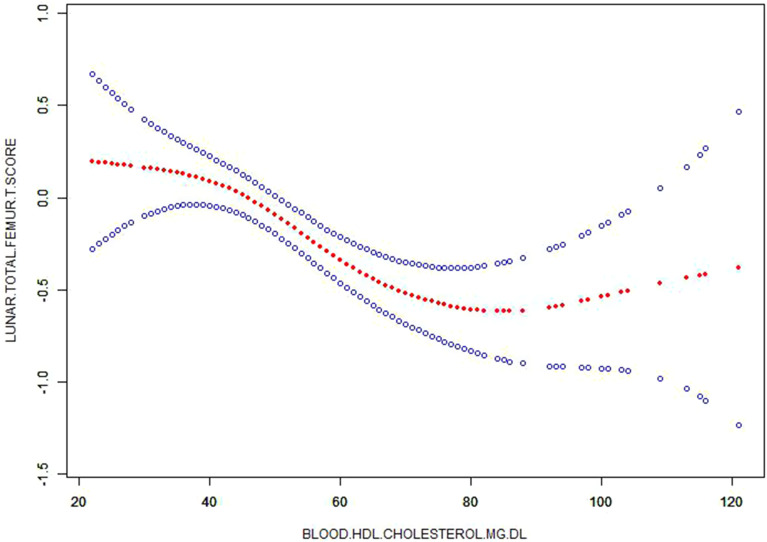
The median age of them was 52.5 years, and the number of males was 176 (40%). Univariate analysis showed that blood high-density lipoprotein-cholesterol (HDL-C) level was negatively related to lunar total femur (r = -0.266, P < 0.001), lunar radius ultradistal (UD) (r = -0.297, P < 0.001), lunar radius 1/3 (r = -0.307, P = 0.001) and femoral neck (r = -0.172, P = 0.001). In multivariate linear analysis, except for blood triglyceride, total cholesterol and low-density lipoprotein cholesterol (LDL-C), we found that blood HDL-C level was still negatively related to lunar total femur [B = -0.002, B 95% CI (-0.002, -0.001), P < 0.001], lunar radius UD [B = -0.001, 95% CI (-0.001, 0), P = 0.002], lunar radius 1/3 [B = -0.001, 95% CI (-0.001, 0), P = 0.003] and femoral neck [B = -0.001, 95% CI (-0.002, 0), P = 0.039] after adjustments of demographic characteristics, lifestyle, disease history were made. Furthermore, we found that age, sex, and body mass index (BMI) had modifying effects on this negative association.
This study confirmed the negative association between HDL-C and BMD in the observational analysis from (MIDUS) study and provides high-quality evidence that age, sex and BMI had modifying effects on this negative association.
血脂异常已被发现会增加骨质疏松症的风险,其与骨密度(BMD)的关联仍存在争议。我们确定血脂水平是否与骨密度变化有关。
在来自MIDUS II研究的大样本中,我们试图评估血脂水平与骨密度之间的关系。通过控制一系列混杂因素构建多元线性回归模型和平滑曲线分析。
他们的年龄中位数为52.5岁,男性有176人(40%)。单因素分析显示,血液高密度脂蛋白胆固醇(HDL-C)水平与月骨总股骨(r = -0.266,P < 0.001)、月骨半径超远端(UD)(r = -0.297,P < 0.001)、月骨半径1/3(r = -0.307,P = 0.001)和股骨颈(r = -0.172,P = 0.001)呈负相关。在多元线性分析中,除了血液甘油三酯、总胆固醇和低密度脂蛋白胆固醇(LDL-C)外,我们发现,在调整了人口统计学特征、生活方式、疾病史后,血液HDL-C水平仍与月骨总股骨[B = -0.002,B 95%置信区间(-0.002,-0.001),P < 0.001]、月骨半径UD[B = -0.001,95%置信区间(-0.001,0),P = 0.002]、月骨半径1/3[B = -0.001,95%置信区间(-0.001,0),P = 0.003]和股骨颈[B = -0.001,95%置信区间(-0.002,0),P = 0.039]呈负相关。此外,我们发现年龄、性别和体重指数(BMI)对这种负相关有调节作用。
本研究在(MIDUS)研究的观察性分析中证实了HDL-C与BMD之间的负相关,并提供了高质量的证据表明年龄、性别和BMI对这种负相关有调节作用。