Liu Tianlong, Sun Yingying, Li Hao, Xu Haochen, Xiao Ning, Wang Xuliang, Song Li, Bai Congxia, Wen Hongyan, Ge Jing, Zhang Yinhui, Song Weihua, Chen Jingzhou
State Key Laboratory of Cardiovascular Disease, Fuwai Hospital, National Center for Cardiovascular Diseases, Chinese Academy of Medical Sciences and Peking Union Medical College, Beijing, China.
Department of Pharmacy, Affiliated Hospital of Inner Mongolia Medical University, Hohhot, China.
Front Physiol. 2021 Nov 19;12:770223. doi: 10.3389/fphys.2021.770223. eCollection 2021.
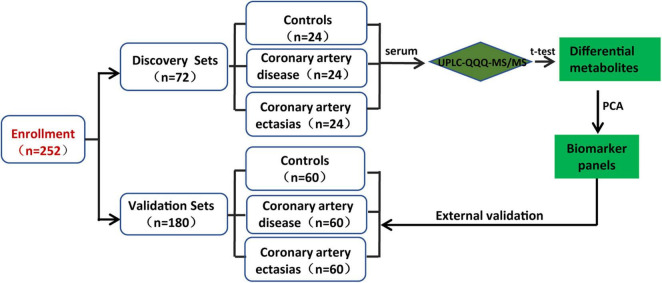
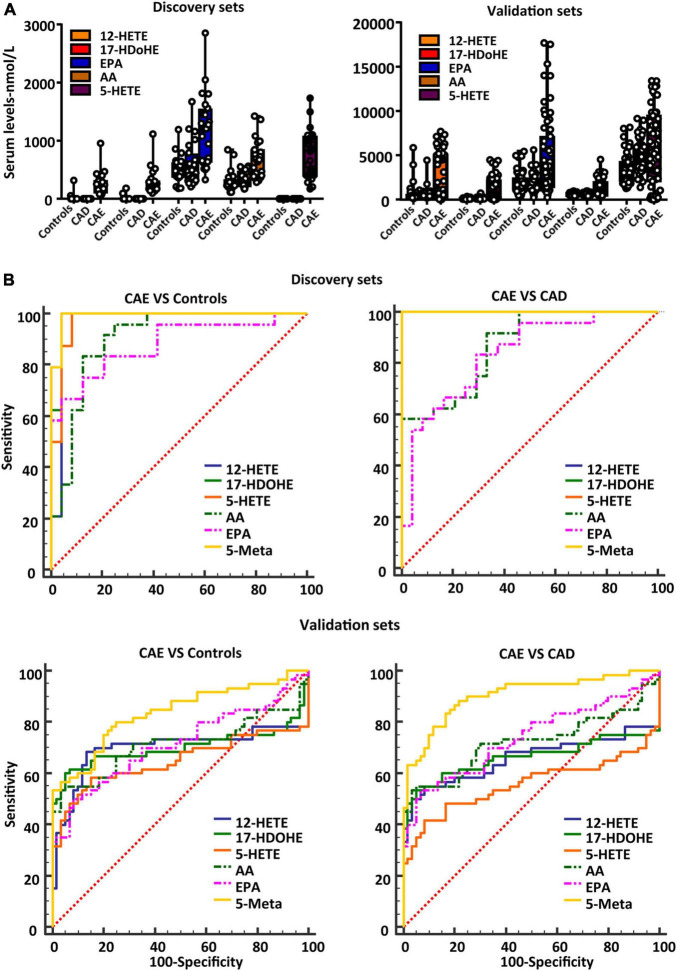
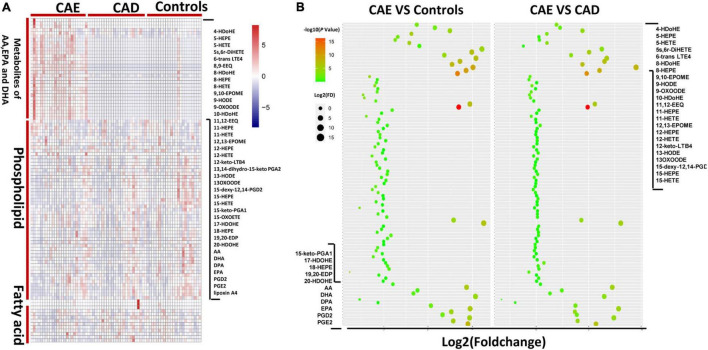
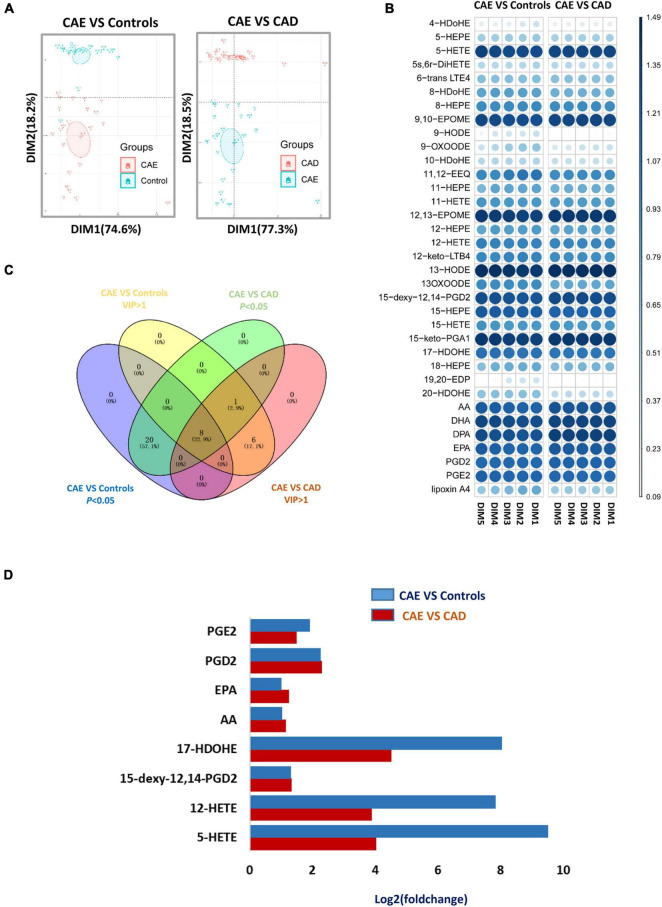
We used a targeted metabolomics approach to identify fatty acid (FA) metabolites that distinguished patients with coronary artery ectasia (CAE) from healthy Controls and patients with coronary artery disease (CAD). Two hundred fifty-two human subjects were enrolled in our study, such as patients with CAE, patients with CAD, and Controls. All the subjects were diagnosed by coronary angiography. Plasma metabolomic profiles of FAs were determined by an ultra-high-performance liquid chromatography coupled to triple quadrupole mass spectrometric (UPLC-QqQ-MS/MS). Ninety-nine plasma metabolites were profiled in the discovery sets ( = 72), such as 35 metabolites of arachidonic acid (AA), eicosapentaenoic acid (EPA), and docosahexaenoic acid (DHA), 10 FAs, and 54 phospholipids. Among these metabolites, 36 metabolites of AA, EPA, and DHA showed the largest difference between CAE and Controls or CAD. 12-hydroxyeicosatetraenoic acid (12-HETE), 17()-hydroxydocosahexaenoic acid (17-HDoHE), EPA, AA, and 5-HETE were defined as a biomarker panel in peripheral blood to distinguish CAE from CAD and Controls in a discovery set ( = 72) and a validation set ( = 180). This biomarker panel had a better diagnostic performance than metabolite alone in differentiating CAE from Controls and CAD. The areas under the ROC curve of the biomarker panel were 0.991 and 0.836 for CAE versus Controls and 1.00 and 0.904 for CAE versus CAD in the discovery and validation sets, respectively. Our findings revealed that the metabolic profiles of FAs in the plasma from patients with CAE can be distinguished from those of Controls and CAD. Differences in FAs metabolites may help to interpret pathological mechanisms of CAE.
我们采用靶向代谢组学方法来鉴定脂肪酸(FA)代谢物,这些代谢物可将冠状动脉扩张(CAE)患者与健康对照以及冠状动脉疾病(CAD)患者区分开来。我们的研究纳入了252名人类受试者,包括CAE患者、CAD患者和对照。所有受试者均通过冠状动脉造影进行诊断。通过超高效液相色谱-三重四极杆质谱联用(UPLC-QqQ-MS/MS)测定血浆中FA的代谢组学谱。在发现集(n = 72)中分析了99种血浆代谢物,包括35种花生四烯酸(AA)、二十碳五烯酸(EPA)和二十二碳六烯酸(DHA)的代谢物、10种脂肪酸和54种磷脂。在这些代谢物中,AA、EPA和DHA的36种代谢物在CAE与对照或CAD之间表现出最大差异。在发现集(n = 72)和验证集(n = 180)中,12-羟基二十碳四烯酸(12-HETE)、17(S)-羟基二十二碳六烯酸(17-HDoHE)、EPA、AA和5-HETE被定义为外周血中的生物标志物组,用于区分CAE与CAD和对照。该生物标志物组在区分CAE与对照和CAD方面比单独的代谢物具有更好的诊断性能。在发现集和验证集中,生物标志物组对CAE与对照的ROC曲线下面积分别为0.991和0.836,对CAE与CAD的ROC曲线下面积分别为1.00和0.904。我们的研究结果表明,CAE患者血浆中FA的代谢谱可与对照和CAD患者的代谢谱区分开来。FA代谢物的差异可能有助于解释CAE的病理机制。