School of Electronics Engineering, Vellore Institute of Technology, Chennai 600127, India.
J Healthc Eng. 2021 Nov 26;2021:6081570. doi: 10.1155/2021/6081570. eCollection 2021.
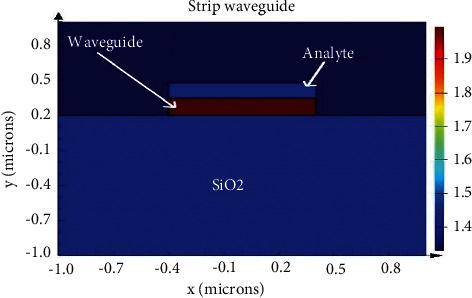
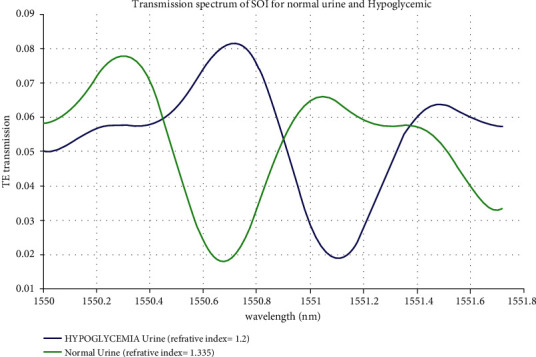
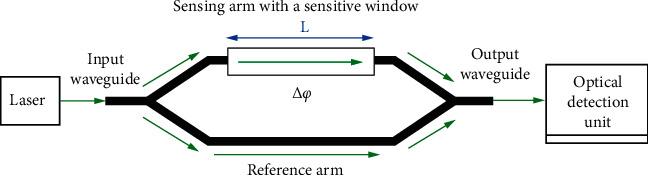
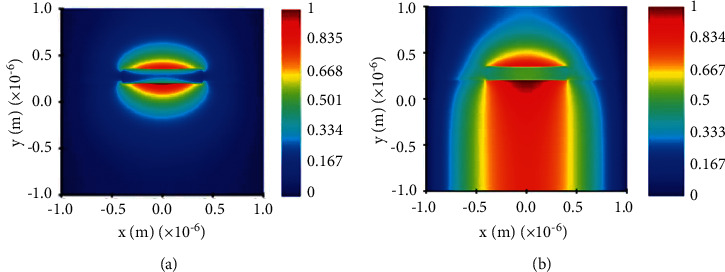
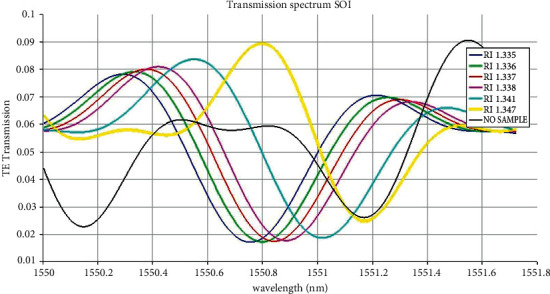
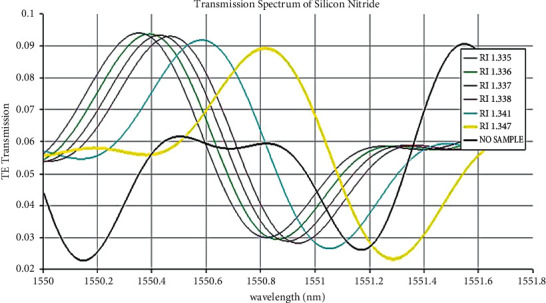
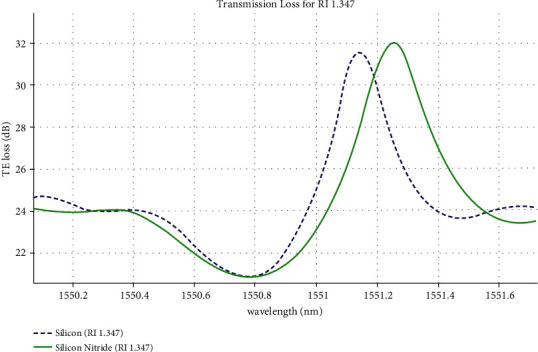
Diabetes mellitus is a chronic metabolic condition that affects millions of people worldwide. The present paper investigates the bulk sensitivity of silicon and silicon nitride strip waveguides in the transverse electric (TE) mode. At 1550 nm wavelength, silicon on insulator (SOI) and silicon nitride (SiN) are two distinct waveguides of the same geometry structure that can react to refractive changes around the waveguide surface. This article examines the response of two silicon-based waveguide structures to the refractive index of urine samples (human renal fluids) to diagnose diabetes mellitus. An asymmetric Mach-Zehnder interferometer has waveguide sensing and a reference arm with a device that operates in the transverse electric (TE) mode. 3D FDTD simulated waveguide width 800 nm, thickness 220 nm, and analyte thickness 130 nm give the bulk sensitivity of 1.09 (RIU/RIU) and 1.04 (RIU/RIU) for silicon and silicon nitride, respectively, high compared to the regular transverse magnetic (TM) mode strip waveguides. Furthermore, the proposed design gives simple fabrication, contrasting sharply with the state-of-the-art 220 nm wafer technology.
糖尿病是一种影响全球数百万人的慢性代谢疾病。本文研究了硅和氮化硅条形波导在横电(TE)模式下的体灵敏度。在 1550nm 波长下,绝缘体上硅(SOI)和氮化硅(SiN)是两种具有相同几何结构的不同波导,它们都可以对波导表面周围的折射率变化做出反应。本文研究了两种基于硅的波导结构对尿液样本(人体肾液)折射率的响应,以诊断糖尿病。非对称马赫-曾德尔干涉仪具有波导传感和参考臂,其采用横向电场(TE)模式工作。3D FDTD 模拟波导宽度为 800nm,厚度为 220nm,分析物厚度为 130nm,硅和氮化硅的体灵敏度分别为 1.09(RIU/RIU)和 1.04(RIU/RIU),与常规横磁(TM)模式条形波导相比,灵敏度较高。此外,所提出的设计具有简单的制造工艺,与最先进的 220nm 晶圆技术形成鲜明对比。