Kobayashi Kanami, Shimizu Yukiyo, Haginoya Ayumu, Hada Yasushi, Yamazaki Masashi
Clinical Science, Graduate School of Comprehensive Human Science, Tsukuba, JPN.
Rehabilitation Medicine, University of Tsukuba, Tsukuba, JPN.
Cureus. 2021 Oct 29;13(10):e19136. doi: 10.7759/cureus.19136. eCollection 2021 Oct.
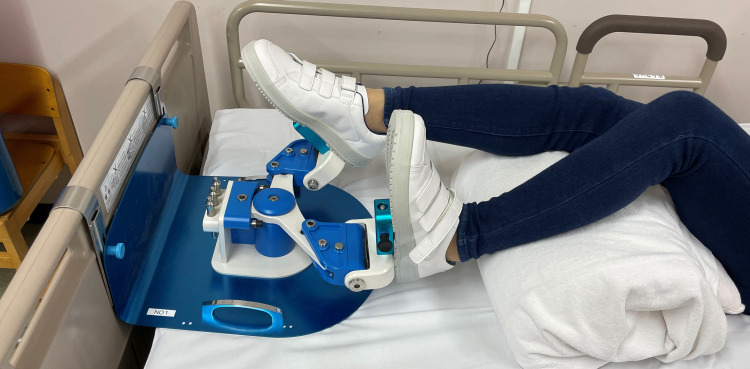
Venous thromboembolism (VTE) is a complication in patients with a spinal disease requiring bedfast for conservative therapies. We previously developed a novel leg exercise apparatus (LEX) to encourage patients to exercise their lower extremities during bed rest. The purpose of this study was to evaluate the feasibility and safety of the LEX for the prevention of VTE in patients on bed rest due to spinal disease.
Patients with spinal diseases requiring bed rest were included in the study. Exercise using the LEX was performed for ≥5 minutes. The exercises were performed three or more times per day during the bed rest period. In addition, we evaluated adverse events, such as symptomatic VTE and changes in vital signs, using venous ultrasonography, blood tests, and measurement of vital signs.
In total, 31 patients were enrolled (11 men, 20 women), with mean age, height, weight, and body mass index of 72.4 years, 155.2 cm, 55.0 kg, and 22.6 kg/m, respectively. Twenty-four subjects had spinal fractures. Twenty-nine patients continued exercising until they could leave their beds. No symptomatic VTE was observed in any patient, and no other severe adverse events were observed. There were no significant changes in vital signs. The average number of exercise days with LEX and length of hospitalization were 11 and 31 days, respectively.
This is the first study regarding mechanical thromboprophylaxis through in-bed exercise for patients with bedridden spinal disease. The LEX exercise protocol, in addition to mechanical prophylaxis with graduated compression stockings and intermittent pneumatic compression devices, for the prevention of symptomatic VTE may be feasible and safe for patients with bedridden spinal disease.
静脉血栓栓塞症(VTE)是脊柱疾病患者在接受保守治疗需卧床时的一种并发症。我们之前研发了一种新型腿部锻炼器械(LEX),以鼓励患者在卧床休息期间进行下肢锻炼。本研究的目的是评估LEX对预防因脊柱疾病而卧床的患者发生VTE的可行性和安全性。
纳入需要卧床休息的脊柱疾病患者。使用LEX进行锻炼的时间≥5分钟。在卧床休息期间,每天进行3次或更多次锻炼。此外,我们通过静脉超声、血液检查和生命体征测量来评估不良事件,如症状性VTE和生命体征变化。
总共纳入了31例患者(11例男性,20例女性),平均年龄、身高、体重和体重指数分别为72.4岁、155.2厘米、55.0千克和22.6千克/平方米。24名受试者有脊柱骨折。29名患者持续锻炼直至能够下床。所有患者均未观察到症状性VTE,也未观察到其他严重不良事件。生命体征无显著变化。使用LEX锻炼的平均天数和住院时间分别为11天和31天。
这是第一项关于通过卧床锻炼对卧床脊柱疾病患者进行机械性血栓预防的研究。除了使用分级压力弹力袜和间歇性气动压迫装置进行机械预防外,LEX锻炼方案对于预防卧床脊柱疾病患者的症状性VTE可能是可行且安全的。