Gao Yang, Sun Zhao, Gu Junjie, Li Zhe, Xu Xiuxiu, Xue Chunling, Li Xuechun, Zhao Lin, Zhou Jianfeng, Bai Chunmei, Han Qin, Zhao Robert Chunhua
Department of Oncology, Peking Union Medical College Hospital, Chinese Academy of Medical Sciences and Peking Union Medical College, Beijing, China.
Department of Gynecologic Oncology, National Cancer Center/National Clinical Research Center for Cancer/Cancer Hospital, Chinese Academy of Medical Sciences and Peking Union Medical College, Beijing, China.
Front Oncol. 2021 Nov 19;11:748465. doi: 10.3389/fonc.2021.748465. eCollection 2021.
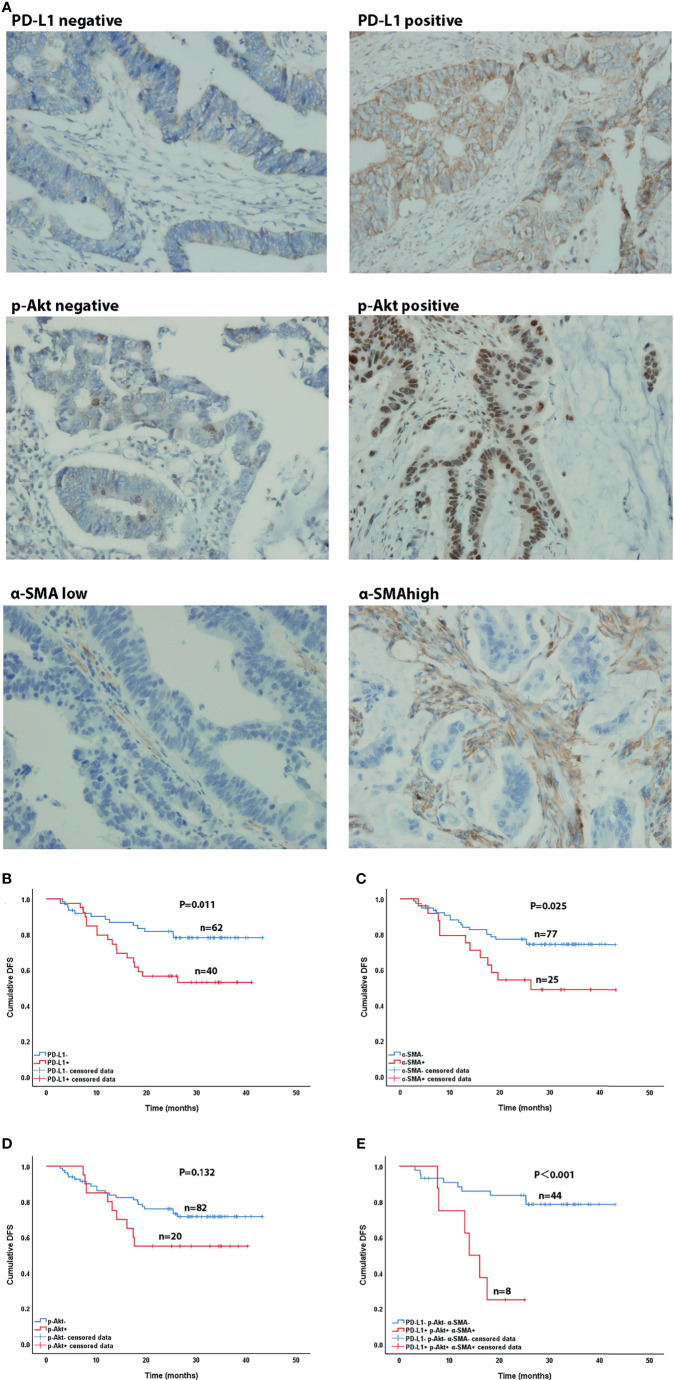
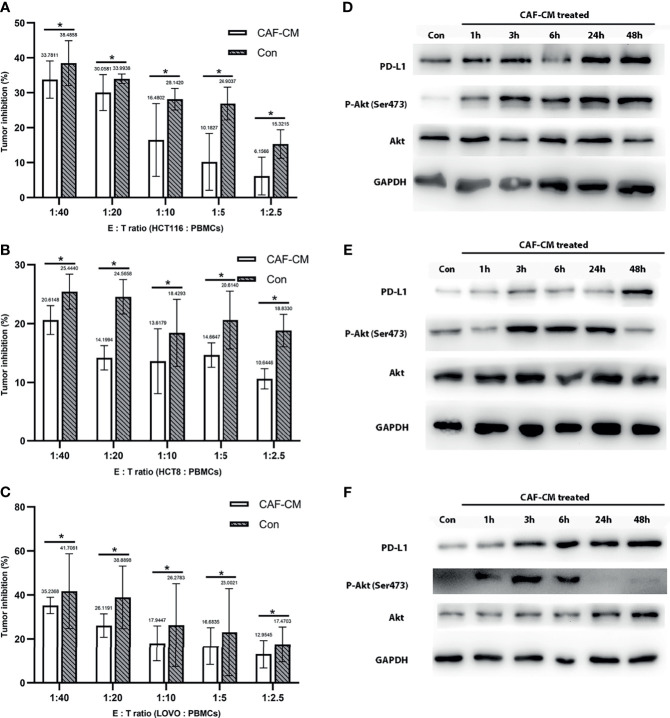
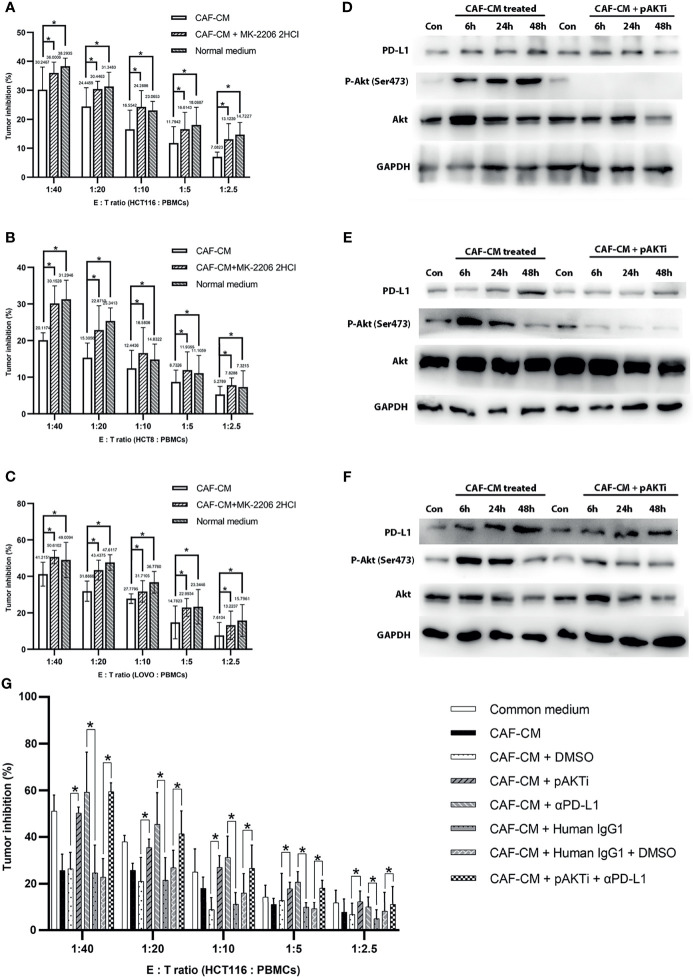
Upregulation of immune checkpoint proteins is one of the main mechanisms for tumor immune escape. The expression of programmed death ligand-1 (PD-L1) in colorectal cancer (CRC) is higher than in normal colorectal epithelial tissue, and patients with higher PD-L1 expression have a poorer prognosis. Additionally, PD-L1 expression in CRC is affected by the tumor microenvironment (TME). As a major component of the TME, cancer-associated fibroblasts (CAFs) can act as immune regulators and generate an immunosuppressive tumor microenvironment. Therefore, we speculated that CAFs may be related to the upregulation of PD-L1 in CRC, which leads to tumor immune escape. We found that CAFs upregulate PD-L1 expression in CRC cells through AKT phosphorylation, thereby reducing the killing of CRC cells by peripheral blood mononuclear cells. The ratio of CAFs to CRC cells was positively correlated with AKT phosphorylation and the expression of PD-L1 in CRC Consistent with the results, high CAF content and high expression of PD-L1 were negatively correlated with disease-free survival (DFS) of CRC patients. These results indicate that the upregulation of PD-L1 expression in CRC by CAFs through the activation of Akt is one of the molecular mechanisms of tumor immune escape. Thus, targeted anti-CAF therapy may help improve the efficacy of immunotherapy.
免疫检查点蛋白的上调是肿瘤免疫逃逸的主要机制之一。程序性死亡配体-1(PD-L1)在结直肠癌(CRC)中的表达高于正常结直肠上皮组织,PD-L1表达较高的患者预后较差。此外,CRC中PD-L1的表达受肿瘤微环境(TME)影响。作为TME的主要成分,癌症相关成纤维细胞(CAFs)可作为免疫调节因子,并产生免疫抑制性肿瘤微环境。因此,我们推测CAFs可能与CRC中PD-L1的上调有关,从而导致肿瘤免疫逃逸。我们发现CAFs通过AKT磷酸化上调CRC细胞中PD-L1的表达,从而减少外周血单个核细胞对CRC细胞的杀伤。CAFs与CRC细胞的比例与AKT磷酸化以及CRC中PD-L1的表达呈正相关。与结果一致,高CAF含量和高PD-L1表达与CRC患者的无病生存期(DFS)呈负相关。这些结果表明,CAFs通过激活Akt上调CRC中PD-L1的表达是肿瘤免疫逃逸的分子机制之一。因此,靶向抗CAF治疗可能有助于提高免疫治疗疗效。