Mello-Grand Maurizia, Bruno Antonino, Sacchetto Lidia, Cristoni Simone, Gregnanin Ilaria, Dematteis Alessandro, Zitella Andrea, Gontero Paolo, Peraldo-Neia Caterina, Ricotta Riccardo, Noonan Douglas M, Albini Adriana, Chiorino Giovanna
Cancer Genomics Laboratory, Fondazione Edo ed Elvo Tempia, Biella, Italy.
Laboratory of Innate Immunity, Unit of Molecular Pathology, Biochemistry, and Immunology, Istituto di Ricovero e Cura a Carattere Scientifico (IRCCS) MultiMedica, Milan, Italy.
Front Oncol. 2021 Nov 19;11:769158. doi: 10.3389/fonc.2021.769158. eCollection 2021.
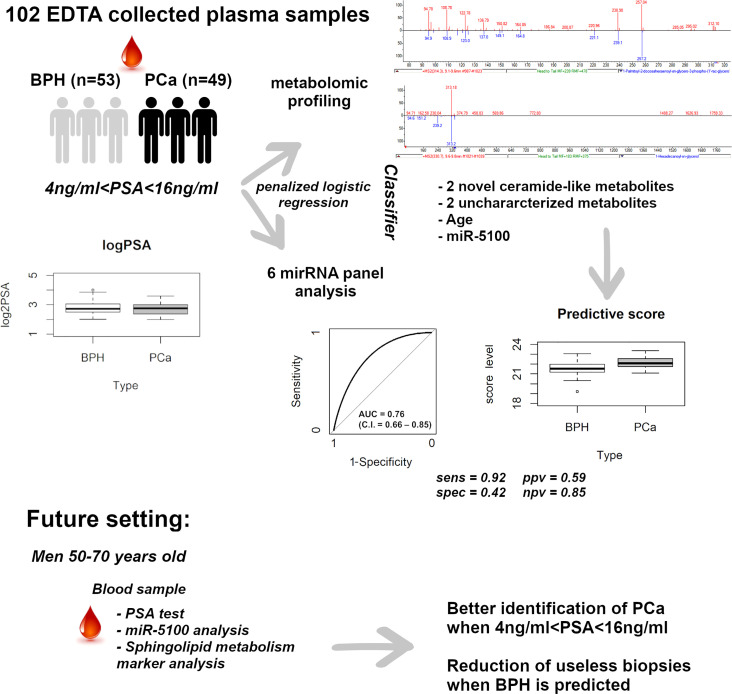
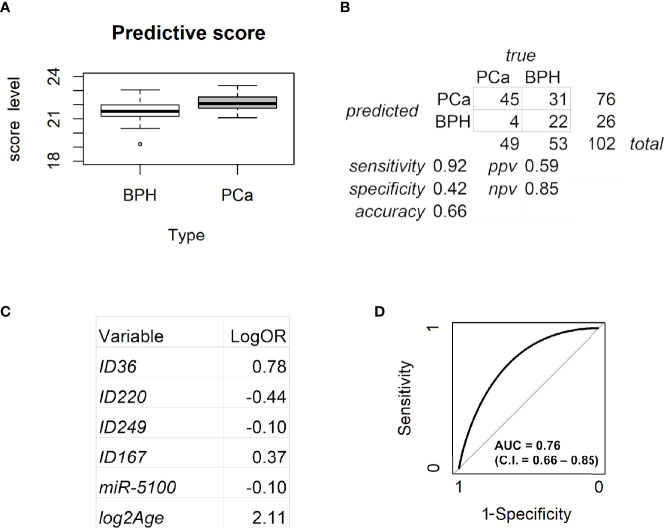
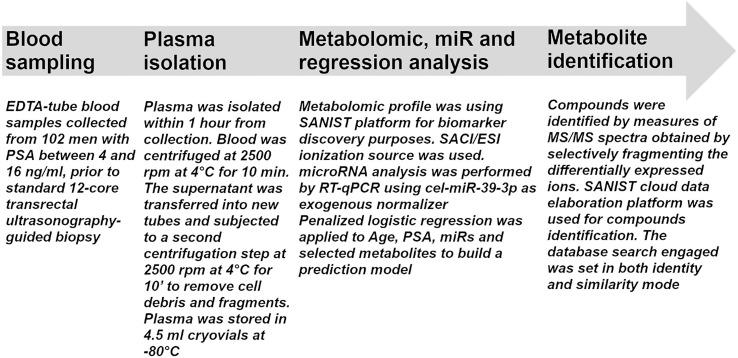
Reliable liquid biopsy-based tools able to accurately discriminate prostate cancer (PCa) from benign prostatic hyperplasia (BPH), when PSA is within the "gray zone" (PSA 4-10), are still urgent. We analyzed plasma samples from a cohort of 102 consecutively recruited patients with PSA levels between 4 and 16 ng/ml, using the SANIST-Cloud Ion Mobility Metabolomic Mass Spectrometry platform, combined with the analysis of a panel of circulating microRNAs (miR). By coupling CIMS ion mobility technology with SANIST, we were able to reveal three new structures among the most differentially expressed metabolites in PCa vs. BPH. In particular, two were classified as polyunsaturated ceramide ester-like and one as polysaturated glycerol ester-like. Penalized logistic regression was applied to build a model to predict PCa, using six circulating miR, seven circulating metabolites, and demographic/clinical variables, as covariates. Four circulating metabolites, miR-5100, and age were selected by the model, and the corresponding prediction score gave an AUC of 0.76 (C.I. = 0.66-0.85). At a specified cut-off, no high-risk tumor was misclassified, and 22 out of 53 BPH were correctly identified, reducing by 40% the false positives of PSA. We developed and applied a novel, minimally invasive, liquid biopsy-based powerful tool to characterize novel metabolites and identified new potential non-invasive biomarkers to better predict PCa, when PSA is uninformative as a tool for precision medicine in genitourinary cancers.
当前列腺特异性抗原(PSA)处于“灰色区域”(PSA 4-10)时,能够准确区分前列腺癌(PCa)和良性前列腺增生(BPH)的基于液体活检的可靠工具仍然十分迫切。我们使用SANIST-Cloud离子淌度代谢组质谱平台,并结合一组循环微RNA(miR)的分析,对102名连续招募的PSA水平在4至16 ng/ml之间的患者的血浆样本进行了分析。通过将CIMS离子淌度技术与SANIST相结合,我们能够在PCa与BPH中差异表达最明显的代谢物中发现三种新结构。具体而言,两种被归类为多不饱和神经酰胺酯样,一种为多饱和甘油酯样。应用惩罚逻辑回归建立一个预测PCa的模型,使用六种循环miR、七种循环代谢物以及人口统计学/临床变量作为协变量。该模型选择了四种循环代谢物、miR-5100和年龄,相应的预测评分给出的曲线下面积(AUC)为0.76(置信区间=0.66-0.85)。在指定的临界值下,没有高风险肿瘤被错误分类,53例BPH中有22例被正确识别,将PSA的假阳性率降低了40%。我们开发并应用了一种新型的、微创的、基于液体活检的强大工具来表征新型代谢物,并识别出新的潜在非侵入性生物标志物,以便在PSA作为泌尿生殖系统癌症精准医学工具缺乏信息时更好地预测PCa。