Lin Jietao, Sun Antonia RuJia, Li Jian, Yuan Tianying, Cheng Wenxiang, Ke Liqing, Chen Jianhai, Sun Wei, Mi Shengli, Zhang Peng
Center for Translational Medicine Research and Development, Shenzhen Institute of Advanced Technology, Chinese Academy of Science, Shenzhen, China.
University of Chinese Academy of Sciences, Beijing, China.
Front Bioeng Biotechnol. 2021 Nov 12;9:764212. doi: 10.3389/fbioe.2021.764212. eCollection 2021.
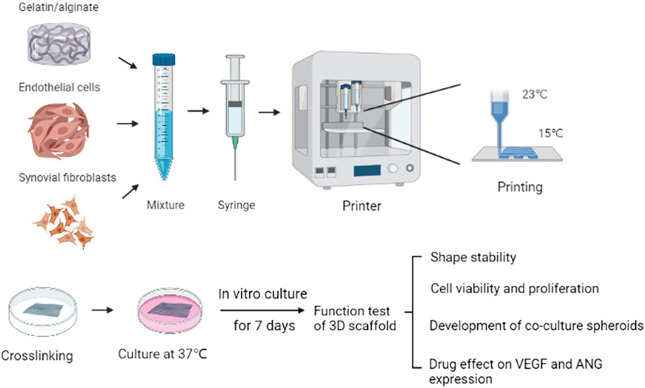
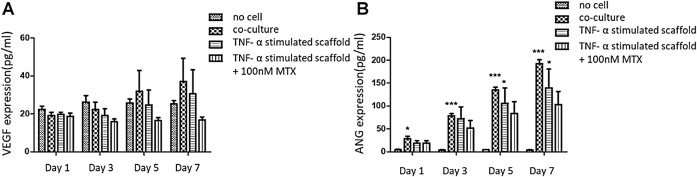
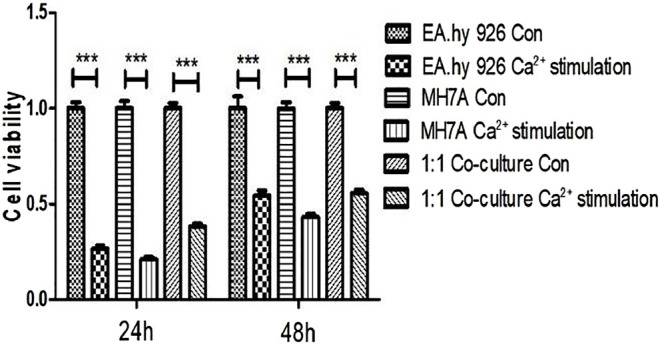
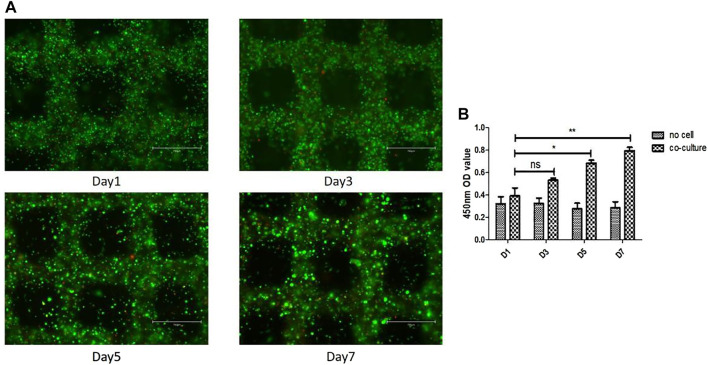
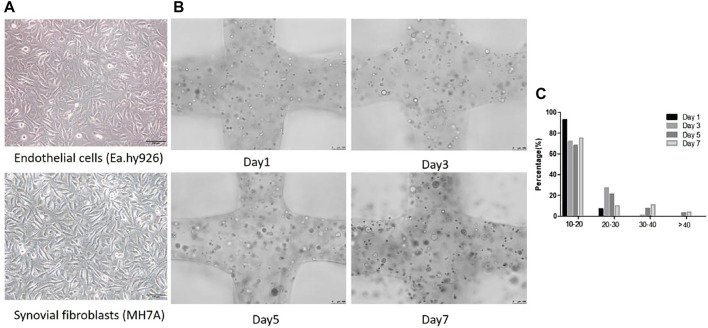
Three-dimensional (3D) co-culture models have closer physiological cell composition and behavior than traditional 2D culture. They exhibit pharmacological effects like responses, and therefore serve as a high-throughput drug screening model to evaluate drug efficacy and safety . In this study, we created a 3D co-culture environment to mimic pathological characteristics of rheumatoid arthritis (RA) pannus tissue. 3D scaffold was constructed by bioprinting technology with synovial fibroblasts (MH7A), vascular endothelial cells (EA.hy 926) and gelatin/alginate hydrogels. Cell viability was observed during 7-day culture and the proliferation rate of co-culture cells showed a stable increase stage. Cell-cell interactions were evaluated in the 3D printed scaffold and we found that spheroid size increased with time. TNF-α stimulated MH7A and EA.hy 926 in 3D pannus model showed higher vascular endothelial growth factor (VEGF) and angiopoietin (ANG) protein expression over time. For drug validation, methotrexate (MTX) was used to examine inhibition effects of angiogenesis in 3D pannus co-culture model. In conclusion, this 3D co-culture pannus model with biological characteristics may help the development of anti-RA drug research.
三维(3D)共培养模型比传统的二维培养具有更接近生理状态的细胞组成和行为。它们表现出类似反应的药理作用,因此可作为评估药物疗效和安全性的高通量药物筛选模型。在本研究中,我们创建了一个3D共培养环境来模拟类风湿性关节炎(RA)血管翳组织的病理特征。通过生物打印技术,利用滑膜成纤维细胞(MH7A)、血管内皮细胞(EA.hy 926)和明胶/藻酸盐水凝胶构建3D支架。在7天的培养过程中观察细胞活力,共培养细胞的增殖率呈现稳定上升阶段。在3D打印支架中评估细胞间相互作用,我们发现球体大小随时间增加。在3D血管翳模型中,肿瘤坏死因子-α刺激的MH7A和EA.hy 926随着时间的推移显示出更高的血管内皮生长因子(VEGF)和血管生成素(ANG)蛋白表达。为了进行药物验证,使用甲氨蝶呤(MTX)检测3D血管翳共培养模型中血管生成的抑制作用。总之,这种具有生物学特性的3D共培养血管翳模型可能有助于抗类风湿性关节炎药物研究的发展。