Sagi-Dain Lena, Singer Amihood, Petersen Olav B, Lou Stina, Vogel Ida
Prenatal Genetics, Genetics Institute, Carmel Medical Center, Affiliated to the Ruth and Bruce Rappaport Faculty of Medicine, Technion - Israel Institute of Technology, Haifa, Israel.
Community Genetics, Public Health Services, Ministry of Health, Jerusalem, Israel.
Front Med (Lausanne). 2021 Nov 17;8:768997. doi: 10.3389/fmed.2021.768997. eCollection 2021.
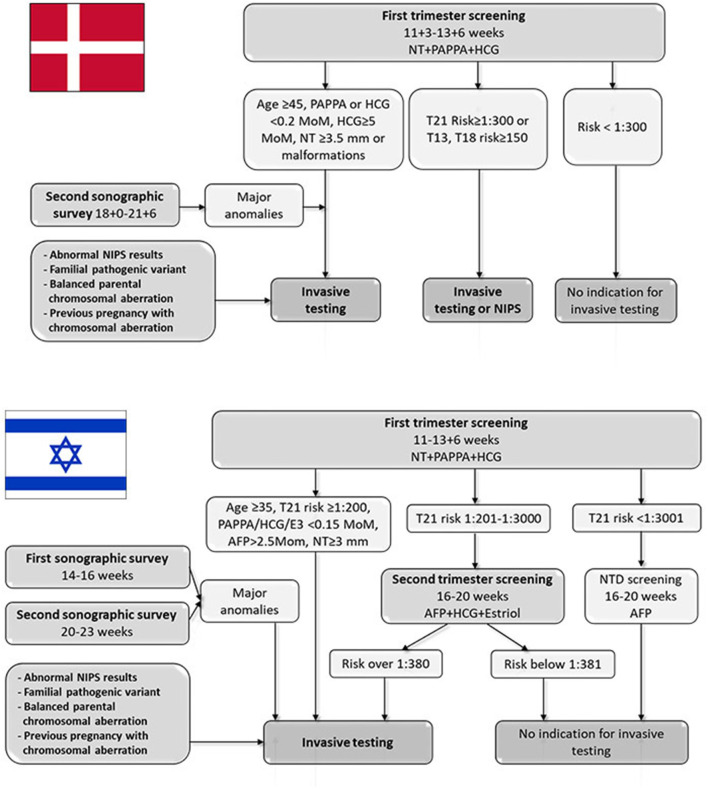
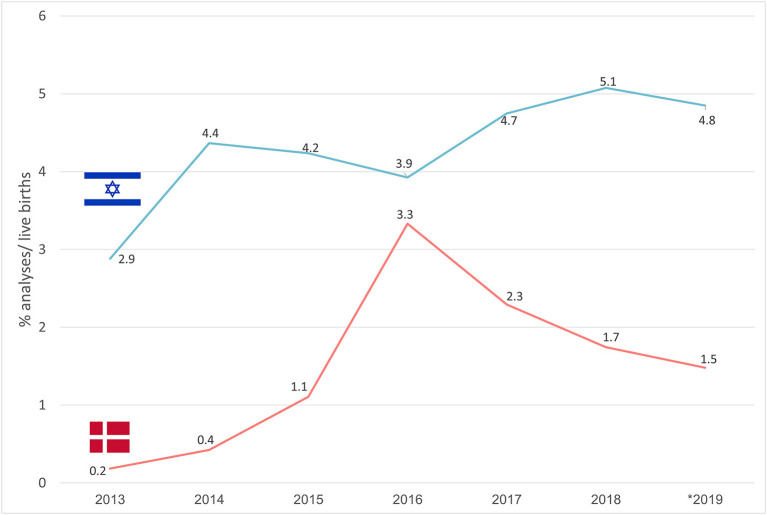
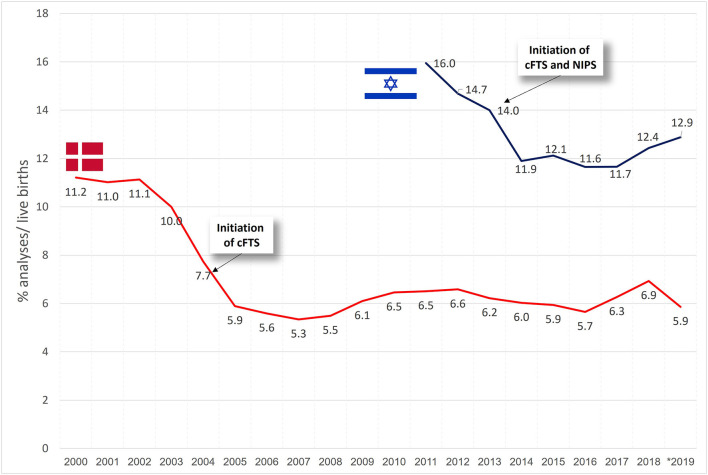
Following the wide distribution of non-invasive prenatal genetic screening (NIPS), numerous studies have reported a decline in total invasive tests in the recent years, up to 50-70% in some countries. However, in Denmark and Israel we have not experienced these declines. The objective of our study was to evaluate the trends in NIPS and chromosomal microarray analysis (CMA) use in Denmark and Israel. This retrospective study was performed by data acquisition from the Danish Cytogenetics Central Registry throughout the years 2000-2019, and Israeli Public Health Services, Ministry of Health computerized database (from 2011). Of the 1,243,956 live births registered in Denmark over the years 2000-2019, a relatively steady level of invasive testing around 6% was noted since 2004, as opposed to 13.0% in Israel based on 1,594,962 live births between 2011 and 2019. The average uptake of NIPS was 1.1 ± 0.5% in Denmark vs. 4.3% in Israel (2013-2019). Relatively steady rates of invasive testing were noted in both countries, compared to a slight decline in NIPS in the recent years. The recent decrease in the rates of invasive testing in the NIPS era was not observed in Denmark or in Israel. These results imply that Danish and Israeli women and/or health providers might favor the high resolution and yield of CMA testing over the non-invasiveness of NIPS. We explore and discuss this phenomenon, based on five central factors.
随着无创产前基因检测(NIPS)的广泛应用,众多研究报告称近年来侵入性检测的总数有所下降,在一些国家下降幅度高达50%-70%。然而,在丹麦和以色列,我们并未经历这种下降。我们研究的目的是评估丹麦和以色列NIPS及染色体微阵列分析(CMA)的使用趋势。这项回顾性研究通过从丹麦细胞遗传学中央登记处获取2000年至2019年全年的数据,以及从以色列公共卫生服务部、卫生部计算机数据库(2011年起)获取数据来进行。在2000年至2019年丹麦登记的1,243,956例活产中,自2004年以来侵入性检测水平相对稳定在6%左右,而基于2011年至2019年期间1,594,962例活产数据,以色列的这一比例为13.0%。丹麦NIPS的平均使用率为1.1±0.5%,而以色列(2013 - 2019年)为4.3%。与近年来NIPS略有下降相比,两国的侵入性检测率相对稳定。在丹麦或以色列未观察到NIPS时代侵入性检测率的近期下降。这些结果表明,丹麦和以色列的女性和/或医疗服务提供者可能更青睐CMA检测的高分辨率和高检出率,而非NIPS的非侵入性。我们基于五个核心因素对这一现象进行探讨。