Mphuthi Lehlohonolo E, Erasmus Elizabeth, Langner Ernst H G
Department of Chemistry, University of the Free State, Nelson Mandela Drive, P.O. Box 339, Bloemfontein 9300, South Africa.
ACS Omega. 2021 Nov 15;6(47):31632-31645. doi: 10.1021/acsomega.1c04142. eCollection 2021 Nov 30.
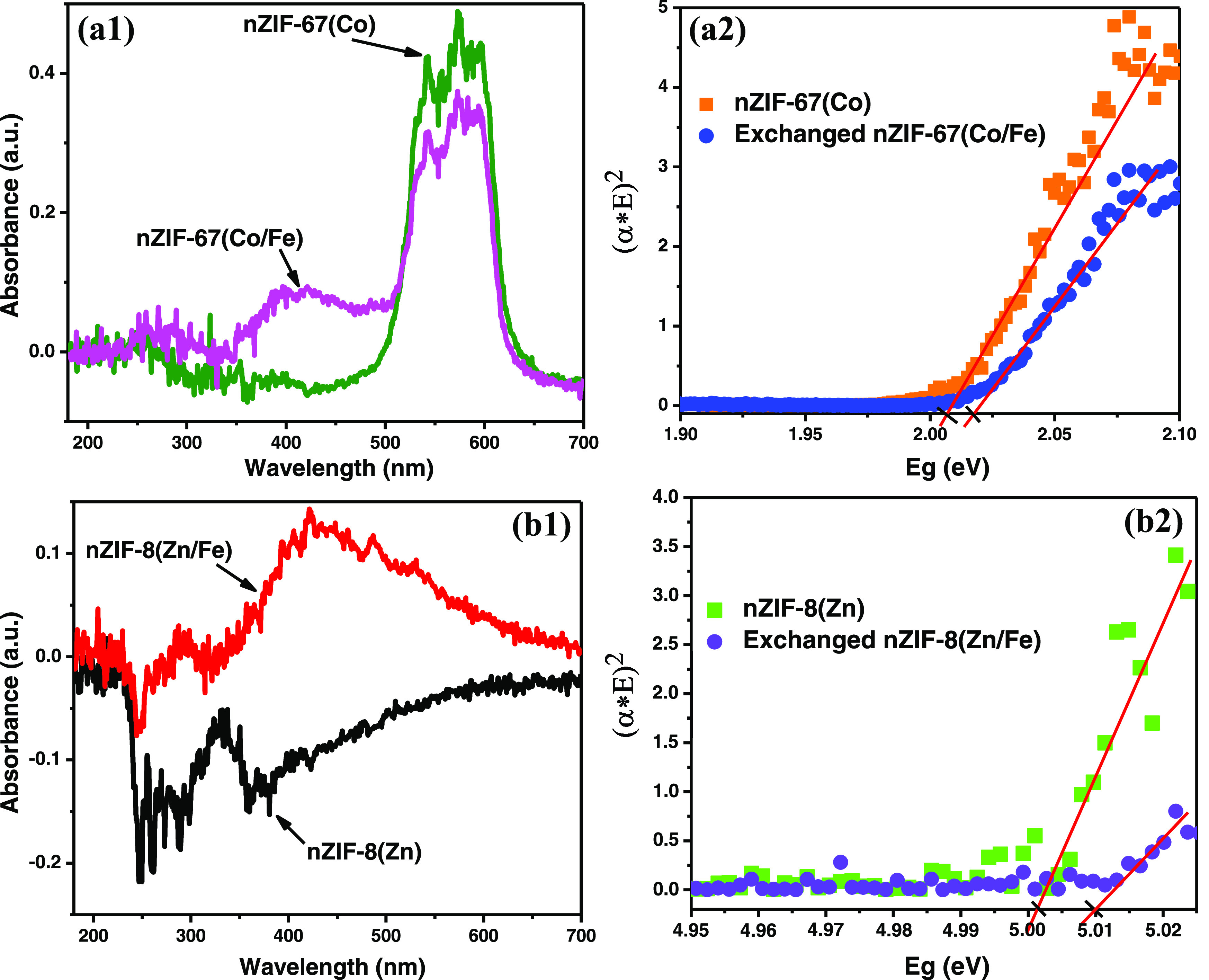
Zeolitic imidazolate frameworks (ZIFs), such as ZIF-8 and ZIF-67, were found to be efficient catalysts. However, ZIFs are not used much in photocatalysis due to their low photocatalytic activity for most reactions. The photocatalytic activity can be improved by modifying the framework by exchanging the Zn(II) ions (ZIF-8) and Co(II) ions (ZIF-67) with a more photocatalytically active metal(II) ion to form an efficient bimetallic ZIF photocatalyst. Redox-active iron (Fe)-based materials are known to be highly potent photocatalysts. Thus, incorporating iron into ZIFs could significantly enhance their photocatalytic performance. In this study, we modified nanosized ZIF-8(Zn) and ZIF-67(Co) via metal (Fe) exchange to produce bimetallic frameworks that are photocatalytically more active than their parent ZIFs. Nanosized ZIF-8 and ZIF-67 were synthesized isothermally in either water or methanol under ambient conditions. From these, Fe-containing bimetallic ZIF-8 and ZIF-67 nanoparticles were synthesized via the metal exchange, and their performance on the photocatalytic degradation of dye was evaluated. The morphology and crystal structures of the pristine ZIF-8 and ZIF-67 nanoparticles were retained to a large extent during the iron exchange. Their Brunauer-Emmett-Teller (BET) surface areas decreased by less than 15% for nZIF-8 and less than 12% for nZIF-67. The binding energy values on X-ray photoelectron spectroscopy (XPS) confirmed the preservation of the oxidation state of Fe(II) during the exchange process. A remarkably higher catalytic activity was observed for the photocatalytic degradation of dye by the Fe-exchanged nZIF-8 and nZIF-67 compared to their parent ZIFs. This proved that the incorporation of Fe(II) centers into the ZIF framework enhanced the photocatalytic activity of the framework dramatically. In addition, these catalysts can be regenerated and reused without an appreciable loss in activity.
沸石咪唑酯骨架材料(ZIFs),如ZIF-8和ZIF-67,被发现是高效催化剂。然而,由于ZIFs对大多数反应的光催化活性较低,它们在光催化中使用不多。通过用具有更高光催化活性的金属(II)离子交换Zn(II)离子(ZIF-8)和Co(II)离子(ZIF-67)来修饰骨架,可以提高光催化活性,从而形成高效的双金属ZIF光催化剂。已知具有氧化还原活性的铁(Fe)基材料是高效的光催化剂。因此,将铁掺入ZIFs中可以显著提高其光催化性能。在本研究中,我们通过金属(Fe)交换修饰了纳米级ZIF-8(Zn)和ZIF-67(Co),以制备比其母体ZIFs具有更高光催化活性的双金属骨架。纳米级ZIF-8和ZIF-67在环境条件下于水或甲醇中恒温合成。由此,通过金属交换合成了含铁的双金属ZIF-8和ZIF-67纳米颗粒,并评估了它们对染料的光催化降解性能。在铁交换过程中,原始ZIF-8和ZIF-67纳米颗粒的形态和晶体结构在很大程度上得以保留。对于纳米ZIF-8,其布鲁诺尔-埃米特-泰勒(BET)表面积减少不到15%,对于纳米ZIF-67,减少不到12%。X射线光电子能谱(XPS)上的结合能值证实了在交换过程中Fe(II)氧化态的保留。与它们的母体ZIFs相比,Fe交换的纳米ZIF-8和纳米ZIF-67对染料的光催化降解表现出显著更高催化活性。这证明将Fe(II)中心掺入ZIF骨架中极大地提高了骨架的光催化活性。此外,这些催化剂可以再生和重复使用,而活性没有明显损失。