Department of Ophthalmology, University of Washington, Seattle.
Roger and Angie Karalis Johnson Retina Center, Seattle, Washington.
JAMA Intern Med. 2022 Feb 1;182(2):134-141. doi: 10.1001/jamainternmed.2021.6990.
Visual function is important for older adults. Interventions to preserve vision, such as cataract extraction, may modify dementia risk.
To determine whether cataract extraction is associated with reduced risk of dementia among older adults.
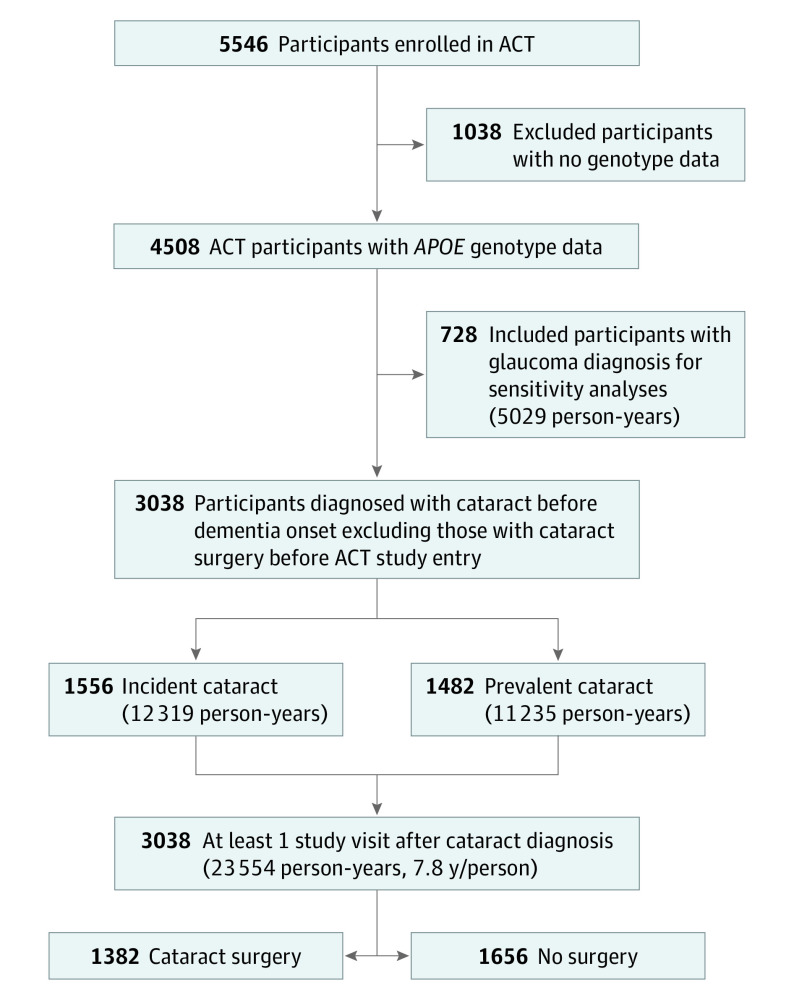
DESIGN, SETTING, AND PARTICIPANTS: This prospective, longitudinal cohort study analyzed data from the Adult Changes in Thought study, an ongoing, population-based cohort of randomly selected, cognitively normal members of Kaiser Permanente Washington. Study participants were 65 years of age or older and dementia free at enrollment and were followed up biennially until incident dementia (all-cause, Alzheimer disease, or Alzheimer disease and related dementia). Only participants who had a diagnosis of cataract or glaucoma before enrollment or during follow-up were included in the analyses (ie, a total of 3038 participants). Data used in the analyses were collected from 1994 through September 30, 2018, and all data were analyzed from April 6, 2019, to September 15, 2021.
The primary exposure of interest was cataract extraction. Data on diagnosis of cataract or glaucoma and exposure to surgery were extracted from electronic medical records. Extensive lists of dementia-related risk factors and health-related variables were obtained from study visit data and electronic medical records.
The primary outcome was dementia as defined by Diagnostic and Statistical Manual of Mental Disorders (Fourth Edition) criteria. Multivariate Cox proportional hazards regression analyses were conducted with the primary outcome. To address potential healthy patient bias, weighted marginal structural models incorporating the probability of surgery were used and the association of dementia with glaucoma surgery, which does not restore vision, was evaluated.
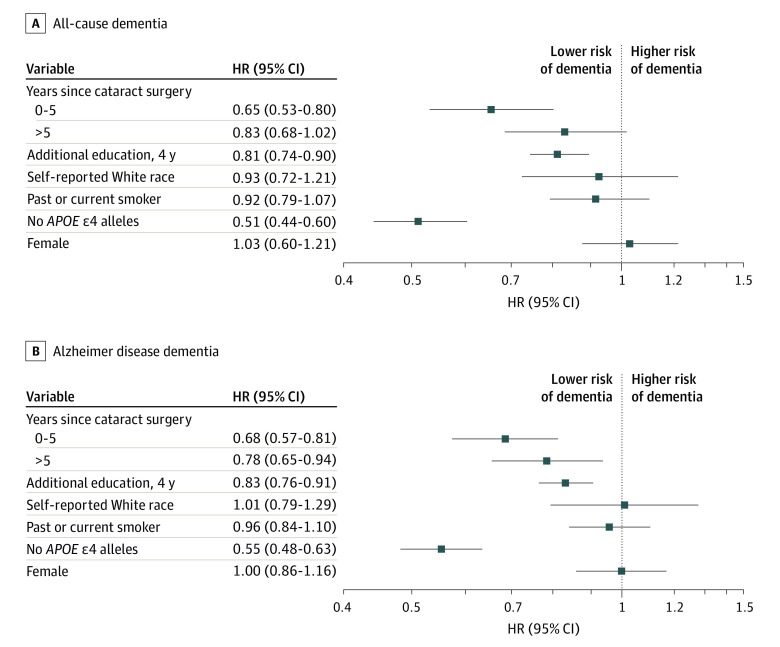
In total, 3038 participants were included (mean [SD] age at first cataract diagnosis, 74.4 (6.2) years; 1800 women (59%) and 1238 men (41%); and 2752 (91%) self-reported White race). Based on 23 554 person-years of follow-up, cataract extraction was associated with significantly reduced risk (hazard ratio, 0.71; 95% CI, 0.62-0.83; P < .001) of dementia compared with participants without surgery after controlling for years of education, self-reported White race, and smoking history and stratifying by apolipoprotein E genotype, sex, and age group at cataract diagnosis. Similar results were obtained in marginal structural models after adjusting for an extensive list of potential confounders. Glaucoma surgery did not have a significant association with dementia risk (hazard ratio, 1.08; 95% CI, 0.75-1.56; P = .68). Similar results were found with the development of Alzheimer disease dementia.
This cohort study found that cataract extraction was significantly associated with lower risk of dementia development. If validated in future studies, cataract surgery may have clinical relevance in older adults at risk of developing dementia.
视觉功能对老年人很重要。例如白内障摘除术等干预措施可以降低痴呆的风险。
确定白内障摘除术是否与老年人痴呆风险降低相关。
设计、地点和参与者:这是一项前瞻性、纵向队列研究,分析了成人思维变化研究的数据,这是一项正在进行的、基于人群的、随机选择的、认知正常的 Kaiser Permanente Washington 成员的队列研究。研究参与者年龄在 65 岁或以上,入组时无痴呆,每两年随访一次,直到出现痴呆(所有原因、阿尔茨海默病或阿尔茨海默病和相关痴呆)。仅包括在入组前或随访期间患有白内障或青光眼诊断的参与者(即,共 3038 名参与者)进行分析。用于分析的数据于 1994 年至 2018 年 9 月 30 日收集,所有数据于 2019 年 4 月 6 日至 2021 年 9 月 15 日进行分析。
主要暴露因素为白内障摘除术。白内障或青光眼的诊断和手术暴露数据从电子病历中提取。从研究访问数据和电子病历中获得了大量与痴呆相关的风险因素和健康相关变量。
主要结果是根据《精神障碍诊断与统计手册(第四版)》标准定义的痴呆。采用多变量 Cox 比例风险回归分析对主要结果进行分析。为了解决潜在的健康患者偏倚问题,使用了纳入手术概率的加权边缘结构模型,并评估了与青光眼手术(不能恢复视力)相关的痴呆风险,后者与痴呆风险无关。
共纳入 3038 名参与者(首次白内障诊断时的平均[SD]年龄,74.4[6.2]岁;1800 名女性[59%]和 1238 名男性[41%];2752 名[91%]自报白人种族)。基于 23554 人年的随访,与未接受手术的参与者相比,白内障摘除术后痴呆风险显著降低(风险比,0.71;95%置信区间,0.62-0.83;P<.001),这是在控制了教育年限、自报白人种族和吸烟史以及按载脂蛋白 E 基因型、性别和白内障诊断时的年龄组分层后得出的结果。在调整了一系列潜在混杂因素后,在边缘结构模型中也得到了类似的结果。青光眼手术与痴呆风险无显著相关性(风险比,1.08;95%置信区间,0.75-1.56;P=0.68)。在阿尔茨海默病性痴呆的发展中也发现了类似的结果。
这项队列研究发现,白内障摘除术与痴呆发展风险降低显著相关。如果在未来的研究中得到验证,白内障手术可能对有痴呆风险的老年人具有临床意义。