Department of Emergency Medicine, Mayo Clinic, Rochester, Minnesota, USA.
Division of Health Care Delivery Research, Mayo Clinic, Rochester, Minnesota, USA.
Acad Emerg Med. 2022 Apr;29(4):476-485. doi: 10.1111/acem.14423. Epub 2021 Dec 17.
The objective was to derive a risk score that uses variables available early during the emergency department (ED) encounter to identify high-risk geriatric patients who may benefit from delirium screening.
This was an observational study of older adults age ≥ 75 years who presented to an academic ED and who were screened for delirium during their ED visit. Variable selection from candidate predictors was performed through a LASSO-penalized logistic regression. A risk score was derived from the final prediction model, and predictive accuracy characteristics were calculated with 95% confidence intervals (CIs).
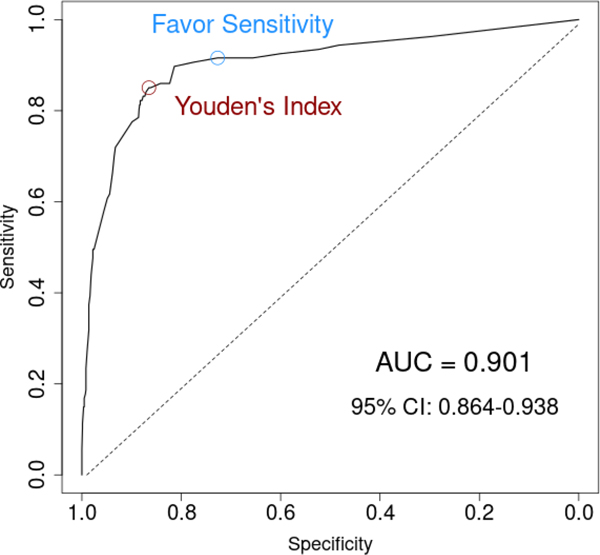
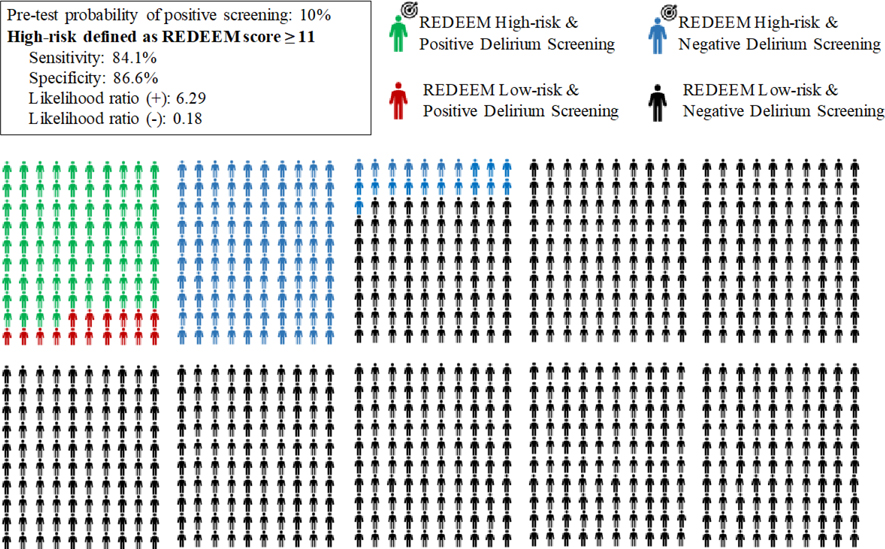
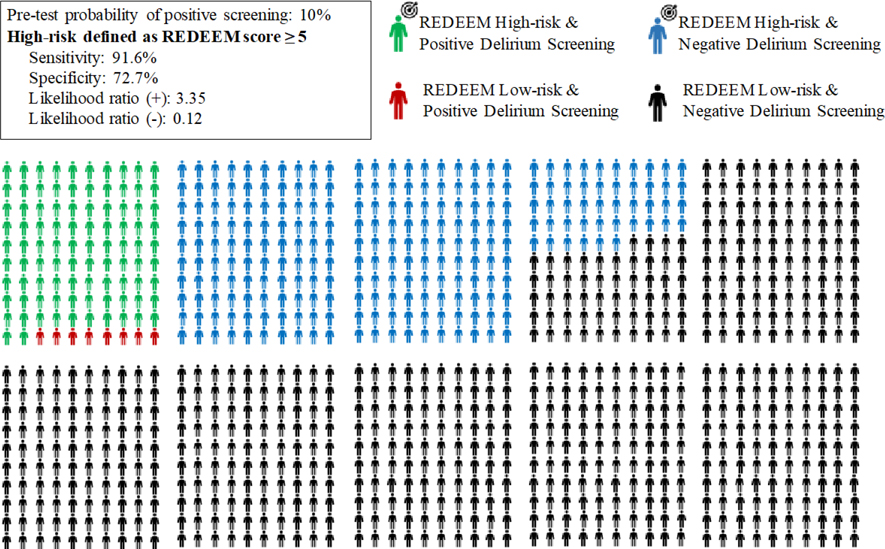
From the 967 eligible ED visits, delirium was detected in 107 (11.1%). The area under the curve for the REcognizing DElirium in Emergency Medicine (REDEEM) score was 0.901 (95% CI = 0.864-0.938). The REEDEM risk score included 10 different variables (seven based on triage information and three obtained during early history taking) with a score ranging from -3 to 66. Using an optimal cutoff of ≥11, we found a sensitivity of 84.1% (90 of 107 ED delirium patients, 95% CI = 75.5%-90.2%) and a specificity of 86.6% (745 of 860 non-ED delirium patients, 95% CI = 84.1%-88.8%). A lower cutoff of ≥5 was found to minimize false negatives with an improved sensitivity at 91.6% (98 of 107 ED delirium patients, 95% CI = 84.2%-95.8%).
A risk stratification score was derived with the potential to augment delirium recognition in geriatric ED patients. This has the potential to assist on delirium-targeted screening of high-risk patients in the ED. Validation of REDEEM, however, is needed prior to implementation.
本研究旨在开发一种风险评分系统,该系统利用急诊科(ED)就诊早期的变量来识别可能需要进行谵妄筛查的高风险老年患者。
这是一项针对年龄≥75 岁的老年患者的观察性研究,这些患者在 ED 就诊期间接受了谵妄筛查。通过 LASSO 惩罚逻辑回归对候选预测因子进行变量选择。从最终预测模型中得出风险评分,并计算 95%置信区间(CI)的预测准确性特征。
在 967 例符合条件的 ED 就诊中,107 例(11.1%)检测出谵妄。REcognizing DElirium in Emergency Medicine(REDEEM)评分的曲线下面积为 0.901(95%CI=0.864-0.938)。REDEEM 风险评分包括 10 个不同的变量(7 个基于分诊信息,3 个在早期病史采集时获得),评分范围为-3 至 66。使用最佳截断值≥11,我们发现敏感性为 84.1%(107 例 ED 谵妄患者中有 90 例,95%CI=75.5%-90.2%),特异性为 86.6%(860 例非 ED 谵妄患者中有 745 例,95%CI=84.1%-88.8%)。发现截断值较低(≥5)可以最大限度地减少假阴性,敏感性提高到 91.6%(107 例 ED 谵妄患者中有 98 例,95%CI=84.2%-95.8%)。
开发了一种风险分层评分系统,有可能提高老年 ED 患者的谵妄识别能力。这有可能帮助在 ED 对高危患者进行谵妄针对性筛查。然而,在实施之前需要对 REDEEM 进行验证。