Liu Gao-Feng, Gao Zhen, Liu Zheng-Nan, Yang Min, Zhang Sheng, Tan Tai-Peng
Graduate Faculty, Tianjin University of Traditional Chinese Medicine, Tianjin 301617, China.
Acupuncture and Tuina School/The 3rd Teaching Hospital, Chengdu University of Traditional Chinese Medicine, Chengdu 6100752, China.
Evid Based Complement Alternat Med. 2021 Nov 27;2021:6868625. doi: 10.1155/2021/6868625. eCollection 2021.
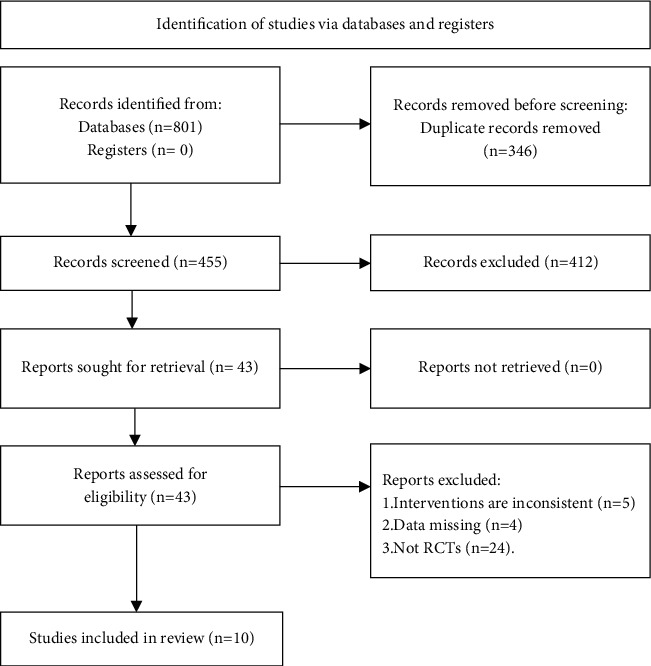
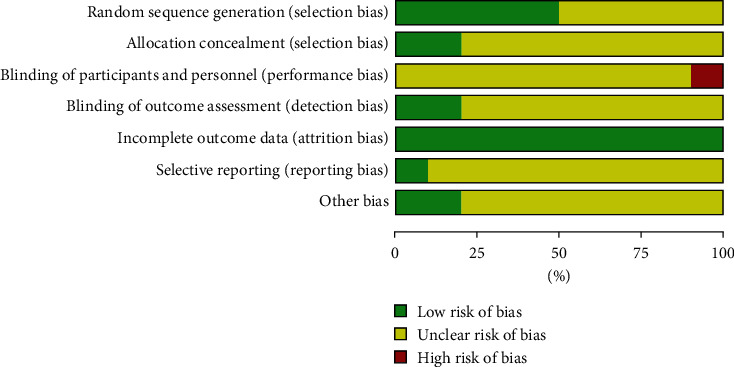
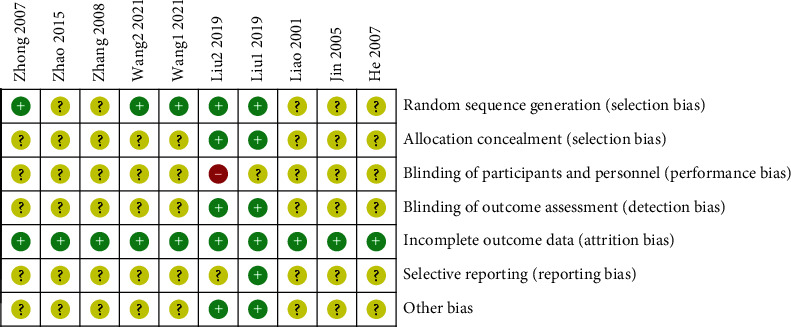
Temporomandibular joint disorders (TMDs) are a common and prevalent disease with main symptoms of pain, joint sounds, and mandibular movement disorders, which seriously affects the mental health and quality of life of the sufferers. In recent years, there have been an increasing number of studies utilizing warm needle acupuncture (WNA) for the treatment of TMD, and the quality of the studies has gradually improved. However, evidence from evidence-based medicine is lacking. This study aims to use a systematic review and meta-analysis method to understand the efficacy of WNA for the treatment of TMD. We searched randomized controlled trials (RCTs) of WNA for the treatment of TMD from 9 electronic databases, including 5 English databases (PubMed, EMBASE, Cochrane Library, Web of Science, and MEDLINE) and 4 Chinese databases (Chinese National Knowledge Infrastructure (CNKI), Chinese VIP Information, Wanfang Database, and Chinese Biomedical Literature Database (CBM)) from their inception to May 2021. The included RCTs compared WNA with acupuncture, electroacupuncture, pharmacological therapy, or other therapies. And outcome indicators such as total effective rate and cure rate were assessed. All analyses were conducted using RevMan software V5.3 and Stata16. Measurement count data used the relative risk (RR) as the efficacy statistic, and each effect size was given its point estimate value and 95% confidence interval (CI).
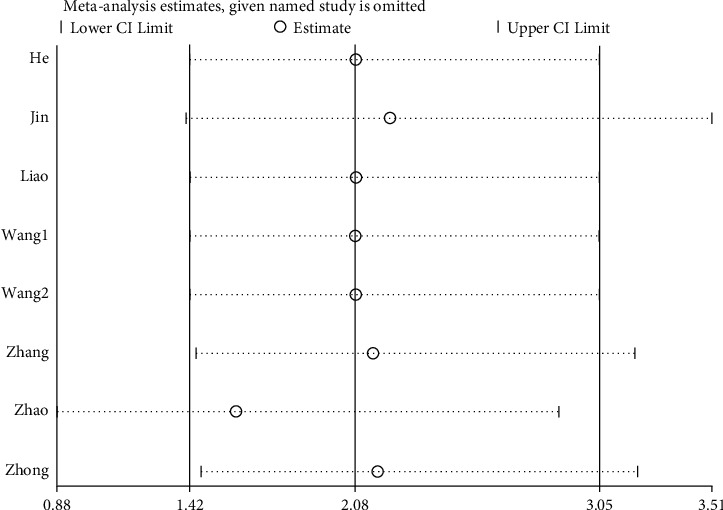
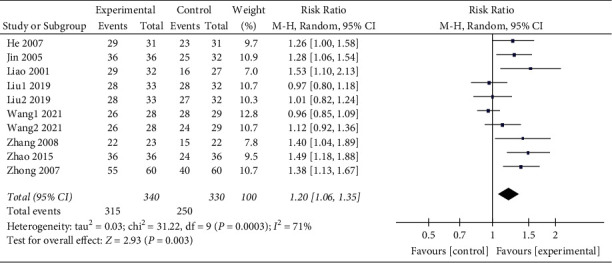
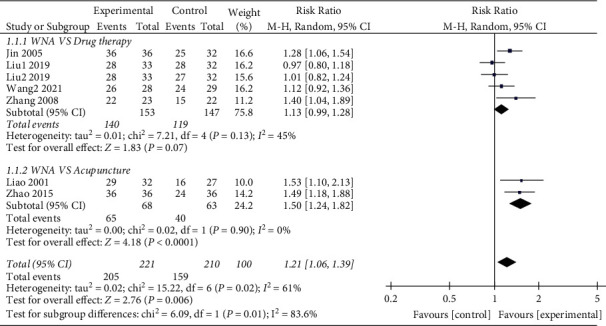
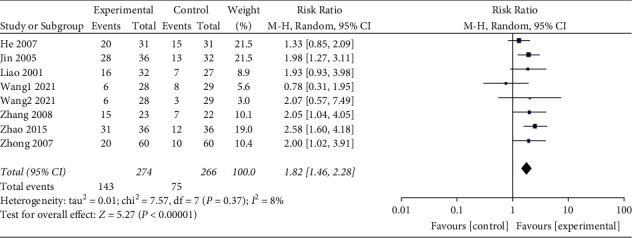
The meta-analysis included 10 studies with a total of 670 patients, which included 340 patients in the experimental group and 330 patients in the control group. The data in this review showed that WNA is superior to treatments such as acupuncture alone, acupuncture therapy combined with TDP, drug therapy, and ultrasonic therapy in terms of effective rate (RR = 1.20; 95% CI, 1.06 to 1.35; and = 0.003) and cure rate (RR = 1.82; 95% CI, 1.46 to 2.28; and < 0.00001) for the treatment of TMD.
This systematic review and meta-analysis provides new evidence for the effectiveness of WNA for the treatment of TMD. However, the above conclusions need to be further verified by multicenter prospective studies of larger samples and higher-quality RCTs. Protocol registration number: INPLASY202160030.
颞下颌关节紊乱病(TMDs)是一种常见且多发的疾病,主要症状为疼痛、关节弹响和下颌运动障碍,严重影响患者的心理健康和生活质量。近年来,运用温针疗法(WNA)治疗TMD的研究日益增多,且研究质量逐步提高。然而,缺乏循证医学证据。本研究旨在采用系统评价和荟萃分析方法,了解WNA治疗TMD的疗效。我们从9个电子数据库中检索了WNA治疗TMD的随机对照试验(RCTs),包括5个英文数据库(PubMed、EMBASE、Cochrane图书馆、Web of Science和MEDLINE)以及4个中文数据库(中国知网(CNKI)、维普资讯、万方数据库和中国生物医学文献数据库(CBM)),检索时间范围从建库至2021年5月。纳入的RCTs将WNA与针刺、电针、药物治疗或其他疗法进行了比较。并评估了总有效率和治愈率等结局指标。所有分析均使用RevMan软件V5.3和Stata16进行。计量计数资料采用相对危险度(RR)作为疗效统计量,每个效应量给出其点估计值和95%置信区间(CI)。
荟萃分析纳入10项研究,共670例患者,其中试验组340例,对照组330例。本综述中的数据表明,在治疗TMD的有效率(RR = 1.20;95%CI,1.06至1.35;P = 0.003)和治愈率(RR = 1.82;95%CI,1.46至2.28;P < 0.00001)方面,WNA优于单纯针刺、针刺结合特定电磁波谱(TDP)治疗、药物治疗和超声治疗等疗法。
本系统评价和荟萃分析为WNA治疗TMD的有效性提供了新证据。然而,上述结论需要通过更大样本量和更高质量RCTs的多中心前瞻性研究进一步验证。方案注册号:INPLASY202160030。