Haag Susanne, Junge Lisa, Lotz Fabian, McGauran Natalie, Paulides Marios, Potthast Regine, Kaiser Thomas
Institute for Quality and Efficiency in Health Care, Cologne, Germany.
Drug Commission of the German Medical Association, Berlin, Germany.
J Patient Rep Outcomes. 2021 Dec 7;5(1):127. doi: 10.1186/s41687-021-00402-1.
Summaries of product characteristics (SmPCs) are regulatory documents published upon drug approval. They should report all relevant study data and advise how to use drugs safely and effectively. Patient-reported outcomes (PROs) are increasingly used in clinical trials to incorporate the patient perspective-SmPCs should thus adequately report PROs. In Germany, new drugs undergo mandatory early benefit assessment. Pharmaceutical companies submit dossiers containing all evidence; the subsequent dossier assessments focus on patient-relevant outcomes and comprehensively report PROs.
The primary aim was to investigate to what extent PROs recorded as outcomes in clinical trials of new drugs are reported in SmPCs.
We analysed dossier assessments with randomized controlled trials (RCTs) of new drugs entering the market between 01/2014 and 07/2018 and the corresponding SmPCs, and compared PRO reporting in both document types. For this purpose, we evaluated dossier assessment characteristics (e.g. drug name, indication, disease category) and study characteristics (e.g. evaluable PROs available?). PROs were divided into symptoms and health-related quality of life (HRQoL). SmPCs were screened to identify RCTs. We conducted 3 main evaluation steps: (1) Did the RCT included in the dossier assessment contain evaluable PROs? (2) If yes, was the RCT included in the SmPC? (3) If yes, were the PROs reported in the SmPC? Results are presented descriptively.
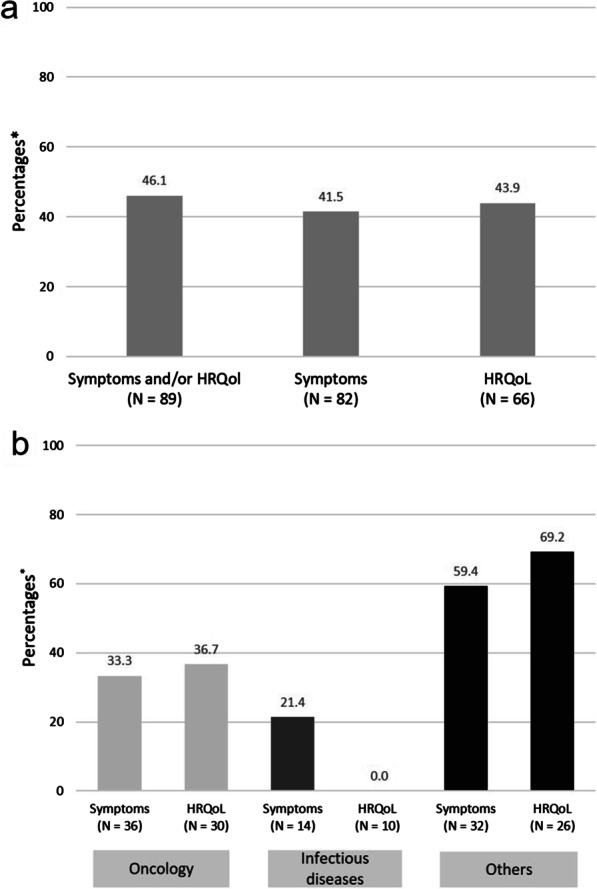
88 dossier assessments including 143 RCTs on 72 drugs were considered: 109 (76.2%) RCTs included evaluable PROs, of which 89 were included in SmPCs. 38 RCTs (42.7%) investigated oncologics, 18 (20.2%) anti-infectives, and 33 (37.1%) other drugs. The RCTs considered symptoms more often than HRQoL (82 vs. 66 RCTs). In SmPCs, PROs were reported for 41 RCTs (46.1%), with a slightly higher reporting rate for RCTs considering HRQoL (43.9%) than for RCTs considering symptoms (41.5%). In oncologic indications, PROs were reported for 36.7% of RCTs considering HRQoL and 33.3% of RCTs considering symptoms. In infectious diseases, the rates were 21.4% (symptoms) and 0% (HRQoL), and for other diseases about 60% (symptoms) to 70% (HRQoL).
Even though a large amount of PRO data on new drugs is available from clinical trials included in SmPCs, the corresponding results are underreported.
产品特性摘要(SmPC)是在药品获批后发布的监管文件。它们应报告所有相关研究数据,并就如何安全有效地使用药物提供建议。患者报告结局(PRO)在临床试验中越来越多地被用于纳入患者的观点——因此,SmPC应充分报告PRO。在德国,新药需进行强制性早期效益评估。制药公司提交包含所有证据的档案;随后的档案评估侧重于与患者相关的结局,并全面报告PRO。
主要目的是调查新药临床试验中记录为结局的PRO在SmPC中的报告程度。
我们分析了2014年1月至2018年7月进入市场的新药的随机对照试验(RCT)的档案评估以及相应的SmPC,并比较了两种文件类型中PRO的报告情况。为此,我们评估了档案评估特征(如药品名称、适应症、疾病类别)和研究特征(如是否有可评估的PRO?)。PRO分为症状和健康相关生活质量(HRQoL)。对SmPC进行筛选以识别RCT。我们进行了3个主要评估步骤:(1)档案评估中包含的RCT是否包含可评估的PRO?(2)如果是,该RCT是否包含在SmPC中?(3)如果是,SmPC中是否报告了PRO?结果以描述性方式呈现。
共考虑了88份档案评估,包括72种药物的143项RCT:109项(76.2%)RCT包含可评估的PRO,其中89项包含在SmPC中。38项RCT(42.7%)研究肿瘤学药物,18项(20.2%)研究抗感染药物,33项(37.1%)研究其他药物。RCT对症状的研究比对HRQoL的研究更频繁(82项对66项RCT)。在SmPC中,41项RCT(46.1%)报告了PRO,考虑HRQoL的RCT的报告率(43.9%)略高于考虑症状的RCT(41.5%)。在肿瘤学适应症中,考虑HRQoL的RCT中有36.7%报告了PRO,考虑症状的RCT中有33.3%报告了PRO。在传染病中,报告率分别为21.4%(症状)和0%(HRQoL),在其他疾病中,报告率约为60%(症状)至70%(HRQoL)。
尽管SmPC中包含的临床试验提供了大量关于新药的PRO数据,但相应结果的报告不足。