Chalasani Meghana, Vaidya Pujita, Mullin Theresa
U.S. Food and Drug Administration, WO51, Room 1146, 10903 New Hampshire Avenue, Silver Spring, MD 20993-0002 USA.
Res Involv Engagem. 2018 Apr 2;4:10. doi: 10.1186/s40900-018-0093-3. eCollection 2018.
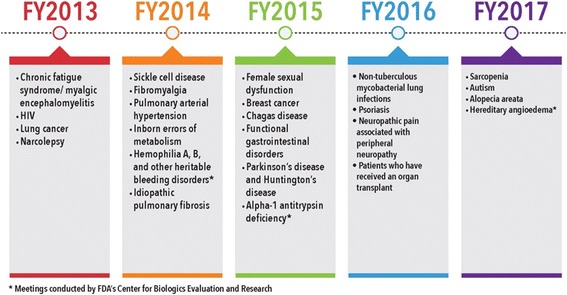
People living with a condition are uniquely positioned to inform the understanding of the therapeutic context for drug development and evaluation. In 2012, the U.S. Food and Drug Administration (FDA) established the Patient-Focused Drug Development (PFDD) initiative to more systematically obtain the patient perspective on specific diseases and their currently available treatments. PFDD meetings are unique among FDA public meetings, with a format designed to engage patients and elicit their perspectives on two topic areas: (1) the most significant symptoms of their condition and the impact of the condition on daily life; and, (2) their current approaches to treatment. FDA has conducted 24 disease-specific PFDD meetings to date. The lessons learned from PFDD meetings range from experiences common across rare diseases to more disease specific experiences that matter most to patients. FDA recognizes that FDA-led PFDD meetings alone cannot address the gaps in information on the patient perspective. Patient-focused drug development is an ongoing effort and FDA looks forward to the next steps in advancing the science and the utilization of patient input throughout drug development and evaluation.
The U.S. Food and Drug Administration (FDA) has multiple mechanisms for its regulators and staff to interact with patients -- but none quite like its novel Patient-Focused Drug Development (PFDD) initiative. FDA established the PFDD initiative to more systematically obtain the patient perspective on specific diseases and their currently available treatments. Since the initiative's inception in 2012, FDA has held 24 PFDD meetings, covering a range of disease areas and hearing directly from thousands of patients and caregivers. FDA's PFDD meetings have also provided key stakeholders, including patient advocates, researchers, drug developers, healthcare providers, and other government officials, an opportunity to hear the patient's voice. The lessons learned include but are not limited to specific experiences that matter most to patients, patient perspectives on meaningful treatment benefits and how patients want to be engaged in the drug development process. FDA recognizes that FDA-led PFDD meetings alone cannot address the gaps in information on the patient perspective. Further enhancing the incorporation of the patient's voice in drug development and evaluation continues to be a priority for FDA.
患有某种疾病的人群在帮助理解药物研发与评估的治疗背景方面具有独特地位。2012年,美国食品药品监督管理局(FDA)发起了以患者为中心的药物研发(PFDD)倡议,以便更系统地获取患者对特定疾病及其现有治疗方法的看法。PFDD会议在美国食品药品监督管理局的公开会议中独具特色,其形式旨在让患者参与其中,并就两个主题领域征求他们的意见:(1)其疾病的最主要症状以及该疾病对日常生活的影响;(2)他们目前的治疗方法。截至目前,FDA已举办了24场针对特定疾病的PFDD会议。从PFDD会议中吸取的经验教训涵盖从罕见病共有的经历到对患者最为重要的更多特定疾病经历。FDA认识到,仅靠FDA主导的PFDD会议无法填补患者视角信息方面的空白。以患者为中心的药物研发是一项持续的工作,FDA期待在推进科学以及在整个药物研发与评估过程中利用患者意见方面迈出下一步。
美国食品药品监督管理局(FDA)有多种机制让其监管人员和工作人员与患者互动——但没有一种机制能像其新颖的以患者为中心的药物研发(PFDD)倡议那样。FDA发起PFDD倡议是为了更系统地获取患者对特定疾病及其现有治疗方法的看法。自该倡议于2012年启动以来,FDA已举办了24场PFDD会议,涵盖一系列疾病领域,并直接听取了数千名患者和护理人员的意见。FDA的PFDD会议还为包括患者权益倡导者、研究人员、药物研发人员、医疗服务提供者和其他政府官员在内 的关键利益相关者提供了倾听患者声音的机会。吸取的经验教训包括但不限于对患者最为重要的特定经历、患者对有意义的治疗益处的看法以及患者希望如何参与药物研发过程。FDA认识到,仅靠FDA主导的PFDD会议无法填补患者视角信息方面的空白。进一步加强在药物研发和评估中纳入患者声音仍然是FDA的一个优先事项。