School of Biological Sciences, University of Bristol, Bristol BS8 1TQ, UK.
Biol Lett. 2021 Dec;17(12):20210487. doi: 10.1098/rsbl.2021.0487. Epub 2021 Dec 8.
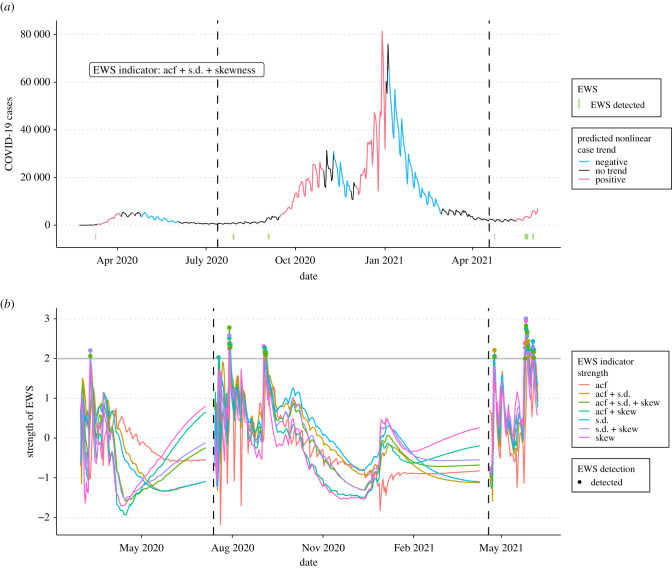
Early warning signals (EWSs) aim to predict changes in complex systems from phenomenological signals in time series data. These signals have recently been shown to precede the emergence of disease outbreaks, offering hope that policymakers can make predictive rather than reactive management decisions. Here, using a novel, sequential analysis in combination with daily COVID-19 case data across 24 countries, we suggest that composite EWSs consisting of variance, autocorrelation and skewness can predict nonlinear case increases, but that the predictive ability of these tools varies between waves based upon the degree of critical slowing down present. Our work suggests that in highly monitored disease time series such as COVID-19, EWSs offer the opportunity for policymakers to improve the accuracy of urgent intervention decisions but best characterize hypothesized critical transitions.
早期预警信号 (EWSs) 旨在通过时间序列数据中的现象学信号预测复杂系统的变化。这些信号最近已被证明可以在疾病爆发之前出现,这为决策者提供了希望,他们可以做出预测性而非反应性的管理决策。在这里,我们使用一种新颖的、连续的分析方法,结合 24 个国家的每日 COVID-19 病例数据,表明由方差、自相关和偏度组成的复合 EWS 可以预测非线性病例增加,但这些工具的预测能力因存在的关键减速程度而异在不同的波之间。我们的工作表明,在 COVID-19 等高度监测的疾病时间序列中,EWSs 为决策者提供了提高紧急干预决策准确性的机会,但最好描述假设的关键转变。