Department of Preventive Medicine, Yonsei Wonju University College of Medicine, Wonju, Korea.
Department of Physiology, Yonsei University Wonju College of Medicine, Wonju, Korea.
J Prev Med Public Health. 2021 Nov;54(6):412-421. doi: 10.3961/jpmph.21.387. Epub 2021 Oct 22.
Non-alcoholic fatty liver disease (NAFLD) is an increasingly prevalent metabolic disease. Muscle is known to influence NAFLD development. Therefore, this study aimed to determine the relationships among low muscle mass, NAFLD, and hepatic fibrosis using various definitions of low muscle mass and NAFLD diagnostic methods, including magnetic resonance imaging-based proton density fat fraction (MRI-PDFF).
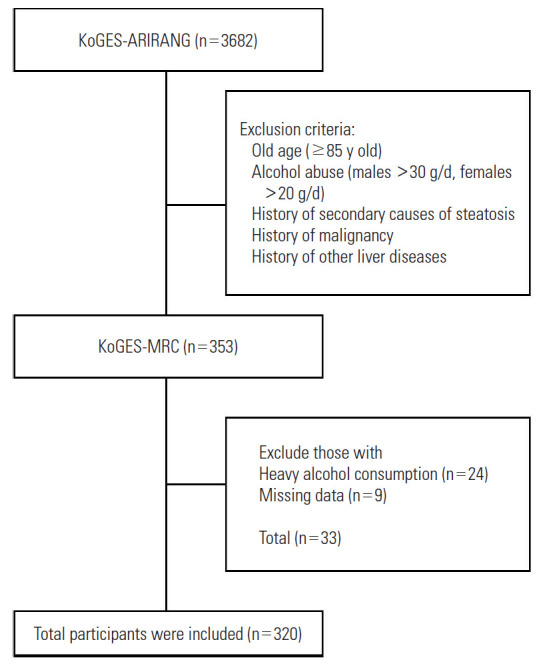
This cross-sectional study included 320 participants (107 males, 213 females) from the Korean Genome and Epidemiology Study on Atherosclerosis Risk of Rural Areas in the Korean General Population cohort. Muscle mass was assessed using whole-body dual-energy X-ray absorptiometry and adjusted for the height squared, body weight, and body mass index (BMI). NAFLD was diagnosed using ultrasonography (US), MRI-PDFF, and the comprehensive NAFLD score (CNS). Hepatic fibrosis was assessed using magnetic resonance elastography. Multivariable logistic and linear regression analyses were performed to determine the aforementioned associations.
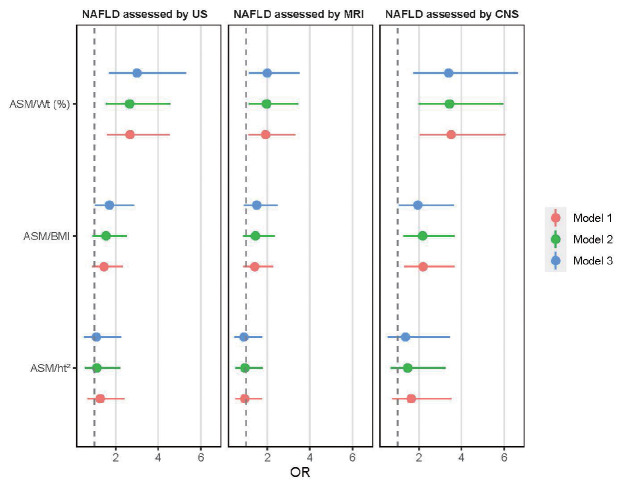
According to US, 183 participants (57.2%) had NAFLD. Muscle mass adjusted for body weight was associated with NAFLD diagnosed using US (odds ratio [OR], 3.00; 95% confidence interval [CI], 1.70 to 5.31), MRI-PDFF (OR, 2.00; 95% CI, 1.13 to 3.53), and CNS (OR, 3.39; 95% CI, 1.73 to 6.65) and hepatic fibrosis (males: β=-0.070, p<0.01; females: β=-0.037, p<0.04). Muscle mass adjusted for BMI was associated with NAFLD diagnosed by US (OR, 1.71; 95% CI, 1.02 to 2.86) and CNS (OR, 1.95; 95% CI, 1.04 to 3.65), whereas muscle mass adjusted for height was not associated with NAFLD.
Low muscle mass was associated with NAFLD and liver fibrosis; therefore, maintaining sufficient muscle mass is important to prevent NAFLD. A prospective study and additional consideration of muscle quality are needed to strengthen the findings regarding this association.
非酒精性脂肪性肝病(NAFLD)是一种越来越普遍的代谢性疾病。已知肌肉会影响 NAFLD 的发展。因此,本研究旨在使用各种低肌肉量和 NAFLD 诊断方法(包括基于磁共振成像的质子密度脂肪分数[MRI-PDFF]),确定低肌肉量、NAFLD 和肝纤维化之间的关系。
本横断面研究纳入了韩国农村地区动脉粥样硬化风险的韩国基因组和流行病学研究(Korean General Population cohort)中的 320 名参与者(男性 107 名,女性 213 名)。使用全身双能 X 射线吸收法评估肌肉量,并根据身高平方、体重和体重指数(BMI)进行调整。使用超声(US)、MRI-PDFF 和综合 NAFLD 评分(CNS)诊断 NAFLD。使用磁共振弹性成像评估肝纤维化。进行多变量逻辑和线性回归分析以确定上述关联。
根据 US,183 名参与者(57.2%)患有 NAFLD。体重调整后的肌肉量与 US 诊断的 NAFLD 相关(比值比[OR],3.00;95%置信区间[CI],1.70 至 5.31)、MRI-PDFF(OR,2.00;95%CI,1.13 至 3.53)和 CNS(OR,3.39;95%CI,1.73 至 6.65)和肝纤维化(男性:β=-0.070,p<0.01;女性:β=-0.037,p<0.04)。BMI 调整后的肌肉量与 US 诊断的 NAFLD(OR,1.71;95%CI,1.02 至 2.86)和 CNS(OR,1.95;95%CI,1.04 至 3.65)相关,而身高调整后的肌肉量与 NAFLD 无关。
低肌肉量与 NAFLD 和肝纤维化相关;因此,保持足够的肌肉量对于预防 NAFLD 很重要。需要进行前瞻性研究并进一步考虑肌肉质量,以加强对这种关联的发现。