Institute for Nanobiotechnology, Johns Hopkins University, Baltimore, MD, USA.
Department of Biomedical Engineering, Johns Hopkins University, Baltimore, MD, USA.
Fluids Barriers CNS. 2021 Dec 7;18(1):56. doi: 10.1186/s12987-021-00291-y.
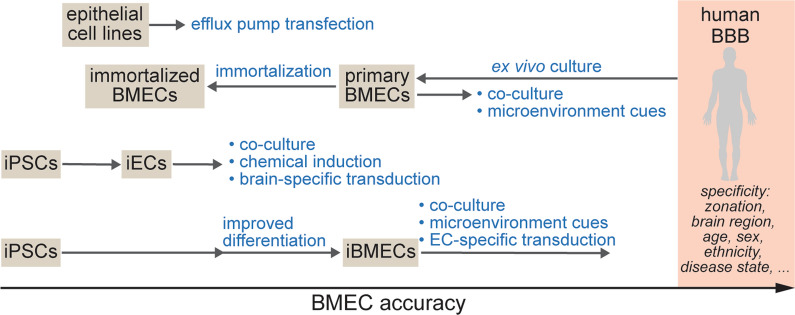
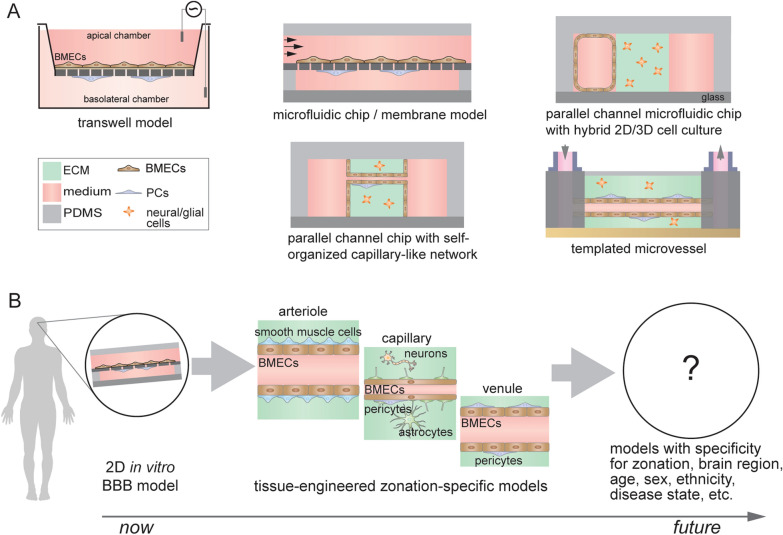
With the limitations associated with post-mortem tissue and animal models, In vitro BBB models enable precise control of independent variables and microenvironmental cues, and hence play an important role in studying the BBB. Advances in stem cell technology and tissue engineering provide the tools to create next-generation in vitro BBB models with spatial organization of different cell types in 3D microenvironments that more closely match the human brain. These models will be capable of assessing the physiological and pathological responses to different perturbations relevant to health and disease. Here, we review the factors that determine the accuracy of in vitro BBB models, and describe how these factors will guide the development of next-generation models. Improving the accuracy of cell sources and microenvironmental cues will enable in vitro BBB models with improved accuracy and specificity to study processes and phenomena associated with zonation, brain region, age, sex, ethnicity, and disease state.
由于死后组织和动物模型的局限性,体外 BBB 模型能够精确控制独立变量和微环境线索,因此在研究 BBB 方面发挥着重要作用。干细胞技术和组织工程学的进步为创建具有不同细胞类型的空间组织的下一代体外 BBB 模型提供了工具,这些模型在 3D 微环境中更接近人脑。这些模型将能够评估与健康和疾病相关的不同扰动的生理和病理反应。在这里,我们回顾了决定体外 BBB 模型准确性的因素,并描述了这些因素将如何指导下一代模型的发展。提高细胞来源和微环境线索的准确性将使体外 BBB 模型具有更高的准确性和特异性,从而研究与分区、脑区、年龄、性别、种族和疾病状态相关的过程和现象。