Department of Cardiovascular Medicine, TAHA Clinical Trial Group, School of Medicine, Shiraz University of Medical Sciences, Zand Street, Shiraz, Iran.
Students' Research Committee, Shiraz University of Medical Sciences, Shiraz, Iran.
Stem Cell Res Ther. 2021 Dec 7;12(1):600. doi: 10.1186/s13287-021-02667-1.
Trials investigating the role of mesenchymal stem cells (MSCs) in increasing ejection fraction (LVEF) after acute myocardial infarction (AMI) have raised some controversies. This study was conducted to find whether transplantation of MSCs after AMI can help improve myocardial performance indices or clinical outcomes.
Randomized trials which evaluated transplantation of MSCs after AMI were enrolled. The primary outcome was LVEF change. We also assessed the role of cell origin, cell number, transplantation time interval after AMI, and route of cell delivery on the primary outcome.
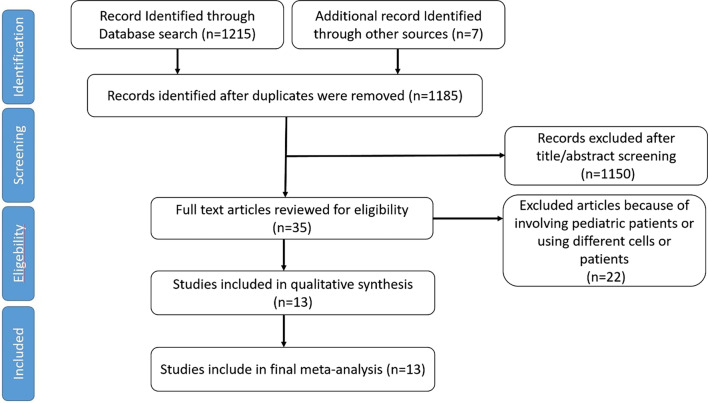
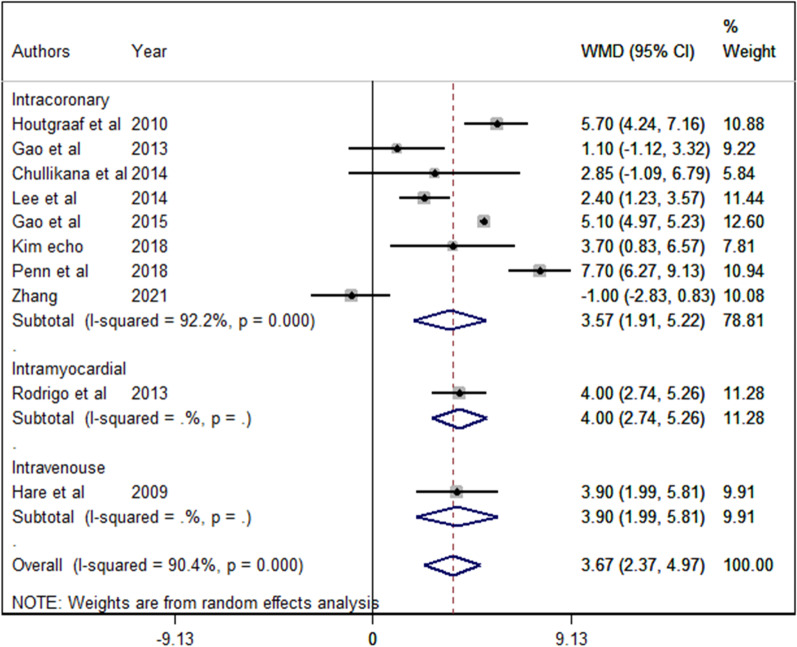
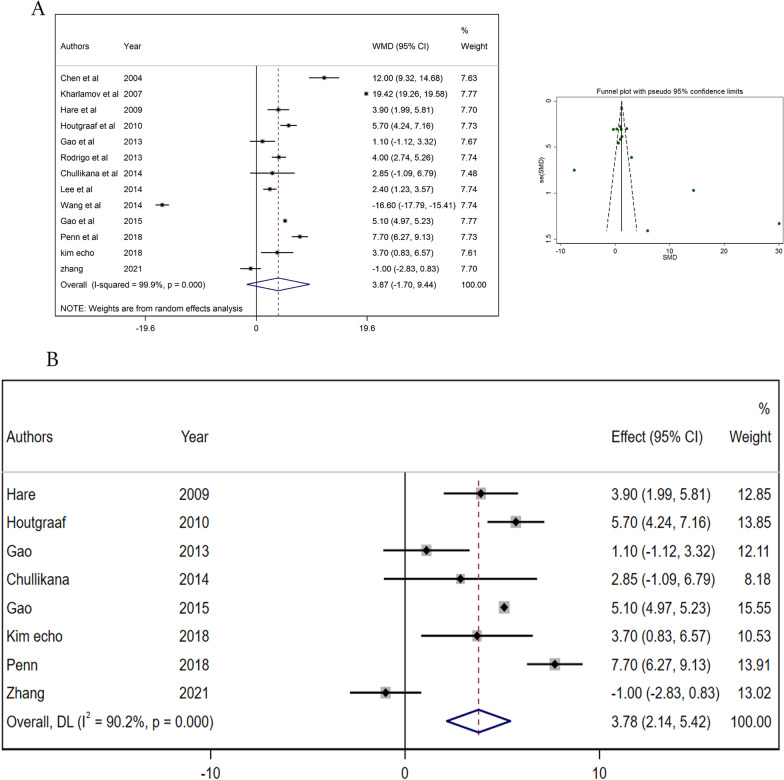
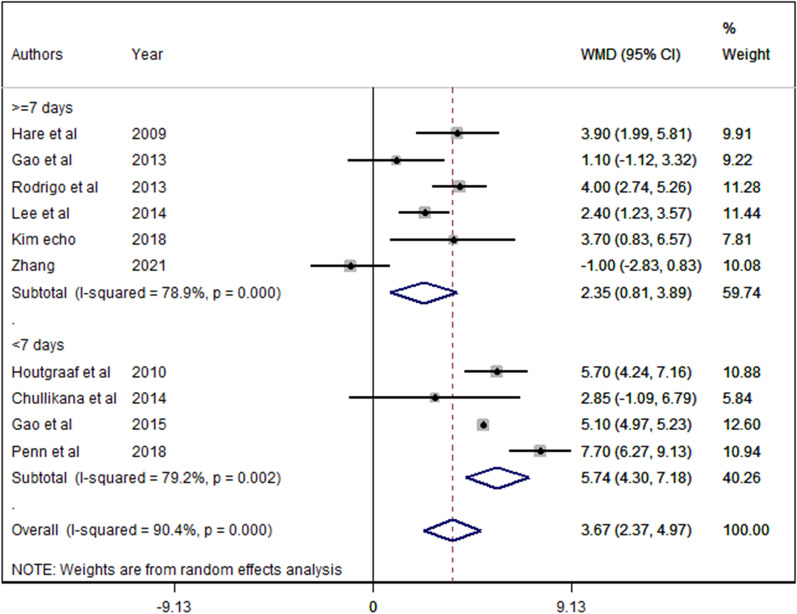
Thirteen trials including 956 patients (468 and 488 in the intervention and control arms) were enrolled. After excluding the biased data, LVEF was significantly increased compared to the baseline among those who received MSC (WMD = 3.78%, 95% CI: 2.14 to 5.42, p < 0.001, I = 90.2%) with more pronounced effect if the transplantation occurred within the first week after AMI (MD = 5.74%, 95%CI: 4.297 to 7.183; I = 79.2% p < 0.001). The efficacy of trans-endocardial injection was similar to that of intracoronary infusion (4% [95%CI: 2.741 to 5.259, p < 0.001] vs. 3.565% [95%CI: 1.912 to 5.218, p < 0.001], respectively). MSC doses of lower and higher than 10 cells did not improve LVEF differently (5.24% [95%CI: 2.06 to 8.82, p = 0.001] vs. 3.19% [95%CI: 0.17 to 6.12, p = 0.04], respectively).
Transplantation of MSCs after AMI significantly increases LVEF, showing a higher efficacy if done in the first week. Further clinical studies should be conducted to investigate long-term clinical outcomes such as heart failure and cardiovascular mortality.
临床试验表明,间充质干细胞(MSCs)移植可增加急性心肌梗死(AMI)后的射血分数(LVEF),但这一结论存在争议。本研究旨在评估 AMI 后 MSCs 移植对改善心肌功能指标或临床结局的作用。
我们纳入了评估 AMI 后 MSCs 移植的随机对照试验。主要结局为 LVEF 变化。我们还评估了细胞来源、细胞数量、AMI 后移植时间间隔和细胞输送途径对主要结局的影响。
纳入了 13 项临床试验,共 956 例患者(干预组和对照组分别为 468 例和 488 例)。排除偏倚数据后,与基线相比,接受 MSCs 治疗的患者 LVEF 显著增加(WMD=3.78%,95%CI:2.14 至 5.42,p<0.001,I²=90.2%),如果在 AMI 后第一周内进行移植,效果更为明显(MD=5.74%,95%CI:4.297 至 7.183;I²=79.2%,p<0.001)。心内膜内注射与冠状动脉内输注的疗效相似(4%[95%CI:2.741 至 5.259,p<0.001] vs. 3.565%[95%CI:1.912 至 5.218,p<0.001])。细胞剂量低于或高于 10 个细胞对 LVEF 的改善作用没有差异(5.24%[95%CI:2.06 至 8.82,p=0.001] vs. 3.19%[95%CI:0.17 至 6.12,p=0.04])。
AMI 后 MSCs 移植可显著提高 LVEF,AMI 后第一周内移植效果更佳。应开展进一步的临床研究,以评估长期临床结局,如心力衰竭和心血管死亡率。