• 文献检索
  • 文档翻译
  • 深度研究
  • 学术资讯
  • Suppr Zotero 插件Zotero 插件
  • 邀请有礼
  • 套餐&价格
  • 历史记录
应用&插件
Suppr Zotero 插件Zotero 插件浏览器插件Mac 客户端Windows 客户端微信小程序
定价
高级版会员购买积分包购买API积分包
服务
文献检索文档翻译深度研究API 文档MCP 服务
关于我们
关于 Suppr公司介绍联系我们用户协议隐私条款
关注我们

Suppr 超能文献

核心技术专利:CN118964589B侵权必究
粤ICP备2023148730 号-1Suppr @ 2026

文献检索

告别复杂PubMed语法,用中文像聊天一样搜索,搜遍4000万医学文献。AI智能推荐,让科研检索更轻松。

立即免费搜索

文件翻译

保留排版,准确专业,支持PDF/Word/PPT等文件格式,支持 12+语言互译。

免费翻译文档

深度研究

AI帮你快速写综述,25分钟生成高质量综述,智能提取关键信息,辅助科研写作。

立即免费体验

新型可穿戴技术的连续无创远程自动血压监测:初步验证研究。

Continuous Noninvasive Remote Automated Blood Pressure Monitoring With Novel Wearable Technology: A Preliminary Validation Study.

机构信息

School of Nursing, McMaster University, Hamilton, ON, Canada.

Population Health Research Institute, Hamilton, ON, Canada.

出版信息

JMIR Mhealth Uhealth. 2022 Feb 28;10(2):e24916. doi: 10.2196/24916.

DOI:10.2196/24916
PMID:34876396
原文链接:https://pmc.ncbi.nlm.nih.gov/articles/PMC8922156/
Abstract

BACKGROUND

Wearable continuous monitoring biosensor technologies have the potential to transform postoperative care with early detection of impending clinical deterioration.

OBJECTIVE

Our aim was to validate the accuracy of Cloud DX Vitaliti continuous vital signs monitor (CVSM) continuous noninvasive blood pressure (cNIBP) measurements in postsurgical patients. A secondary aim was to examine user acceptance of the Vitaliti CVSM with respect to comfort, ease of application, sustainability of positioning, and aesthetics.

METHODS

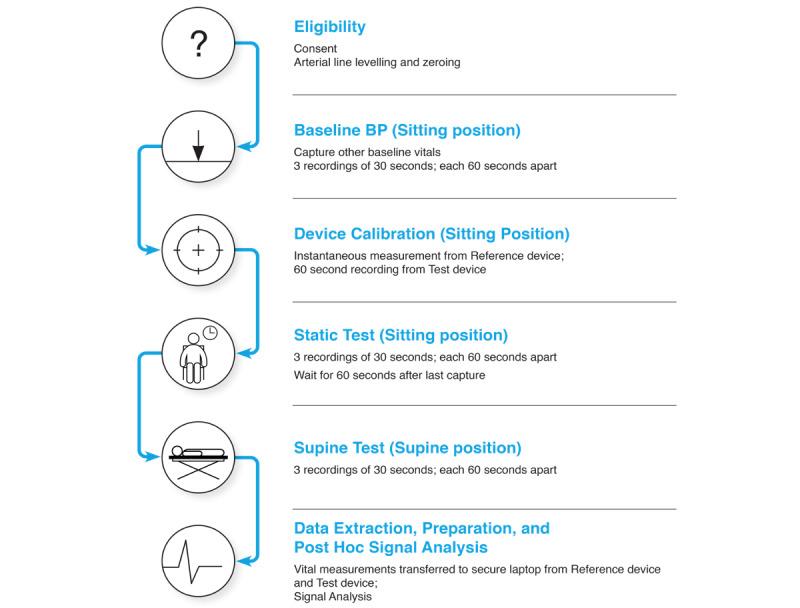
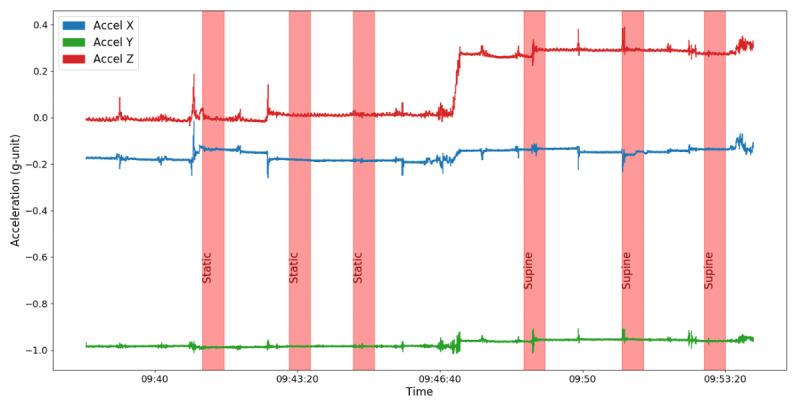
Included participants were ≥18 years old and recovering from surgery in a cardiac intensive care unit (ICU). We targeted a maximum recruitment of 80 participants for verification and acceptance testing. We also oversampled to minimize the effect of unforeseen interruptions and other challenges to the study. Validation procedures were according to the International Standards Organization (ISO) 81060-2:2018 standards for wearable, cuffless blood pressure (BP) measuring devices. Baseline BP was determined from the gold-standard ICU arterial catheter. The Vitaliti CVSM was calibrated against the reference arterial catheter. In static (seated in bed) and supine positions, 3 cNIBP measurements, each 30 seconds, were taken for each patient with the Vitaliti CVSM and an invasive arterial catheter. At the conclusion of each test session, captured cNIBP measurements were extracted using MediCollector BEDSIDE data extraction software, and Vitaliti CVSM measurements were extracted to a secure laptop through a cable connection. The errors of these determinations were calculated. Participants were interviewed about device acceptability.

RESULTS

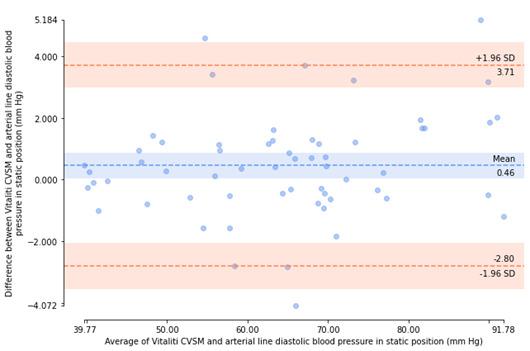
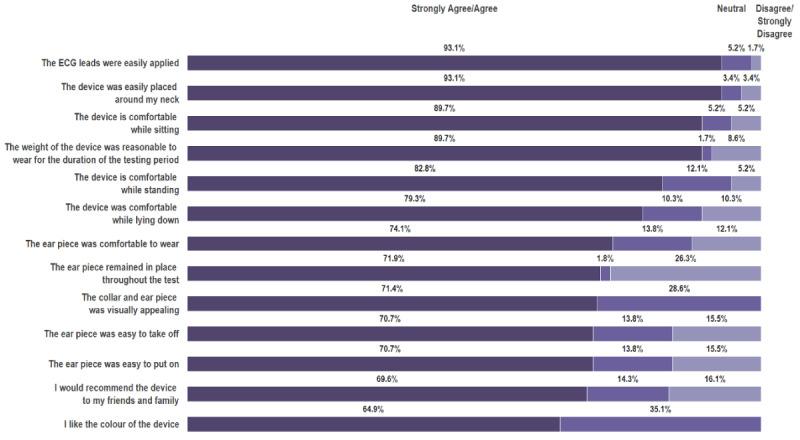
The validation analysis included data for 20 patients. The average times from calibration to first measurement in the static position and to first measurement in the supine position were 133.85 seconds (2 minutes 14 seconds) and 535.15 seconds (8 minutes 55 seconds), respectively. The overall mean errors of determination for the static position were -0.621 (SD 4.640) mm Hg for systolic blood pressure (SBP) and 0.457 (SD 1.675) mm Hg for diastolic blood pressure (DBP). Errors of determination were slightly higher for the supine position, at 2.722 (SD 5.207) mm Hg for SBP and 2.650 (SD 3.221) mm Hg for DBP. The majority rated the Vitaliti CVSM as comfortable. This study was limited to evaluation of the device during a very short validation period after calibration (ie, that commenced within 2 minutes after calibration and lasted for a short duration of time).

CONCLUSIONS

We found that the Cloud DX's Vitaliti CVSM demonstrated cNIBP measurement in compliance with ISO 81060-2:2018 standards in the context of evaluation that commenced within 2 minutes of device calibration; this device was also well-received by patients in a postsurgical ICU setting. Future studies will examine the accuracy of the Vitaliti CVSM in ambulatory contexts, with attention to assessment over a longer duration and the impact of excessive patient motion on data artifacts and signal quality.

TRIAL REGISTRATION

ClinicalTrials.gov NCT03493867; https://clinicaltrials.gov/ct2/show/NCT03493867.

摘要

背景

可穿戴式连续监测生物传感器技术有可能通过早期发现即将发生的临床恶化来改变术后护理。

目的

我们旨在验证 Cloud DX Vitaliti 连续生命体征监测仪(CVSM)连续无创血压(cNIBP)测量在术后患者中的准确性。次要目的是检查 Vitaliti CVSM 的用户接受度,包括舒适度、易用性、定位的可持续性和美观度。

方法

纳入标准为年龄≥18 岁且正在心脏重症监护病房(ICU)接受手术恢复的患者。我们的目标是最多招募 80 名参与者进行验证和接受性测试。我们还进行了超额采样,以最大限度地减少研究中不可预见的中断和其他挑战的影响。验证程序符合国际标准化组织(ISO)81060-2:2018 标准,用于可穿戴式、无袖带血压(BP)测量设备。基线 BP 由金标准 ICU 动脉导管确定。Vitaliti CVSM 与参考动脉导管进行校准。在静态(卧床时坐立)和仰卧位,对每位患者使用 Vitaliti CVSM 和侵入性动脉导管进行 3 次 cNIBP 测量,每次 30 秒。在每个测试会话结束时,使用 MediCollector BEDSIDE 数据提取软件提取捕获的 cNIBP 测量值,并通过电缆连接将 Vitaliti CVSM 测量值提取到安全的笔记本电脑上。计算这些测定的误差。对患者进行了有关设备可接受性的访谈。

结果

验证分析包括 20 名患者的数据。从校准到静态位置的第一次测量和到仰卧位的第一次测量的平均时间分别为 133.85 秒(2 分钟 14 秒)和 535.15 秒(8 分钟 55 秒)。静态位置的总体平均误差为收缩压(SBP)为-0.621(SD 4.640)mmHg,舒张压(DBP)为 0.457(SD 1.675)mmHg。仰卧位的误差稍高,SBP 为 2.722(SD 5.207)mmHg,DBP 为 2.650(SD 3.221)mmHg。大多数人认为 Vitaliti CVSM 很舒适。这项研究仅限于在设备校准后非常短的验证期内(即在校准后 2 分钟内开始,持续很短时间)评估设备。

结论

我们发现,在评估开始后 2 分钟内进行的 Cloud DX 的 Vitaliti CVSM 符合 ISO 81060-2:2018 标准,测量连续无创血压(cNIBP);该设备也在术后 ICU 环境中受到患者的好评。未来的研究将检查 Vitaliti CVSM 在动态环境中的准确性,注意评估时间的延长,以及患者过度运动对数据伪影和信号质量的影响。

试验注册

ClinicalTrials.gov NCT03493867;https://clinicaltrials.gov/ct2/show/NCT03493867.
https://cdn.ncbi.nlm.nih.gov/pmc/blobs/b859/8922156/77e39fdea011/mhealth_v10i2e24916_fig9.jpg
https://cdn.ncbi.nlm.nih.gov/pmc/blobs/b859/8922156/0440eeeb90f6/mhealth_v10i2e24916_fig1.jpg
https://cdn.ncbi.nlm.nih.gov/pmc/blobs/b859/8922156/42c91469423c/mhealth_v10i2e24916_fig2.jpg
https://cdn.ncbi.nlm.nih.gov/pmc/blobs/b859/8922156/2f16c162c7a4/mhealth_v10i2e24916_fig3.jpg
https://cdn.ncbi.nlm.nih.gov/pmc/blobs/b859/8922156/5b306806c680/mhealth_v10i2e24916_fig4.jpg
https://cdn.ncbi.nlm.nih.gov/pmc/blobs/b859/8922156/e1588c23b5ac/mhealth_v10i2e24916_fig5.jpg
https://cdn.ncbi.nlm.nih.gov/pmc/blobs/b859/8922156/111f57bf762c/mhealth_v10i2e24916_fig6.jpg
https://cdn.ncbi.nlm.nih.gov/pmc/blobs/b859/8922156/a28331ee616c/mhealth_v10i2e24916_fig7.jpg
https://cdn.ncbi.nlm.nih.gov/pmc/blobs/b859/8922156/f4de398d7ec7/mhealth_v10i2e24916_fig8.jpg
https://cdn.ncbi.nlm.nih.gov/pmc/blobs/b859/8922156/77e39fdea011/mhealth_v10i2e24916_fig9.jpg
https://cdn.ncbi.nlm.nih.gov/pmc/blobs/b859/8922156/0440eeeb90f6/mhealth_v10i2e24916_fig1.jpg
https://cdn.ncbi.nlm.nih.gov/pmc/blobs/b859/8922156/42c91469423c/mhealth_v10i2e24916_fig2.jpg
https://cdn.ncbi.nlm.nih.gov/pmc/blobs/b859/8922156/2f16c162c7a4/mhealth_v10i2e24916_fig3.jpg
https://cdn.ncbi.nlm.nih.gov/pmc/blobs/b859/8922156/5b306806c680/mhealth_v10i2e24916_fig4.jpg
https://cdn.ncbi.nlm.nih.gov/pmc/blobs/b859/8922156/e1588c23b5ac/mhealth_v10i2e24916_fig5.jpg
https://cdn.ncbi.nlm.nih.gov/pmc/blobs/b859/8922156/111f57bf762c/mhealth_v10i2e24916_fig6.jpg
https://cdn.ncbi.nlm.nih.gov/pmc/blobs/b859/8922156/a28331ee616c/mhealth_v10i2e24916_fig7.jpg
https://cdn.ncbi.nlm.nih.gov/pmc/blobs/b859/8922156/f4de398d7ec7/mhealth_v10i2e24916_fig8.jpg
https://cdn.ncbi.nlm.nih.gov/pmc/blobs/b859/8922156/77e39fdea011/mhealth_v10i2e24916_fig9.jpg

相似文献

1
Continuous Noninvasive Remote Automated Blood Pressure Monitoring With Novel Wearable Technology: A Preliminary Validation Study.新型可穿戴技术的连续无创远程自动血压监测:初步验证研究。
JMIR Mhealth Uhealth. 2022 Feb 28;10(2):e24916. doi: 10.2196/24916.
2
Validation and Acceptability of a Cuffless Wrist-Worn Wearable Blood Pressure Monitoring Device Among Users and Health Care Professionals: Mixed Methods Study. cuffless 腕带式可穿戴血压监测设备在用户和医疗保健专业人员中的验证和可接受性:混合方法研究。
JMIR Mhealth Uhealth. 2019 Sep 14;7(10):e14706. doi: 10.2196/14706.
3
Accuracy of Vital Signs Measurements by a Smartwatch and a Portable Health Device: Validation Study.智能手表和平板健康设备测量生命体征的准确性:验证研究。
JMIR Mhealth Uhealth. 2020 Feb 12;8(2):e16811. doi: 10.2196/16811.
4
A Comparison and Calibration of a Wrist-Worn Blood Pressure Monitor for Patient Management: Assessing the Reliability of Innovative Blood Pressure Devices.用于患者管理的腕式血压监测仪的比较与校准:评估创新血压设备的可靠性
J Med Internet Res. 2018 Apr 25;20(4):e111. doi: 10.2196/jmir.8009.
5
Remote Blood Pressure Monitoring With a Wearable Photoplethysmographic Device (Senbiosys): Protocol for a Single-Center Prospective Clinical Trial.使用可穿戴光电容积脉搏波描记设备(Senbiosys)进行远程血压监测:单中心前瞻性临床试验方案。
JMIR Res Protoc. 2021 Oct 7;10(10):e30051. doi: 10.2196/30051.
6
The CNAP™ Finger Cuff for Noninvasive Beat-To-Beat Monitoring of Arterial Blood Pressure: An Evaluation in Intensive Care Unit Patients and a Comparison with 2 Intermittent Devices.用于无创逐搏动脉血压监测的CNAP™指套袖带:在重症监护病房患者中的评估及与两种间歇式设备的比较
Anesth Analg. 2016 Nov;123(5):1126-1135. doi: 10.1213/ANE.0000000000001324.
7
Blood Pressure Measurement Based on the Camera and Inertial Measurement Unit of a Smartphone: Instrument Validation Study.基于智能手机摄像头和惯性测量单元的血压测量:仪器验证研究。
JMIR Mhealth Uhealth. 2023 Sep 8;11:e44147. doi: 10.2196/44147.
8
Wearable wireless continuous vital signs monitoring on the general ward.普通病房的可穿戴无线连续生命体征监测。
Curr Opin Crit Care. 2024 Jun 1;30(3):275-282. doi: 10.1097/MCC.0000000000001160. Epub 2024 Apr 5.
9
Enabling Wearable Pulse Transit Time-Based Blood Pressure Estimation for Medically Underserved Areas and Health Equity: Comprehensive Evaluation Study.实现可穿戴脉搏传播时间法血压估算在医疗资源匮乏地区和健康公平中的应用:全面评估研究。
JMIR Mhealth Uhealth. 2021 Aug 2;9(8):e27466. doi: 10.2196/27466.
10
ChroniSense National Early Warning Score Study: Comparison Study of a Wearable Wrist Device to Measure Vital Signs in Patients Who Are Hospitalized.ChroniSense 全国预警评分研究:可穿戴腕带设备测量住院患者生命体征的比较研究。
J Med Internet Res. 2023 Feb 6;25:e40226. doi: 10.2196/40226.

引用本文的文献

1
- xed Reality Interface for Monitoring: A HoloLens based prototype for healthcare practices.用于监测的混合现实接口:一种基于HoloLens的医疗保健实践原型。
Comput Struct Biotechnol J. 2024 Mar 1;24:160-175. doi: 10.1016/j.csbj.2024.02.024. eCollection 2024 Dec.
2
Human Factors, Human-Centered Design, and Usability of Sensor-Based Digital Health Technologies: Scoping Review.基于传感器的数字健康技术的人因工程、以人为中心的设计和可用性:范围综述。
J Med Internet Res. 2024 Nov 15;26:e57628. doi: 10.2196/57628.
3
A prototype photoplethysmography-based cuffless device shows promising results in tracking changes in blood pressure.

本文引用的文献

1
Challenges With Continuous Pulse Oximetry Monitoring and Wireless Clinician Notification Systems After Surgery: Reactive Analysis of a Randomized Controlled Trial.术后连续脉搏血氧饱和度监测及无线临床医生通知系统面临的挑战:一项随机对照试验的反应性分析
JMIR Med Inform. 2019 Oct 28;7(4):e14603. doi: 10.2196/14603.
2
Current concepts of perioperative monitoring in high-risk surgical patients: a review.高危手术患者围手术期监测的当前概念:综述
Patient Saf Surg. 2019 Oct 23;13:32. doi: 10.1186/s13037-019-0213-5. eCollection 2019.
3
Reliability of a wearable wireless patch for continuous remote monitoring of vital signs in patients recovering from major surgery: a clinical validation study from the TRaCINg trial.
一种基于光电容积脉搏波描记法的无袖带原型设备在追踪血压变化方面显示出了有前景的结果。
Front Med Technol. 2024 Oct 21;6:1464473. doi: 10.3389/fmedt.2024.1464473. eCollection 2024.
4
Wearable Blood Pressure Monitoring Devices: Understanding Heterogeneity in Design and Evaluation.可穿戴血压监测设备:了解设计与评估中的异质性
IEEE Trans Biomed Eng. 2024 Dec;71(12):3569-3592. doi: 10.1109/TBME.2024.3434344. Epub 2024 Nov 21.
5
Accuracy of non-invasive cuffless blood pressure in the intensive care unit: Promises and challenges.重症监护病房中无创无袖带血压测量的准确性:前景与挑战。
Front Med (Lausanne). 2023 Apr 17;10:1154041. doi: 10.3389/fmed.2023.1154041. eCollection 2023.
用于大手术后康复患者生命体征连续远程监测的可穿戴无线贴片的可靠性:来自TRaCINg试验的一项临床验证研究
BMJ Open. 2019 Aug 15;9(8):e031150. doi: 10.1136/bmjopen-2019-031150.
4
Automated continuous noninvasive ward monitoring: future directions and challenges.自动化连续式非侵入性病房监测:未来方向与挑战。
Crit Care. 2019 May 30;23(1):194. doi: 10.1186/s13054-019-2485-7.
5
Incidence, Severity, and Detection of Blood Pressure Perturbations after Abdominal Surgery: A Prospective Blinded Observational Study.腹部手术后血压波动的发生率、严重程度和检测:一项前瞻性盲法观察研究。
Anesthesiology. 2019 Apr;130(4):550-559. doi: 10.1097/ALN.0000000000002626.
6
Beyond 'failure to rescue': the time has come for continuous ward monitoring.超越“未能挽救”:持续病房监测的时代已经到来。
Br J Anaesth. 2019 Mar;122(3):304-306. doi: 10.1016/j.bja.2018.12.003. Epub 2019 Jan 3.
7
Wearable sensors to improve detection of patient deterioration.可穿戴传感器提高患者病情恶化检测率。
Expert Rev Med Devices. 2019 Feb;16(2):145-154. doi: 10.1080/17434440.2019.1563480. Epub 2019 Jan 6.
8
Postoperative Remote Automated Monitoring: Need for and State of the Science.术后远程自动化监测:必要性和科学现状。
Can J Cardiol. 2018 Jul;34(7):850-862. doi: 10.1016/j.cjca.2018.04.021. Epub 2018 Apr 25.
9
Techniques for Non-Invasive Monitoring of Arterial Blood Pressure.无创动脉血压监测技术
Front Med (Lausanne). 2018 Jan 8;4:231. doi: 10.3389/fmed.2017.00231. eCollection 2017.
10
Continuous Monitoring of Vital Signs Using Wearable Devices on the General Ward: Pilot Study.在普通病房使用可穿戴设备持续监测生命体征:初步研究。
JMIR Mhealth Uhealth. 2017 Jul 5;5(7):e91. doi: 10.2196/mhealth.7208.