Harsha Prathiba, Paul James E, Chong Matthew A, Buckley Norm, Tidy Antonella, Clarke Anne, Buckley Diane, Sirko Zenon, Vanniyasingam Thuva, Walsh Jake, McGillion Michael, Thabane Lehana
Health Research Methods, Evidence and Impact, McMaster University, Hamilton, ON, Canada.
Department of Anesthesia, McMaster University, Hamilton, ON, Canada.
JMIR Med Inform. 2019 Oct 28;7(4):e14603. doi: 10.2196/14603.
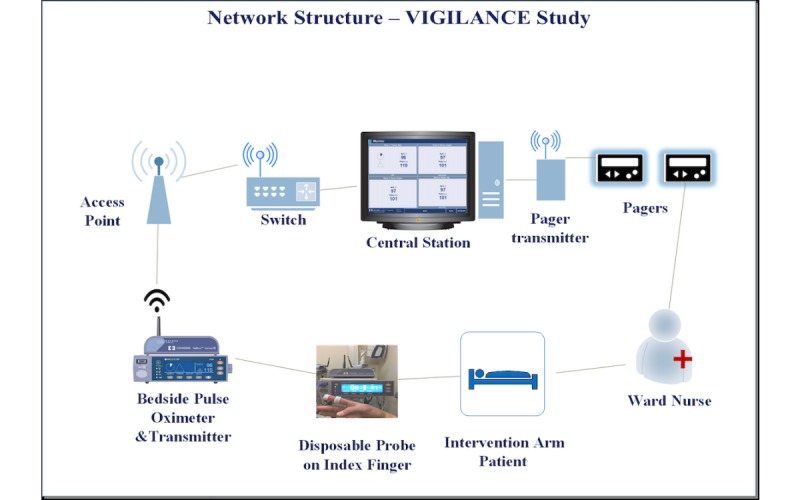
Research has shown that introducing electronic Health (eHealth) patient monitoring interventions can improve healthcare efficiency and clinical outcomes. The VIGILANCE (VItal siGns monItoring with continuous puLse oximetry And wireless cliNiCian notification aftEr surgery) study was a randomized controlled trial (n=2049) designed to assess the impact of continuous vital sign monitoring with alerts sent to nursing staff when respiratory resuscitations with naloxone, code blues, and intensive care unit transfers occurred in a cohort of postsurgical patients in a ward setting. This report identifies and evaluates key issues and challenges associated with introducing wireless monitoring systems into complex hospital infrastructure during the VIGILANCE eHealth intervention implementation. Potential solutions and suggestions for future implementation research are presented.
The goals of this study were to: (1) identify issues related to the deployment of the eHealth intervention system of the VIGILANCE study; and (2) evaluate the influence of these issues on intervention adoption.
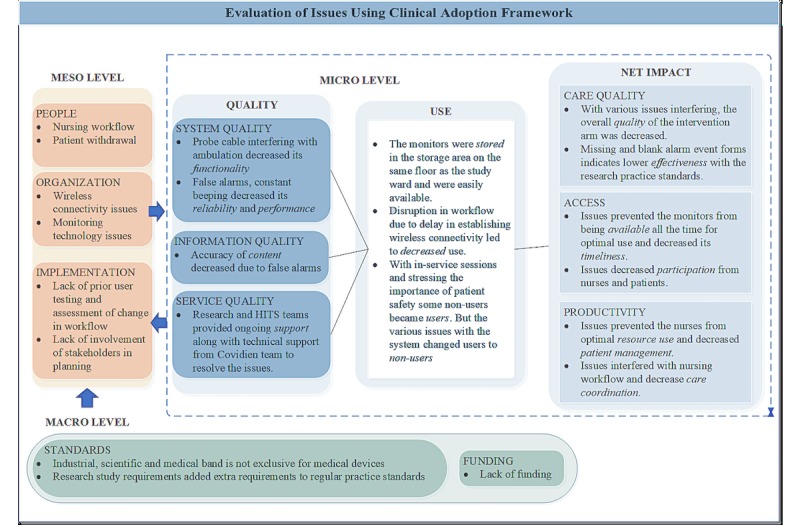
During the VIGILANCE study, issues affecting the implementation of the eHealth intervention were documented on case report forms, alarm event forms, and a nursing user feedback questionnaire. These data were collated by the research and nursing personnel and submitted to the research coordinator. In this evaluation report, the clinical adoption framework was used as a guide to organize the identified issues and evaluate their impact.
Using the clinical adoption framework, we identified issues within the framework dimensions of people, organization, and implementation at the meso level, as well as standards and funding issues at the macro level. Key issues included: nursing workflow changes with blank alarm forms (24/1030, 2.33%) and missing alarm forms (236/1030, 22.91%), patient withdrawal (110/1030, 10.68%), wireless network connectivity, false alarms (318/1030, 30.87%), monitor malfunction (36/1030, 3.49%), probe issues (16/1030, 1.55%), and wireless network standards. At the micro level, these issues affected the quality of the service in terms of support provided, the quality of the information yielded by the monitors, and the functionality, reliability, and performance of the monitoring system. As a result, these issues impacted access through the decreased ability of nurses to make complete use of the monitors, impacted care quality of the trial intervention through decreased effectiveness, and impacted productivity through interference in the coordination of care, thus decreasing clinical adoption of the monitoring system.
Patient monitoring with eHealth technology in surgical wards has the potential to improve patient outcomes. However, proper planning that includes engagement of front-line nurses, installation of appropriate wireless network infrastructure, and use of comfortable cableless devices is required to maximize the potential of eHealth monitoring.
ClinicalTrials.gov NCT02907255; https://clinicaltrials.gov/ct2/show/NCT02907255.
研究表明,引入电子健康(eHealth)患者监测干预措施可提高医疗效率和临床疗效。VIGILANCE(术后通过连续脉搏血氧饱和度监测及无线临床医生通知进行生命体征监测)研究是一项随机对照试验(n = 2049),旨在评估在病房环境下,对一组术后患者进行连续生命体征监测,并在发生用纳洛酮进行呼吸复苏、蓝色急救事件及重症监护病房转运时向护理人员发送警报的影响。本报告识别并评估了在VIGILANCE eHealth干预实施过程中,将无线监测系统引入复杂医院基础设施所涉及的关键问题和挑战。并针对未来实施研究提出了潜在的解决方案和建议。
本研究的目标是:(1)识别与VIGILANCE研究的eHealth干预系统部署相关的问题;(2)评估这些问题对干预措施采用情况的影响。
在VIGILANCE研究期间,影响eHealth干预实施的问题记录在病例报告表、警报事件表及护理用户反馈问卷上。这些数据由研究人员和护理人员整理后提交给研究协调员。在本评估报告中,临床采用框架被用作指导,以组织识别出的问题并评估其影响。
利用临床采用框架,我们在中观层面的人员、组织和实施框架维度内识别出问题,以及宏观层面的标准和资金问题。关键问题包括:护理工作流程因空白警报表(24/1030,2.33%)和缺失警报表(236/1030,22.91%)而改变、患者退出(110/1030,10.68%)、无线网络连接、误报(318/1030,30.87%)、监测器故障(36/1030,3.49%)、探头问题(16/1030,1.55%)以及无线网络标准。在微观层面,这些问题在提供的支持、监测器产生的信息质量以及监测系统的功能、可靠性和性能方面影响了服务质量。因此,这些问题通过降低护士充分使用监测器的能力影响了获取途径,通过降低有效性影响了试验干预的护理质量,并通过干扰护理协调影响了生产力,从而降低了监测系统的临床采用率。
外科病房采用eHealth技术进行患者监测有改善患者预后的潜力。然而,需要进行适当规划,包括让一线护士参与、安装合适的无线网络基础设施以及使用舒适的无线设备,以最大限度发挥eHealth监测的潜力。
ClinicalTrials.gov NCT02907255;https://clinicaltrials.gov/ct2/show/NCT02907255