Translational Research Institute of Brain and Brain-Like Intelligence, Shanghai Fourth People's Hospital, School of Medicine, Tongji University, Shanghai, 200434, China.
Department of Anatomy, Histology and Embryology, School of Medicine, Tongji University, Shanghai, 200092, China.
Nat Commun. 2021 Dec 7;12(1):7093. doi: 10.1038/s41467-021-27419-w.
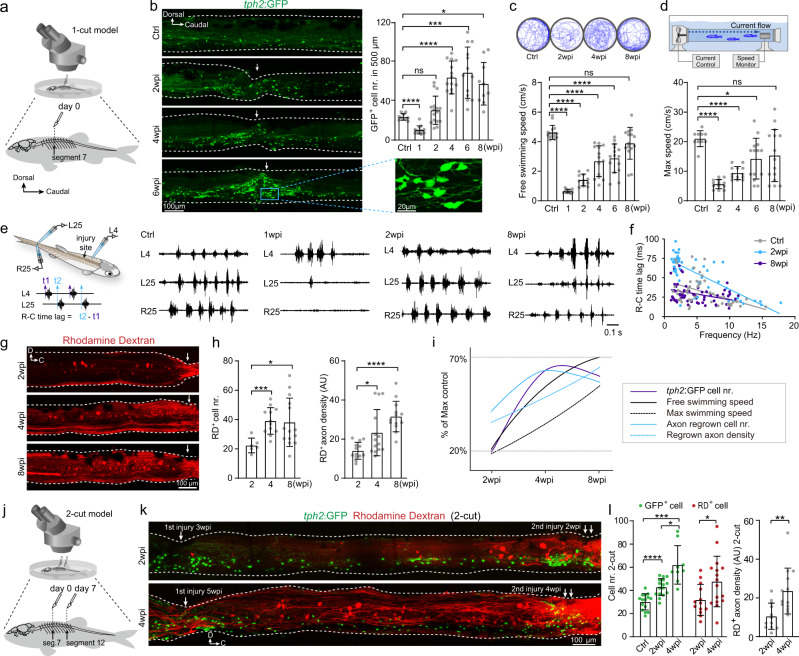
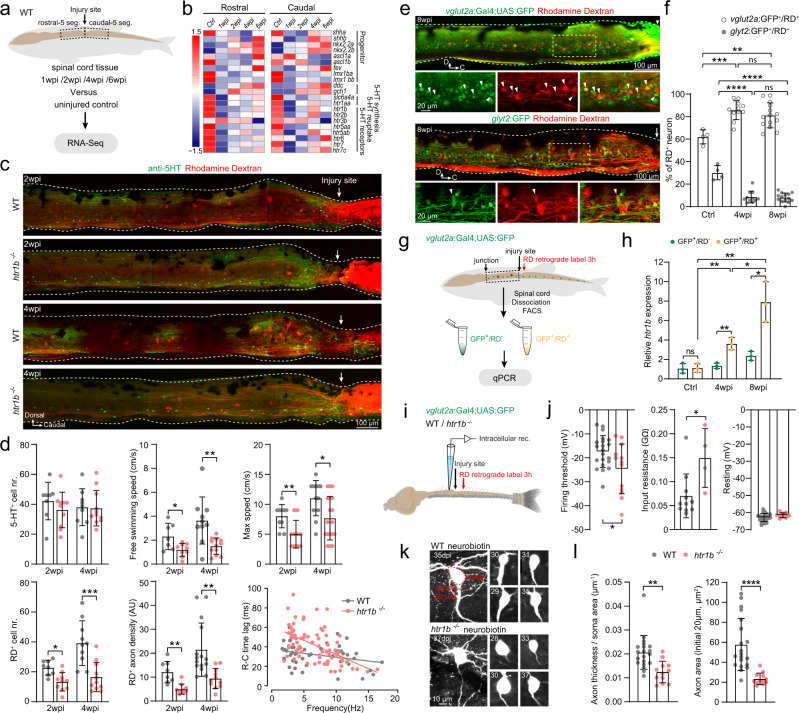
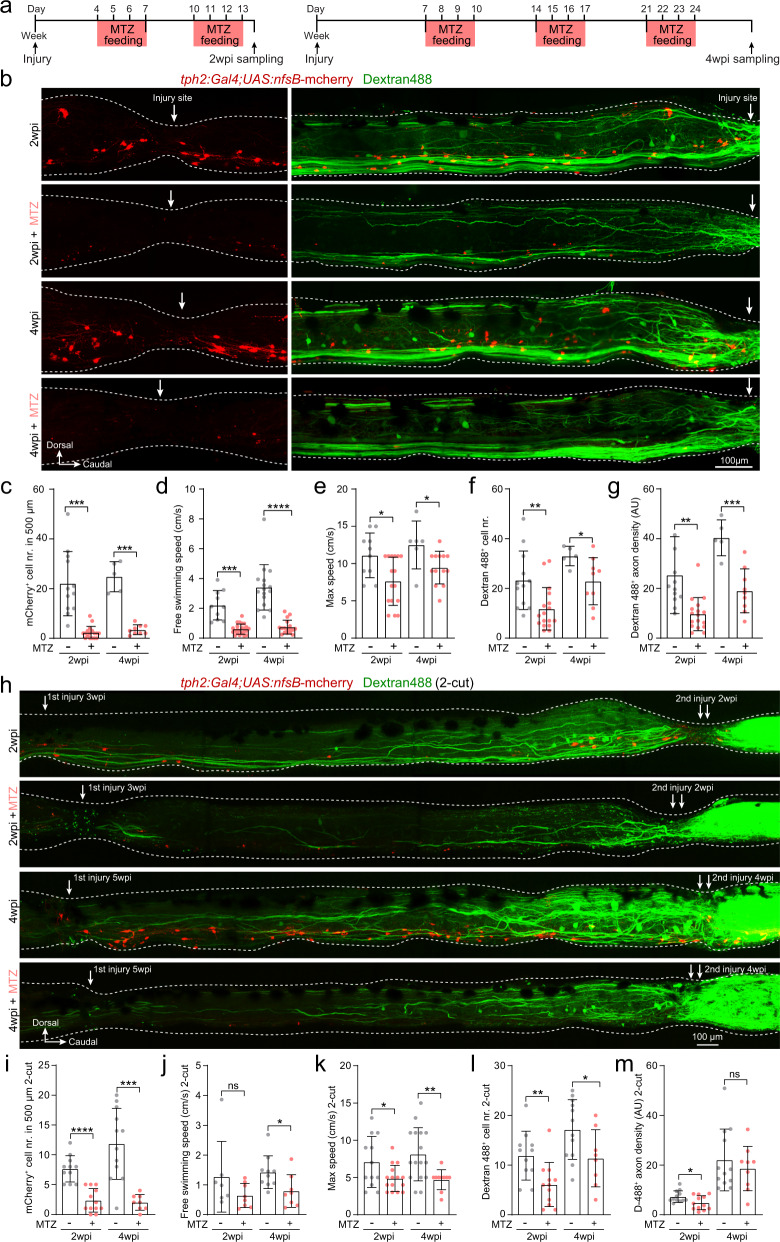
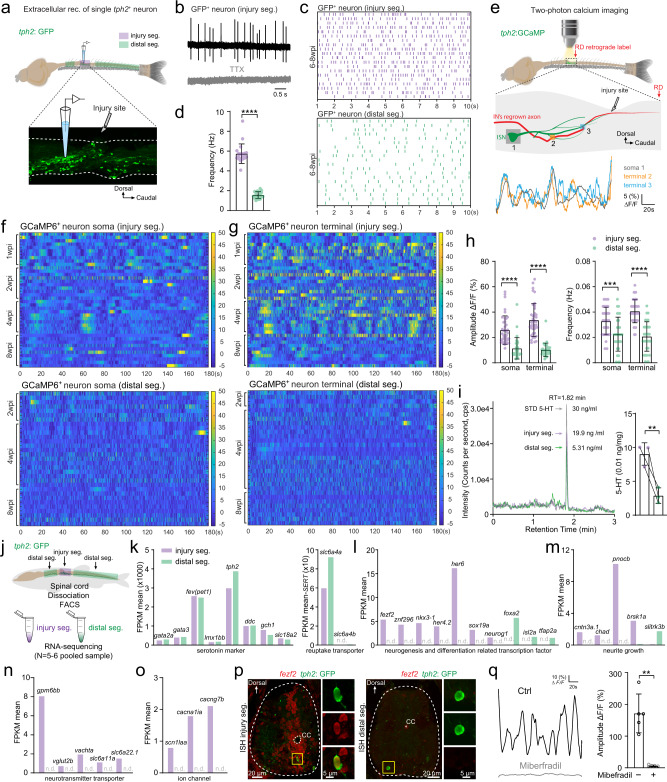
Spinal cord injury (SCI) interrupts long-projecting descending spinal neurons and disrupts the spinal central pattern generator (CPG) that controls locomotion. The intrinsic mechanisms underlying re-wiring of spinal neural circuits and recovery of locomotion after SCI are unclear. Zebrafish shows axonal regeneration and functional recovery after SCI making it a robust model to study mechanisms of regeneration. Here, we use a two-cut SCI model to investigate whether recovery of locomotion can occur independently of supraspinal connections. Using this injury model, we show that injury induces the localization of a specialized group of intraspinal serotonergic neurons (ISNs), with distinctive molecular and cellular properties, at the injury site. This subpopulation of ISNs have hyperactive terminal varicosities constantly releasing serotonin activating 5-HT receptors, resulting in axonal regrowth of spinal interneurons. Axon regrowth of excitatory interneurons is more pronounced compared to inhibitory interneurons. Knock-out of htr1b prevents axon regrowth of spinal excitatory interneurons, negatively affecting coordination of rostral-caudal body movements and restoration of locomotor function. On the other hand, treatment with 5-HT receptor agonizts promotes functional recovery following SCI. In summary, our data show an intraspinal mechanism where a subpopulation of ISNs stimulates axonal regrowth resulting in improved recovery of locomotor functions following SCI in zebrafish.
脊髓损伤 (SCI) 中断了长投射的下行脊髓神经元,并破坏了控制运动的脊髓中枢模式发生器 (CPG)。SCI 后脊髓神经回路重新布线和运动功能恢复的内在机制尚不清楚。斑马鱼在 SCI 后表现出轴突再生和功能恢复,使其成为研究再生机制的强大模型。在这里,我们使用双切口 SCI 模型来研究运动功能的恢复是否可以独立于中枢神经系统的连接。使用这种损伤模型,我们表明损伤会诱导一组特殊的脊髓内 5-羟色胺能神经元 (ISN) 在损伤部位定位于损伤部位。这群 ISN 具有活跃的末梢膨体,持续释放 5-羟色胺激活 5-HT 受体,导致脊髓中间神经元的轴突再生。兴奋性中间神经元的轴突再生比抑制性中间神经元更为明显。htr1b 的敲除可防止脊髓兴奋性中间神经元的轴突再生,从而对头部到尾部身体运动的协调和运动功能的恢复产生负面影响。另一方面,5-HT 受体激动剂的治疗可促进 SCI 后的功能恢复。总之,我们的数据显示了一种脊髓内机制,其中一组 ISN 刺激轴突再生,从而改善了 SCI 后斑马鱼运动功能的恢复。