Malaria Immunology Group, ISGlobal, Hospital Clínic - Universitat de Barcelona, Barcelona, Spain.
Centro de Investigação em Saúde de Manhiça (CISM), Maputo, Mozambique.
Microbiol Spectr. 2021 Dec 22;9(3):e0110921. doi: 10.1128/Spectrum.01109-21. Epub 2021 Dec 8.
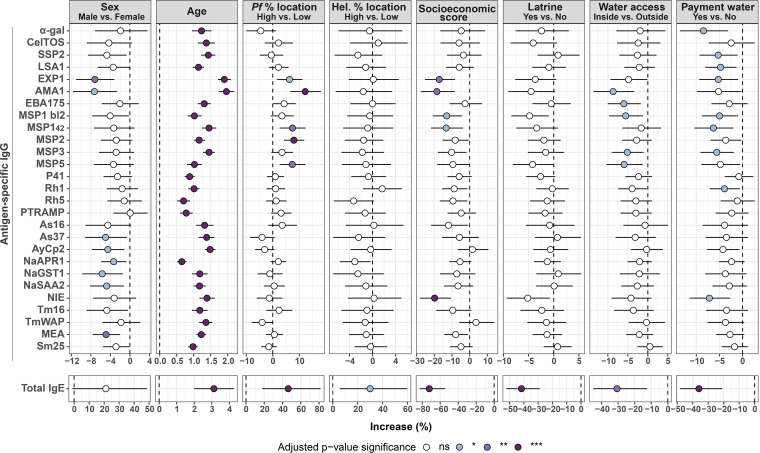
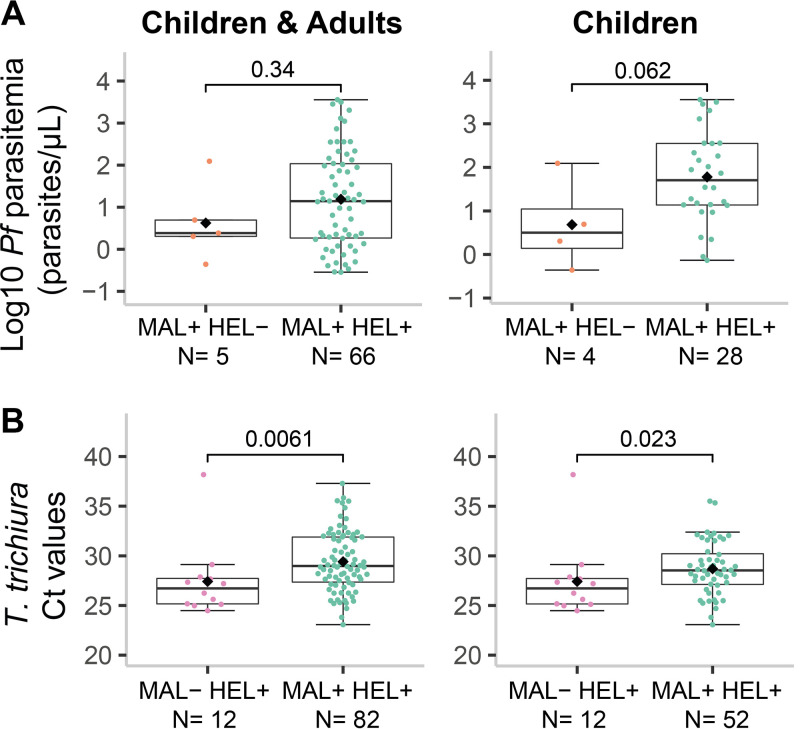
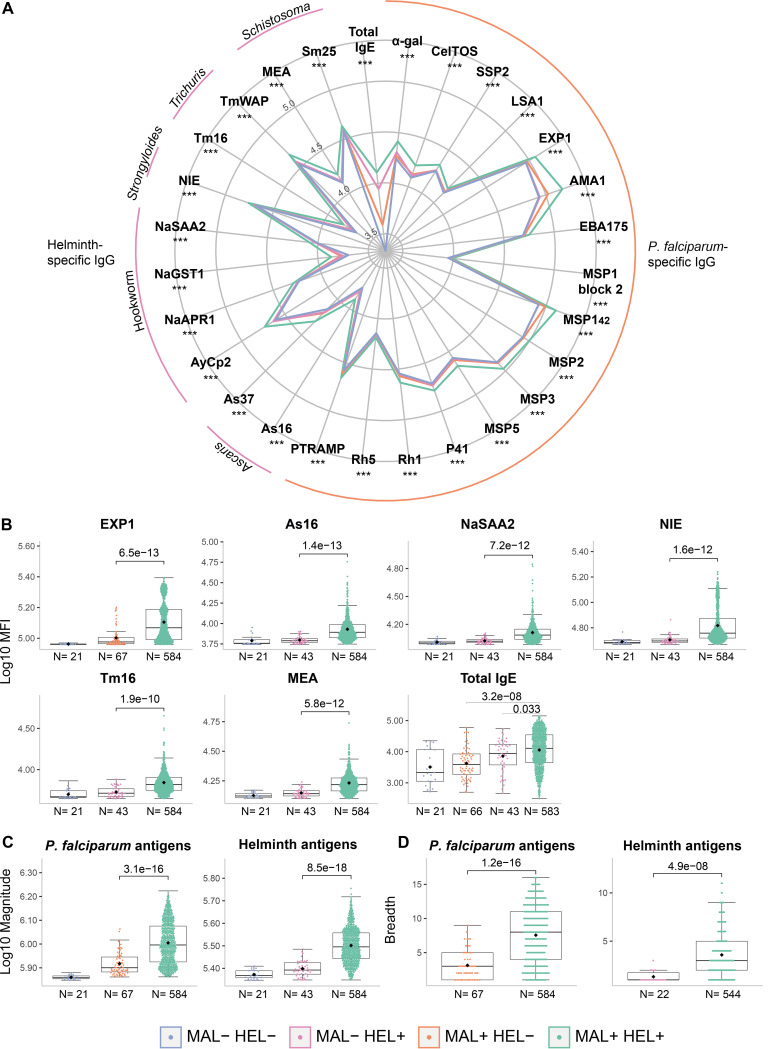
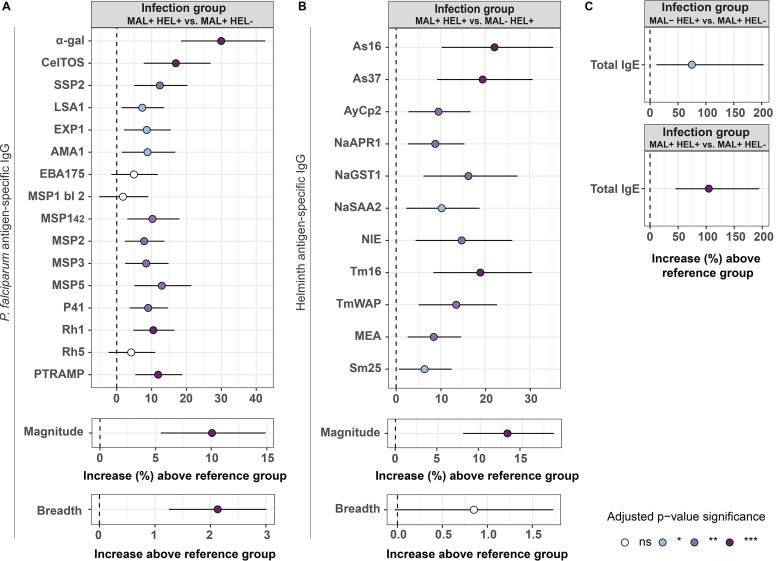
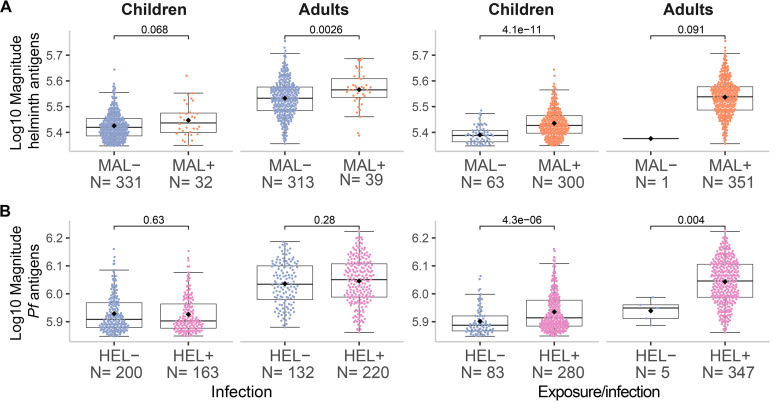
Coinfection with Plasmodium falciparum and helminths may impact the immune response to these parasites because they induce different immune profiles. We studied the effects of coinfections on the antibody profile in a cohort of 715 Mozambican children and adults using the Luminex technology with a panel of 16 antigens from P. falciparum and 11 antigens from helminths (, hookworm, Trichuris trichiura, Strongyloides stercoralis, and spp.) and measured antigen-specific IgG and total IgE responses. We compared the antibody profile between groups defined by P. falciparum and helminth previous exposure (based on serology) and/or current infection (determined by microscopy and/or qPCR). In multivariable regression models adjusted by demographic, socioeconomic, water, and sanitation variables, individuals exposed/infected with P. falciparum and helminths had significantly higher total IgE and antigen-specific IgG levels, magnitude (sum of all levels) and breadth of response to both types of parasites compared to individuals exposed/infected with only one type of parasite ( ≤ 0.05). There was a positive association between exposure/infection with P. falciparum and exposure/infection with helminths or the number of helminth species, and ( ≤ 0.001). In addition, children coexposed/coinfected tended ( = 0.062) to have higher P. falciparum parasitemia than those single exposed/infected. Our results suggest that an increase in the antibody responses in coexposed/coinfected individuals may reflect higher exposure and be due to a more permissive immune environment to infection in the host. Coinfection with Plasmodium falciparum and helminths may impact the immune response to these parasites because they induce different immune profiles. We compared the antibody profile between groups of Mozambican individuals defined by P. falciparum and helminth previous exposure and/or current infection. Our results show a significant increase in antibody responses in individuals coexposed/coinfected with P. falciparum and helminths in comparison with individuals exposed/infected with only one of these parasites, and suggest that this increase is due to a more permissive immune environment to infection in the host. Importantly, this study takes previous exposure into account, which is particularly relevant in endemic areas where continuous infections imprint and shape the immune system. Deciphering the implications of coinfections deserves attention because accounting for the real interactions that occur in nature could improve the design of integrated disease control strategies.
疟原虫和寄生虫的合并感染可能会影响宿主对这些寄生虫的免疫反应,因为它们会诱导不同的免疫特征。我们使用 Luminex 技术,对来自 715 名莫桑比克儿童和成人的样本进行了研究,该技术使用了来自疟原虫的 16 种抗原和寄生虫的 11 种抗原(钩虫、蛔虫、鞭虫、和 spp.)面板,测量了抗原特异性 IgG 和总 IgE 反应。我们比较了根据血清学定义的疟原虫和寄生虫先前暴露(基于血清学)和/或当前感染(通过显微镜和/或 qPCR 确定)组之间的抗体谱。在调整了人口统计学、社会经济、水和卫生变量的多变量回归模型中,与仅感染一种寄生虫的个体相比,感染疟原虫和寄生虫的个体的总 IgE 和抗原特异性 IgG 水平、对两种寄生虫的反应幅度(所有水平的总和)和广度均显著更高(≤0.05)。疟原虫和寄生虫的暴露/感染与暴露/感染或寄生虫种类的数量之间呈正相关(≤0.001)。此外,合并暴露/合并感染的儿童(=0.062)的疟原虫寄生虫血症水平往往高于单一暴露/感染的儿童。我们的结果表明,合并暴露/感染个体的抗体反应增加可能反映了更高的暴露程度,并且可能是由于宿主对感染的免疫环境更为宽容。在寄生虫流行地区,考虑到连续感染对免疫系统的印记和塑造作用,考虑先前暴露尤为重要。因此,解析合并感染的影响值得关注,因为考虑到自然发生的真实相互作用可能会改进综合疾病控制策略的设计。