Department of Anesthesiology, The Affiliated Hospital of Zunyi Medical University, Zunyi, 563000, Guizhou, China.
Yunnan Key Laboratory of Primate Biomedical Research, Institute of Primate Translational Medicine, Kunming University of Science and Technology, Kunming, 650504, Yunnan, China.
Exp Mol Med. 2021 Dec;53(12):1888-1901. doi: 10.1038/s12276-021-00714-8. Epub 2021 Dec 8.
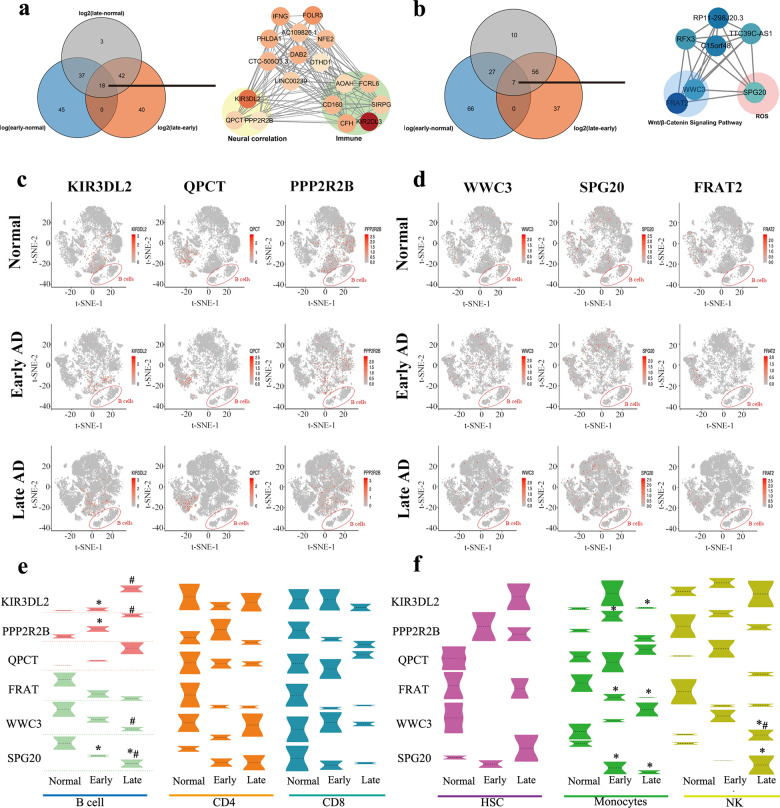
In recent years, biomarkers have been integrated into the diagnostic process and have become increasingly indispensable for obtaining knowledge of the neurodegenerative processes in Alzheimer's disease (AD). Peripheral blood mononuclear cells (PBMCs) in human blood have been reported to participate in a variety of neurodegenerative activities. Here, a single-cell RNA sequencing analysis of PBMCs from 4 AD patients (2 in the early stage, 2 in the late stage) and 2 normal controls was performed to explore the differential cell subpopulations in PBMCs of AD patients. A significant decrease in B cells was detected in the blood of AD patients. Furthermore, we further examined PBMCs from 43 AD patients and 41 normal subjects by fluorescence activated cell sorting (FACS), and combined with correlation analysis, we found that the reduction in B cells was closely correlated with the patients' Clinical Dementia Rating (CDR) scores. To confirm the role of B cells in AD progression, functional experiments were performed in early-stage AD mice in which fibrous plaques were beginning to appear; the results demonstrated that B cell depletion in the early stage of AD markedly accelerated and aggravated cognitive dysfunction and augmented the Aβ burden in AD mice. Importantly, the experiments revealed 18 genes that were specifically upregulated and 7 genes that were specifically downregulated in B cells as the disease progressed, and several of these genes exhibited close correlation with AD. These findings identified possible B cell-based AD severity, which are anticipated to be conducive to the clinical identification of AD progression.
近年来,生物标志物已被整合到诊断过程中,对于了解阿尔茨海默病(AD)的神经退行性过程变得越来越不可或缺。据报道,人类血液中的外周血单核细胞(PBMC)参与了多种神经退行性活动。在这里,对 4 名 AD 患者(2 名早期,2 名晚期)和 2 名正常对照者的 PBMC 进行了单细胞 RNA 测序分析,以探索 AD 患者 PBMC 中的差异细胞亚群。在 AD 患者的血液中检测到 B 细胞显著减少。此外,我们进一步通过荧光激活细胞分选(FACS)检查了 43 名 AD 患者和 41 名正常受试者的 PBMC,并结合相关性分析,发现 B 细胞减少与患者的临床痴呆评分(CDR)密切相关。为了证实 B 细胞在 AD 进展中的作用,在早期出现纤维斑块的 AD 小鼠中进行了功能实验;结果表明,AD 早期 B 细胞耗竭明显加速和加重认知功能障碍,并增加了 AD 小鼠中的 Aβ负担。重要的是,实验揭示了在疾病进展过程中 B 细胞中特异性上调的 18 个基因和特异性下调的 7 个基因,其中几个基因与 AD 密切相关。这些发现确定了基于 B 细胞的 AD 严重程度的可能性,这有望有助于 AD 进展的临床识别。