Galanakis Charis M, Brunori Gianluca, Chiaramonti David, Matthews Robert, Panoutsou Calliope, Fritsche Uwe R
Research & Innovation Department, Galanakis Laboratories, Chania, Greece; Food Waste Recovery Group, ISEKI Food Association, Vienna, Austria.
Università di Pisa, Pisa, Italy.
Sci Total Environ. 2022 Feb 20;808:152180. doi: 10.1016/j.scitotenv.2021.152180. Epub 2021 Dec 6.
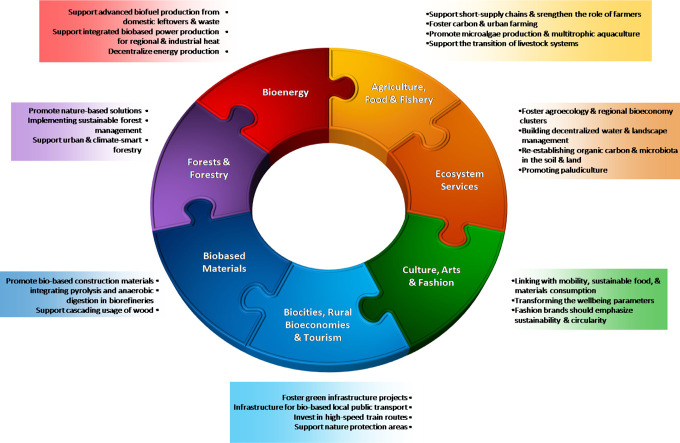
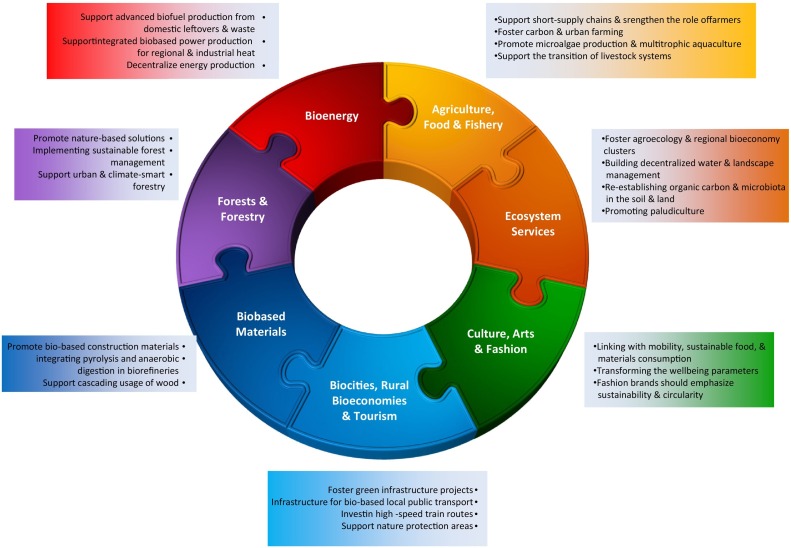
The spread of the COVID-19 pandemic has generated a health crisis and repetitive lockdowns that disrupted different economic and societal segments. As the world has placed hope on the vaccination progress to bring back the socio-economic "normal," this article explores how the bioeconomy can enhance the resilience and sustainability of bio-based, food, and energy systems in the post-COVID-19 era. The proposed recovery approach integrates technological innovations, environment, ecosystem services, "biocities," food, rural economies, and tourism. The importance of integrating culture, arts, and the fashion industry as part of the recovery is underlined towards building a better bioeconomy that, together with environmental safeguards, promotes socio-cultural and economic innovations. This integration could be achieved supporting communities and stakeholders to diversify their activities by combining sustainable production with decarbonization, stimulating private investments in this direction and monitoring the resulting impact of mitigation measures. Food systems should become more resilient in order to allow adapting rapidly to severe crises and future shocks, while it is important to increase circularity towards the valorization of waste, the integration of different processes within the biorefinery concept and the production of bio-based products and biofuels.
新冠疫情的蔓延引发了一场健康危机,并导致多次封锁,扰乱了不同的经济和社会领域。由于全世界都寄希望于疫苗接种进程能让社会经济回归“正常”,本文探讨了生物经济如何增强后新冠时代生物基、食品和能源系统的恢复力和可持续性。提议的复苏方法整合了技术创新、环境、生态系统服务、“生物城市”、食品、农村经济和旅游业。强调了将文化、艺术和时尚产业纳入复苏范畴对于构建更好的生物经济的重要性,这种生物经济与环境保护一道,可促进社会文化和经济创新。实现这种整合可以通过支持社区和利益相关者,将可持续生产与脱碳相结合,从而使其活动多样化,刺激私人资本朝这个方向投资,并监测缓解措施产生的影响。食品系统应具备更强的恢复力,以便能够迅速适应严重危机和未来冲击,与此同时,提高废弃物资源化的循环利用率、在生物炼制概念中整合不同流程以及生产生物基产品和生物燃料也很重要。