The Clinical Hospital of Chengdu Brain Science Institute, High-Field Magnetic Resonance Brain Imaging Key Laboratory of Sichuan Province, School of Life Science and Technology, University of Electronic Science and Technology of China, Chengdu, P. R. China.
Sichuan Provincial Center for Mental Health, The Center of Psychosomatic Medicine of Sichuan Provincial People's Hospital, University of Electronic Science and Technology of China, Chengdu, P. R. China.
Hum Brain Mapp. 2022 Mar;43(4):1449-1462. doi: 10.1002/hbm.25735. Epub 2021 Dec 10.
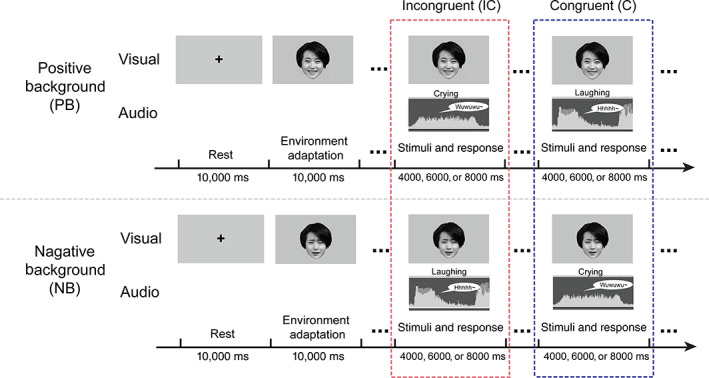
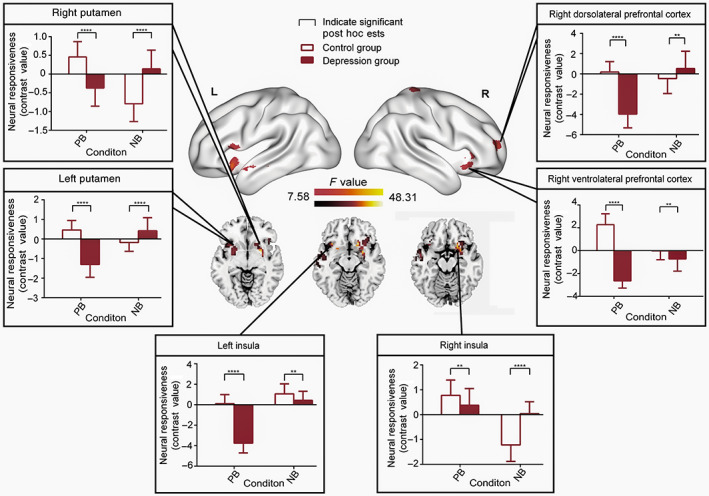
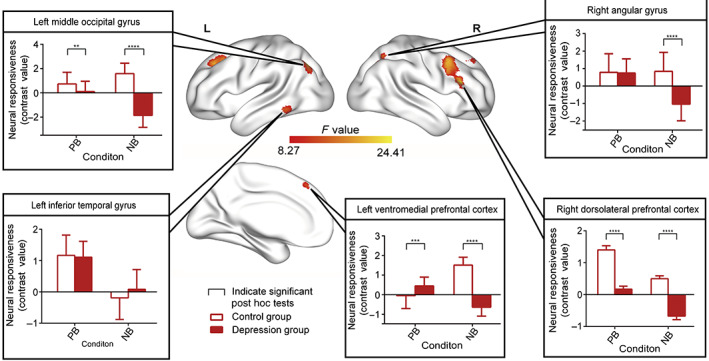
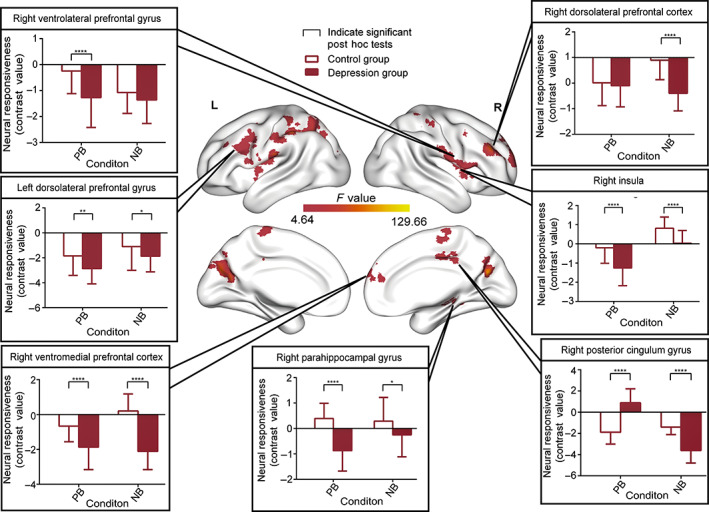
Aberrant affective neural processing and negative emotional bias are trait-marks of major depression disorders (MDDs). However, most research on biased emotional perception in depression has only focused on unimodal experimental stimuli, the neural basis of potentially biased emotional processing of multimodal inputs remains unclear. Here, we addressed this issue by implementing an audiovisual emotional task during functional MRI scanning sessions with 37 patients with MDD and 37 gender-, age- and education-matched healthy controls. Participants were asked to distinguish laughing and crying sounds while being exposed to faces with different emotional valences as background. We combined general linear model and psychophysiological interaction analyses to identify abnormal local functional activity and integrative processes during audiovisual emotional processing in MDD patients. At the local neural level, MDD patients showed increased bias activity in the ventromedial prefrontal cortex (vmPFC) while listening to negative auditory stimuli and concurrently processing visual facial expressions, along with decreased dorsolateral prefrontal cortex (dlPFC) activity in both the positive and negative visual facial conditions. At the network level, MDD exhibited significantly decreased connectivity in areas involved in automatic emotional processes and voluntary control systems during perception of negative stimuli, including the vmPFC, dlPFC, insula, as well as the subcortical regions of posterior cingulate cortex and striatum. These findings support a multimodal emotion dysregulation hypothesis for MDD by demonstrating that negative bias effects may be facilitated by the excessive ventral bottom-up negative emotional influences along with incapability in dorsal prefrontal top-down control system.
情感神经处理异常和负性情绪偏向是重性抑郁障碍(MDD)的特征。然而,大多数关于抑郁患者偏向情绪感知的研究仅集中于单模态实验刺激,对于多模态输入的潜在偏向情绪处理的神经基础仍不清楚。在这里,我们通过在功能磁共振成像扫描期间实施视听情绪任务来解决这个问题,共有 37 名 MDD 患者和 37 名性别、年龄和教育匹配的健康对照组参与了该任务。参与者被要求在听到不同情绪效价的面孔的同时,区分笑声和哭声。我们结合了一般线性模型和心理生理相互作用分析,以确定 MDD 患者在视听情绪处理过程中异常的局部功能活动和整合过程。在局部神经水平上,MDD 患者在听到负性听觉刺激并同时处理视觉面部表情时,腹内侧前额叶皮层(vmPFC)的偏向活动增加,而在正性和负性视觉面部条件下,背外侧前额叶皮层(dlPFC)的活动减少。在网络水平上,MDD 患者在感知负性刺激时,与自动情绪处理和自主控制系统相关的区域的连通性显著降低,包括 vmPFC、dlPFC、岛叶以及后扣带回皮质和纹状体的皮质下区域。这些发现通过表明负性偏向效应可能是由过度的腹侧下传负性情绪影响以及背侧前额叶自上而下控制系统的无能所促进的,支持了 MDD 的多模态情绪失调假说。