Department of Biochemistry, Centre for Research and Development, PRIST University, Thanjavur, India.
Department of Pharmacognosy, College of Pharmacy, King Saud University, Riyadh, Saudi Arabia.
Ann Med. 2021 Dec;53(1):2332-2344. doi: 10.1080/07853890.2021.2009124.
Alzheimer's disease (AD), the most predominant cause of dementia, has evolved tremendously with an escalating frequency, mainly affecting the elderly population. An effective means of delaying, preventing, or treating AD is yet to be achieved. The failure rate of dementia drug trials has been relatively higher than in other disease-related clinical trials. Hence, multi-targeted therapeutic approaches are gaining attention in pharmacological developments.
As an extension of our earlier reports, we have performed docking and molecular dynamic (MD) simulation studies for the same 13 potential ligands against beta-site APP cleaving enzyme 1 (BACE-1) and γ-secretase as a therapeutic target for AD. The screening of these ligands as potential inhibitors of BACE-1 and secretase was performed using AutoDock enabled PyRx v-0.8. The protein-ligand interactions were analyzed in Discovery Studio 2020 (BIOVIA). The stability of the most promising ligand against BACE-1 and secretase was evaluated by MD simulation using Desmond-2018 (Schrodinger, LLC, NY, USA).
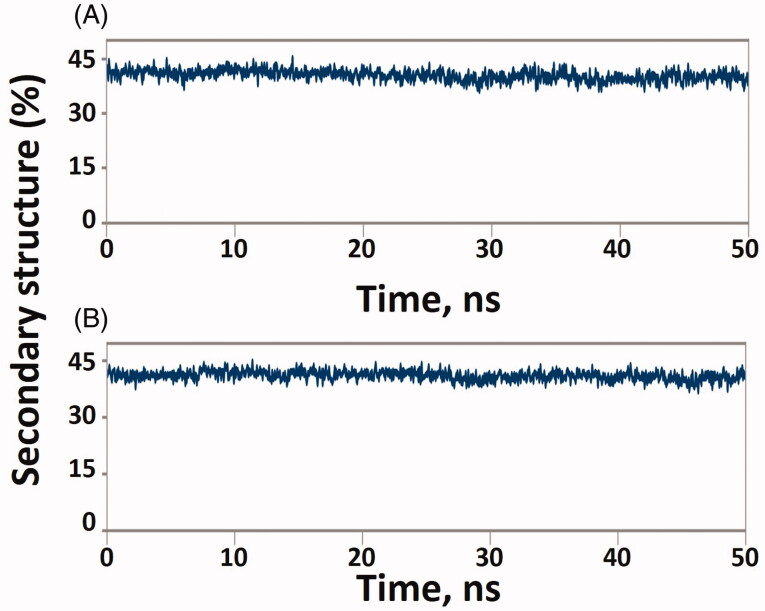
The computational screening revealed that the docking energy values for each of the ligands against both the target enzymes were in the range of -7.0 to -10.1 kcal/mol. Among the 13 ligands, 8 (55E, 6Z2, 6Z5, BRW, F1B, GVP, IQ6, and X37) showed binding energies of ≤-8 kcal/mol against BACE-1 and γ-secretase. For the selected enzyme targets, BACE-1 and γ-secretase, 6Z5 displayed the lowest binding energy of -10.1 and -9.8 kcal/mol, respectively. The MD simulation study confirmed the stability of BACE-6Z5 and γ-secretase-6Z5 complexes and highlighted the formation of a stable complex between 6Z5 and target enzymes.
The virtual screening, molecular docking, and molecular dynamics simulation studies revealed the potential of these multi-enzyme targeted ligands. Among the studied ligands, 6Z5 seems to have the best binding potential and forms a stable complex with BACE-1 and γ-secretase. We recommend the synthesis of 6Z5 for future and studies.
阿尔茨海默病(AD)是痴呆症最主要的病因,其发病率呈指数级上升,主要影响老年人群。目前尚无有效的方法可以延缓、预防或治疗 AD。痴呆症药物试验的失败率相对高于其他相关疾病的临床试验。因此,多靶点治疗方法在药物开发中受到关注。
作为我们之前报告的延伸,我们对同一批 13 种潜在配体针对β-位点 APP 切割酶 1(BACE-1)和γ-分泌酶作为 AD 的治疗靶点进行了对接和分子动力学(MD)模拟研究。使用 AutoDock 使 PyRx v-0.8 对这些配体作为 BACE-1 和分泌酶潜在抑制剂进行筛选。在 Discovery Studio 2020(BIOVIA)中分析蛋白-配体相互作用。使用 Desmond-2018(Schrodinger,LLC,NY,USA)通过 MD 模拟评估针对 BACE-1 和分泌酶的最有前途配体的稳定性。
计算筛选显示,每个配体与两种靶酶的对接能值均在-7.0 至-10.1 kcal/mol 范围内。在 13 种配体中,8 种(55E、6Z2、6Z5、BRW、F1B、GVP、IQ6 和 X37)对 BACE-1 和γ-分泌酶的结合能均低于-8 kcal/mol。对于所选的酶靶标 BACE-1 和γ-分泌酶,6Z5 分别显示出最低的结合能-10.1 和-9.8 kcal/mol。MD 模拟研究证实了 BACE-6Z5 和γ-分泌酶-6Z5 复合物的稳定性,并强调了 6Z5 与靶酶之间形成稳定复合物的能力。
虚拟筛选、分子对接和分子动力学模拟研究揭示了这些多酶靶向配体的潜力。在研究的配体中,6Z5 似乎具有最好的结合潜力,并与 BACE-1 和γ-分泌酶形成稳定的复合物。我们建议合成 6Z5 用于未来的研究。