• 文献检索
  • 文档翻译
  • 深度研究
  • 学术资讯
  • Suppr Zotero 插件Zotero 插件
  • 邀请有礼
  • 套餐&价格
  • 历史记录
应用&插件
Suppr Zotero 插件Zotero 插件浏览器插件Mac 客户端Windows 客户端微信小程序
定价
高级版会员购买积分包购买API积分包
服务
文献检索文档翻译深度研究API 文档MCP 服务
关于我们
关于 Suppr公司介绍联系我们用户协议隐私条款
关注我们

Suppr 超能文献

核心技术专利:CN118964589B侵权必究
粤ICP备2023148730 号-1Suppr @ 2026

文献检索

告别复杂PubMed语法,用中文像聊天一样搜索,搜遍4000万医学文献。AI智能推荐,让科研检索更轻松。

立即免费搜索

文件翻译

保留排版,准确专业,支持PDF/Word/PPT等文件格式,支持 12+语言互译。

免费翻译文档

深度研究

AI帮你快速写综述,25分钟生成高质量综述,智能提取关键信息,辅助科研写作。

立即免费体验

将人工智能模型用于预测紧急剖宫产:克服院际差异带来的挑战。

Transporting an Artificial Intelligence Model to Predict Emergency Cesarean Delivery: Overcoming Challenges Posed by Interfacility Variation.

机构信息

The Mina and Everard Goodman Faculty of Life Sciences, Bar-Ilan University, Ramat Gan, Israel.

Division of Obstetrics & Gynecology, Hadassah Medical Organization and Faculty of Medicine, Hebrew University of Jerusalem, Jerusalem, Israel.

出版信息

J Med Internet Res. 2021 Dec 10;23(12):e28120. doi: 10.2196/28120.

DOI:10.2196/28120
PMID:34890352
原文链接:https://pmc.ncbi.nlm.nih.gov/articles/PMC8709908/
Abstract

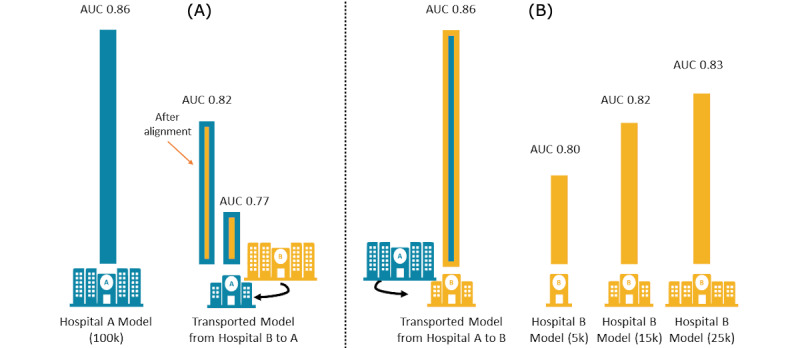
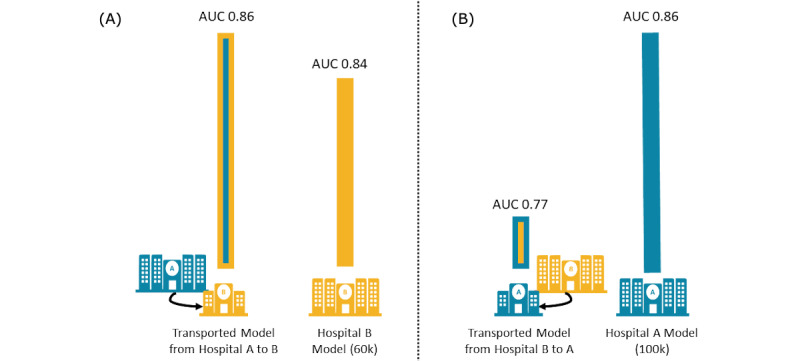
Research using artificial intelligence (AI) in medicine is expected to significantly influence the practice of medicine and the delivery of health care in the near future. However, for successful deployment, the results must be transported across health care facilities. We present a cross-facilities application of an AI model that predicts the need for an emergency caesarean during birth. The transported model showed benefit; however, there can be challenges associated with interfacility variation in reporting practices.

摘要

人工智能(AI)在医学中的应用研究预计将在不久的将来对医学实践和医疗保健的提供产生重大影响。然而,为了成功部署,结果必须在医疗机构之间传输。我们展示了一个人工智能模型在预测分娩时紧急剖宫产需求方面的跨机构应用。该传输模型显示出了益处;然而,在报告实践方面,医疗机构之间的差异可能会带来挑战。
https://cdn.ncbi.nlm.nih.gov/pmc/blobs/5d66/8709908/d9d8cfb3fb64/jmir_v23i12e28120_fig2.jpg
https://cdn.ncbi.nlm.nih.gov/pmc/blobs/5d66/8709908/dab32c18dd84/jmir_v23i12e28120_fig1.jpg
https://cdn.ncbi.nlm.nih.gov/pmc/blobs/5d66/8709908/d9d8cfb3fb64/jmir_v23i12e28120_fig2.jpg
https://cdn.ncbi.nlm.nih.gov/pmc/blobs/5d66/8709908/dab32c18dd84/jmir_v23i12e28120_fig1.jpg
https://cdn.ncbi.nlm.nih.gov/pmc/blobs/5d66/8709908/d9d8cfb3fb64/jmir_v23i12e28120_fig2.jpg

相似文献

1
Transporting an Artificial Intelligence Model to Predict Emergency Cesarean Delivery: Overcoming Challenges Posed by Interfacility Variation.将人工智能模型用于预测紧急剖宫产:克服院际差异带来的挑战。
J Med Internet Res. 2021 Dec 10;23(12):e28120. doi: 10.2196/28120.
2
Use of an artificial intelligence-based rule extraction approach to predict an emergency cesarean section.使用基于人工智能的规则提取方法预测急诊剖宫产。
Int J Gynaecol Obstet. 2022 Jun;157(3):654-662. doi: 10.1002/ijgo.13888. Epub 2021 Sep 6.
3
Contribution of Artificial Intelligence in Pregnancy: A Scoping Review.人工智能在妊娠中的贡献:范围综述。
Stud Health Technol Inform. 2022 Jan 14;289:333-336. doi: 10.3233/SHTI210927.
4
The promise of artificial intelligence: a review of the opportunities and challenges of artificial intelligence in healthcare.人工智能的前景:人工智能在医疗保健领域的机遇与挑战综述。
Br Med Bull. 2021 Sep 10;139(1):4-15. doi: 10.1093/bmb/ldab016.
5
Impact of artificial intelligence on clinical radiography practice: Futuristic prospects in a low resource setting.人工智能对临床放射摄影实践的影响:在资源匮乏环境下的未来前景。
Radiography (Lond). 2021 Oct;27 Suppl 1:S69-S73. doi: 10.1016/j.radi.2021.07.021. Epub 2021 Aug 13.
6
Development of an artificial intelligence-based assessment model for prediction of embryo viability using static images captured by optical light microscopy during IVF.开发一种基于人工智能的评估模型,用于通过体外受精期间光学显微镜拍摄的静态图像预测胚胎活力。
Hum Reprod. 2020 Apr 28;35(4):770-784. doi: 10.1093/humrep/deaa013.
7
Application of Artificial Intelligence in Acute Coronary Syndrome: A Brief Literature Review.人工智能在急性冠状动脉综合征中的应用:简要文献综述
Adv Ther. 2021 Oct;38(10):5078-5086. doi: 10.1007/s12325-021-01908-2. Epub 2021 Sep 15.
8
Artificial Intelligence in the Healthcare System: An Overview.人工智能在医疗保健系统中的应用:概述。
Adv Exp Med Biol. 2021;1335:1-10. doi: 10.1007/5584_2021_620.
9
The Missing Pieces of Artificial Intelligence in Medicine.人工智能在医学中的缺失环节。
Trends Pharmacol Sci. 2019 Aug;40(8):555-564. doi: 10.1016/j.tips.2019.06.001. Epub 2019 Jul 2.
10
Artificial Intelligence and the Practice of Neurology in 2035: The Neurology Future Forecasting Series.2035年的人工智能与神经病学实践:神经病学未来预测系列
Neurology. 2022 Feb 8;98(6):238-245. doi: 10.1212/WNL.0000000000013200.

引用本文的文献

1
Artificial intelligence-based prediction of second stage duration in labor: a multicenter retrospective cohort analysis.基于人工智能的产程第二阶段持续时间预测:一项多中心回顾性队列分析
EClinicalMedicine. 2025 Jan 20;80:103072. doi: 10.1016/j.eclinm.2025.103072. eCollection 2025 Feb.
2
A multimodal model in the prediction of the delivery mode using data from a digital twin-empowered labor monitoring system.一种使用来自数字孪生赋能的分娩监测系统的数据预测分娩方式的多模态模型。
Digit Health. 2024 Dec 8;10:20552076241304934. doi: 10.1177/20552076241304934. eCollection 2024 Jan-Dec.
3
Emergent cesarean section during active labor-does cervical dilatation matter?

本文引用的文献

1
Cross-site transportability of an explainable artificial intelligence model for acute kidney injury prediction.可解释人工智能模型在急性肾损伤预测中的跨站点可移植性研究。
Nat Commun. 2020 Nov 9;11(1):5668. doi: 10.1038/s41467-020-19551-w.
2
A short guide for medical professionals in the era of artificial intelligence.人工智能时代医学专业人员简短指南。
NPJ Digit Med. 2020 Sep 24;3:126. doi: 10.1038/s41746-020-00333-z. eCollection 2020.
3
Real-time data analysis using a machine learning model significantly improves prediction of successful vaginal deliveries.
活跃期分娩时的急诊剖宫产——宫颈扩张程度重要吗?
Arch Gynecol Obstet. 2024 Dec;310(6):2915-2920. doi: 10.1007/s00404-024-07787-6. Epub 2024 Oct 22.
4
Artificial Intelligence in Predicting the Mode of Delivery: A Systematic Review.人工智能在预测分娩方式中的应用:一项系统综述
Cureus. 2024 Sep 10;16(9):e69115. doi: 10.7759/cureus.69115. eCollection 2024 Sep.
使用机器学习模型进行实时数据分析可显著提高阴道分娩成功的预测能力。
Am J Obstet Gynecol. 2020 Sep;223(3):437.e1-437.e15. doi: 10.1016/j.ajog.2020.05.025. Epub 2020 May 17.
4
Artificial intelligence versus clinicians: systematic review of design, reporting standards, and claims of deep learning studies.人工智能与临床医生:深度学习研究的设计、报告标准和主张的系统评价。
BMJ. 2020 Mar 25;368:m689. doi: 10.1136/bmj.m689.
5
Key challenges for delivering clinical impact with artificial intelligence.人工智能实现临床影响的关键挑战。
BMC Med. 2019 Oct 29;17(1):195. doi: 10.1186/s12916-019-1426-2.
6
Machine Learning in Medicine.医学中的机器学习
N Engl J Med. 2019 Apr 4;380(14):1347-1358. doi: 10.1056/NEJMra1814259.
7
Transferability of artificial neural networks for clinical document classification across hospitals: A case study on abnormality detection from radiology reports.医院间临床文档分类的人工神经网络可转移性:以放射学报告异常检测为例的研究。
J Biomed Inform. 2018 Sep;85:68-79. doi: 10.1016/j.jbi.2018.07.017. Epub 2018 Jul 17.
8
Deep learning for healthcare: review, opportunities and challenges.深度学习在医疗保健领域的应用:综述、机遇与挑战。
Brief Bioinform. 2018 Nov 27;19(6):1236-1246. doi: 10.1093/bib/bbx044.
9
Machine learning: Trends, perspectives, and prospects.机器学习:趋势、观点和展望。
Science. 2015 Jul 17;349(6245):255-60. doi: 10.1126/science.aaa8415.
10
A new framework to enhance the interpretation of external validation studies of clinical prediction models.一种增强临床预测模型外部验证研究解释的新框架。
J Clin Epidemiol. 2015 Mar;68(3):279-89. doi: 10.1016/j.jclinepi.2014.06.018. Epub 2014 Aug 30.