Sutter Health Institute for Advancing Health Equity, Sutter Health, Sacramento, CA, USA.
Sutter Health Center for Health Systems Research, Sutter Health, Walnut Creek, CA, USA.
Womens Health (Lond). 2021 Jan-Dec;17:17455065211063300. doi: 10.1177/17455065211063300.
COVID-19 and associated morbidity and mortality has disproportionately affected minoritized populations. The epidemiology of spread of COVID-19 among pregnant women by race/ethnicity is not well described. Using data from a large healthcare system in California, we estimated prevalence and spread during pregnancy and recommend a vaccination approach based on minimizing adverse outcomes.
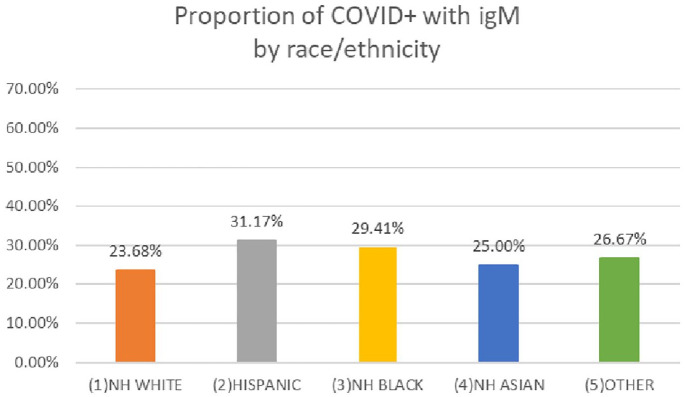
Patients delivering at Sutter Health are tested (molecular) for COVID-19. These results were combined with antibody test results, using samples drawn at delivery. For each racial/ethnic group, we estimated prevalence of COVID-19, using logistic regression to adjust for known sociodemographic and comorbid risk factors. Testing for immunoglobulin G and immunoglobulin M provided insight into timing of infections.
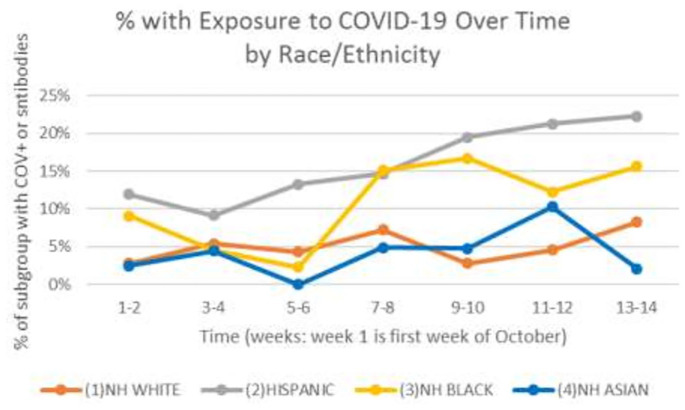
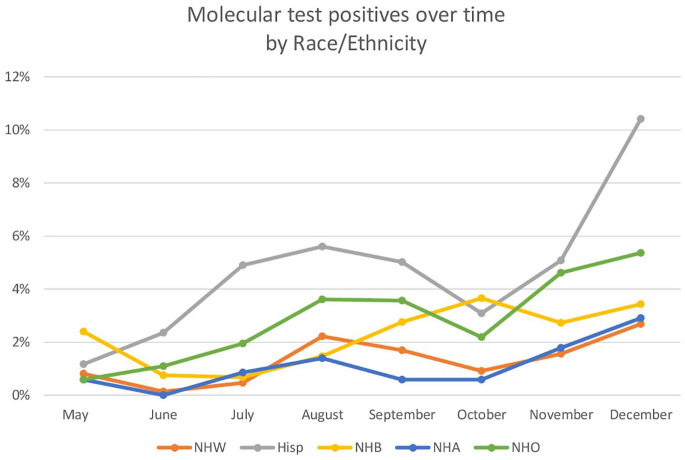
Among 17,446 women delivering May-December, 460 (2.6%) tested positive (molecular). Hispanic women were at 2.6 times the odds of being actively infected as White women (odds ratio = 2.6, 95% confidence interval = 2.0-3.3). August and December were the highest risk periods for active infection (odds ratio = 3.5, 95% confidence interval = 2.1-5.7 and odds ratio = 6.1, 95% confidence interval = 3.8-9.9, compared with May, respectively). Among 4500 women delivering October-December, 425 (9.4%) had positive molecular or antibody tests, ranging from 4.0% (Asian) to 15.7% (Hispanic). Adjusting for covariables, compared with White patients, odds of infection was similar for Black and Asian patients, with Hispanic at 2.4 (1.8-3.3) times the odds.
COVID-19 prevalence was higher among Hispanic women at delivery and in the last trimester than their White counterparts. Higher rates in Black patients are explained by other risk factors. Resources should be directed to increase vaccination rates among Hispanic women in early stages of pregnancy.
COVID-19 及其相关的发病率和死亡率不成比例地影响了少数族裔群体。种族/族裔群体中 COVID-19 在孕妇中的传播流行病学尚未得到充分描述。本研究利用加利福尼亚州一个大型医疗保健系统的数据,估计了怀孕期间的流行率和传播情况,并根据最大限度减少不良后果的原则提出了疫苗接种方法。
在 Sutter Health 分娩的患者接受 COVID-19(分子)检测。将这些结果与使用分娩时采集的样本进行的抗体检测结果相结合。对于每个种族/族裔群体,我们使用逻辑回归来调整已知的社会人口统计学和合并症风险因素,估计 COVID-19 的患病率。检测免疫球蛋白 G 和免疫球蛋白 M 提供了对感染时间的深入了解。
在 5 月至 12 月分娩的 17446 名女性中,有 460 名(2.6%)检测呈阳性(分子)。与白人女性相比,西班牙裔女性感染的可能性是其 2.6 倍(优势比=2.6,95%置信区间=2.0-3.3)。8 月和 12 月是感染活跃的最高风险期(与 5 月相比,优势比=3.5,95%置信区间=2.1-5.7 和优势比=6.1,95%置信区间=3.8-9.9)。在 10 月至 12 月分娩的 4500 名女性中,有 425 名(9.4%)分子或抗体检测呈阳性,范围从 4.0%(亚洲)到 15.7%(西班牙裔)。调整协变量后,与白人患者相比,黑人患者和亚洲患者的感染几率相似,西班牙裔患者的感染几率是其 2.4 倍(1.8-3.3)。
与白人相比,分娩时和最后三个月的西班牙裔女性 COVID-19 的患病率更高。黑人患者的高发病率可归因于其他风险因素。应将资源用于提高西班牙裔女性在妊娠早期的疫苗接种率。