Dai Chengzhen L, Kornilov Sergey A, Roper Ryan T, Cohen-Cline Hannah, Jade Kathleen, Smith Brett, Heath James R, Diaz George, Goldman Jason D, Magis Andrew T, Hadlock Jennifer J
Institute for Systems Biology, Seattle, Washington, USA.
Providence Center for Outcomes Research and Education, Providence Health System, Renton, Washington, USA.
Clin Infect Dis. 2021 Dec 16;73(12):2193-2204. doi: 10.1093/cid/ciab154.
Data on the characteristics of coronavirus disease 2019 (COVID-19) patients disaggregated by race/ethnicity remains limited. We evaluated the sociodemographic and clinical characteristics of patients across racial/ethnic groups and assessed their associations with COVID-19 outcomes.
This retrospective cohort study examined 629 953 patients tested for severe acute respiratory syndrome coronavirus 2 (SARS-CoV-2) in a large health system spanning California, Oregon, and Washington between March 1 and December 31, 2020. Sociodemographic and clinical characteristics were obtained from electronic health records. Odds of SARS-CoV-2 infection, COVID-19 hospitalization, and in-hospital death were assessed with multivariate logistic regression.
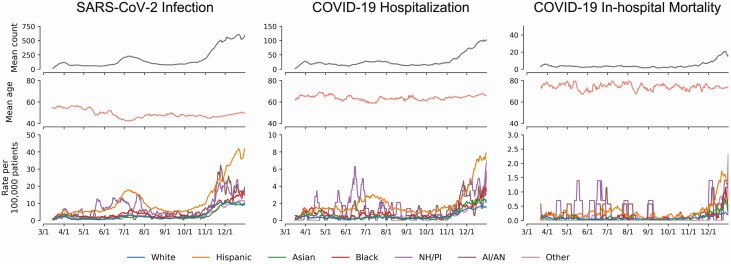
A total of 570 298 patients with known race/ethnicity were tested for SARS-CoV-2, of whom 27.8% were non-White minorities: 54 645 individuals tested positive, with minorities representing 50.1%. Hispanics represented 34.3% of infections but only 13.4% of tests. Although generally younger than White patients, Hispanics had higher rates of diabetes but fewer other comorbidities. A total of 8536 patients were hospitalized and 1246 died, of whom 56.1% and 54.4% were non-White, respectively. Racial/ethnic distributions of outcomes across the health system tracked with state-level statistics. Increased odds of testing positive and hospitalization were associated with all minority races/ethnicities. Hispanic patients also exhibited increased morbidity, and Hispanic race/ethnicity was associated with in-hospital mortality (odds ratio [OR], 1.39; 95% confidence interval [CI], 1.14-1.70).
Major healthcare disparities were evident, especially among Hispanics who tested positive at a higher rate, required excess hospitalization and mechanical ventilation, and had higher odds of in-hospital mortality despite younger age. Targeted, culturally responsive interventions and equitable vaccine development and distribution are needed to address the increased risk of poorer COVID-19 outcomes among minority populations.
按种族/族裔分类的2019冠状病毒病(COVID-19)患者特征数据仍然有限。我们评估了不同种族/族裔群体患者的社会人口统计学和临床特征,并评估了它们与COVID-19结局的关联。
这项回顾性队列研究考察了2020年3月1日至12月31日期间在加利福尼亚州、俄勒冈州和华盛顿州的一个大型医疗系统中接受严重急性呼吸综合征冠状病毒2(SARS-CoV-2)检测的629953名患者。社会人口统计学和临床特征从电子健康记录中获取。通过多因素逻辑回归评估SARS-CoV-2感染、COVID-19住院和院内死亡的几率。
共有570298名已知种族/族裔的患者接受了SARS-CoV-2检测,其中27.8%为非白人少数族裔:54645人检测呈阳性,少数族裔占50.1%。西班牙裔占感染病例的34.3%,但仅占检测病例的13.4%。尽管西班牙裔患者总体上比白人患者年轻,但糖尿病发病率较高,其他合并症较少。共有8536名患者住院,1246人死亡,其中非白人分别占56.1%和54.4%。整个医疗系统中结局的种族/族裔分布与州级统计数据相符。所有少数族裔种族/族裔检测呈阳性和住院的几率均增加。西班牙裔患者也表现出更高的发病率,西班牙裔种族/族裔与院内死亡率相关(比值比[OR]为1.39;95%置信区间[CI]为1.14 - 1.70)。
主要的医疗保健差异很明显,尤其是在西班牙裔人群中,他们检测呈阳性的比例更高,需要额外住院和机械通气,并且尽管年龄较小,但院内死亡几率更高。需要有针对性的、具有文化适应性的干预措施以及公平的疫苗研发和分发,以应对少数族裔人群中COVID-19结局较差风险增加的问题。