Department of Medicine, University of Toronto, Toronto, Canada.
University Health Network, Toronto General Hospital, Immunodeficiency Clinic, Toronto, Canada.
Microbiome. 2021 Dec 10;9(1):239. doi: 10.1186/s40168-021-01183-x.
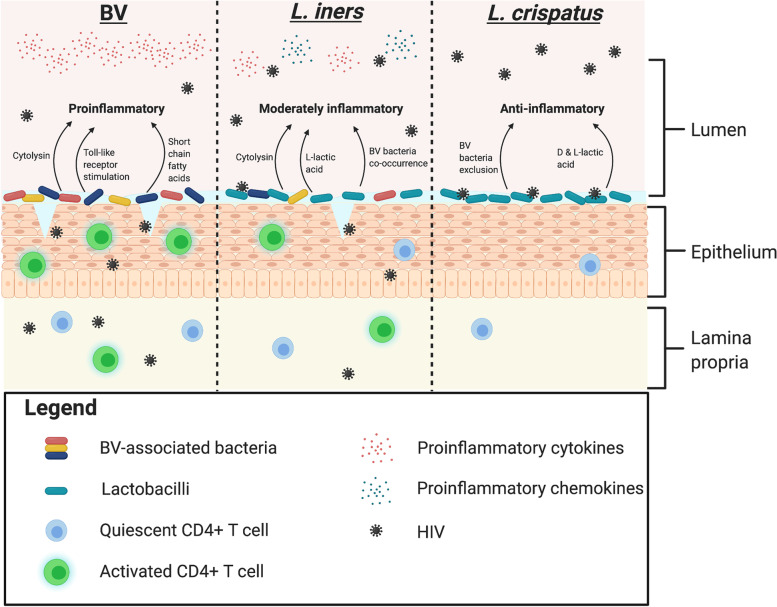
HIV incidence continues to be unacceptably high in Eastern and Southern Africa, with women disproportionately affected. An increased per-contact risk of HIV acquisition among African, Caribbean, and other Black (ACB) women has been associated with the higher prevalence of bacterial vaginosis (BV) in these communities, wherein the vaginal microbiota is predominated by diverse pro-inflammatory anaerobic bacteria. However, while the vaginal microbiota in BV-free women is typically predominated by one of several different Lactobacillus spp., the degree of HIV protection afforded by a Lactobacillus-predominant vaginal microbiota also varies considerably. Specifically, L. crispatus is associated with an immunoregulatory genital immune environment, exclusion of BV-associated bacteria, and reduced HIV risk. In contrast, less HIV protection or exclusion of BV-associated bacteria and fewer immune benefits have been associated with L. iners-which is unfortunately the most common Lactobacillus species among ACB women. These species-specific clinical differences are underpinned by substantial genomic differences between Lactobacillus species: for instance, the much smaller genome of L. iners lacks the coding sequence for D-lactic acid dehydrogenase and cannot produce the D-lactate isomer that enhances HIV trapping in mucus but encodes for epithelial cell toxins and stress resistance proteins that may enhance bacterial survival in the context of microbiota and environmental fluctuations. While more studies are needed to elucidate whether differences in HIV protection between Lactobacillus species are due to direct genital immune effects or the exclusion of proinflammatory BV-associated bacteria, the current body of work suggests that for BV treatment to succeed as an HIV prevention strategy, it may be necessary to induce a vaginal microbiota that is predominated by specific (non-iners) Lactobacillus species. Video abstract.
艾滋病毒在东非和南非的发病率仍然高得令人无法接受,妇女受影响尤为严重。非裔加勒比和其他黑人(ACB)妇女每接触一次艾滋病毒的风险增加,与这些社区中细菌性阴道病(BV)的更高流行率有关,在这些社区中,阴道微生物群主要由多种促炎厌氧细菌组成。然而,虽然无细菌性阴道病的妇女的阴道微生物群通常以几种不同的乳杆菌属为主,但乳杆菌为主的阴道微生物群提供的艾滋病毒保护程度也有很大差异。具体来说,L. crispatus 与免疫调节的生殖免疫环境、排除与 BV 相关的细菌和降低艾滋病毒风险有关。相比之下,L. iners 与较少的艾滋病毒保护或排除与 BV 相关的细菌和较少的免疫益处有关,而 L. iners 不幸是 ACB 妇女中最常见的乳杆菌属。这些特定于物种的临床差异是由乳杆菌属之间的巨大基因组差异所支持的:例如,L. iners 的基因组小得多,缺乏 D-乳酸脱氢酶的编码序列,无法产生增强艾滋病毒在粘液中捕获的 D-乳酸异构体,但编码上皮细胞毒素和应激抗性蛋白,这可能会增强细菌在微生物群和环境波动背景下的生存能力。虽然还需要更多的研究来阐明乳杆菌属之间在艾滋病毒保护方面的差异是否是由于直接的生殖免疫效应还是排除促炎的 BV 相关细菌,但目前的研究表明,为了使 BV 治疗成功作为一种艾滋病毒预防策略,可能有必要诱导一种以特定(非 iners)乳杆菌属为主的阴道微生物群。视频摘要。