Cord-Landwehr Stefan, Moerschbacher Bruno M
Institute for Biology and Biotechnology of Plants, University of Münster, Schlossplatz 8, 48143, Münster, Germany.
Fungal Biol Biotechnol. 2021 Dec 10;8(1):19. doi: 10.1186/s40694-021-00127-2.
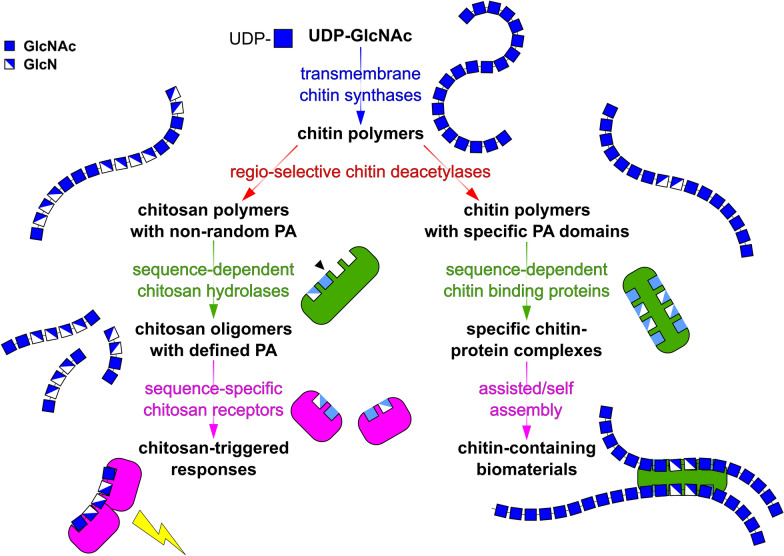
Chitins and chitosans are among the most widespread and versatile functional biopolymers, with interesting biological activities and superior material properties. While chitins are evolutionary ancient and present in many eukaryotes except for higher plants and mammals, the natural distribution of chitosans, i.e. extensively deacetylated derivatives of chitin, is more limited. Unequivocal evidence for its presence is only available for fungi where chitosans are produced from chitin by the action of chitin deacetylases. However, neither the structural details such as fraction and pattern of acetylation nor the physiological roles of natural chitosans are known at present. We hypothesise that the chitin deacetylases are generating chitins and chitosans with specific acetylation patterns and that these provide information for the interaction with specific chitin- and chitosan-binding proteins. These may be structural proteins involved in the assembly of the complex chitin- and chitosan-containing matrices such as fungal cell walls and insect cuticles, chitin- and chitosan-modifying and -degrading enzymes such as chitin deacetylases, chitinases, and chitosanases, but also chitin- and chitosan-recognising receptors of the innate immune systems of plants, animals, and humans. The acetylation pattern, thus, may constitute a kind of 'ChitoCode', and we are convinced that new in silico, in vitro, and in situ analytical tools as well as new synthetic methods of enzyme biotechnology and organic synthesis are currently offering an unprecedented opportunity to decipher this code. We anticipate a deeper understanding of the biology of chitin- and chitosan-containing matrices, including their synthesis, assembly, mineralisation, degradation, and perception. This in turn will improve chitin and chitosan biotechnology and the development of reliable chitin- and chitosan-based products and applications, e.g. in medicine and agriculture, food and feed sciences, as well as cosmetics and material sciences.
几丁质和壳聚糖是分布最为广泛、功能最为多样的功能性生物聚合物,具有有趣的生物活性和卓越的材料性能。几丁质在进化上出现得很早,除高等植物和哺乳动物外,存在于许多真核生物中,而壳聚糖(即几丁质的高度脱乙酰化衍生物)的自然分布则较为有限。目前仅在真菌中有明确证据表明其存在,在真菌中壳聚糖是几丁质通过几丁质脱乙酰酶的作用产生的。然而,目前既不清楚壳聚糖的乙酰化程度和模式等结构细节,也不清楚天然壳聚糖的生理作用。我们推测,几丁质脱乙酰酶正在生成具有特定乙酰化模式的几丁质和壳聚糖,这些模式为与特定的几丁质和壳聚糖结合蛋白相互作用提供信息。这些蛋白可能是参与复杂的含几丁质和壳聚糖基质(如真菌细胞壁和昆虫表皮)组装的结构蛋白、几丁质和壳聚糖修饰及降解酶(如几丁质脱乙酰酶、几丁质酶和壳聚糖酶),也可能是植物、动物和人类先天免疫系统中识别几丁质和壳聚糖的受体。因此,乙酰化模式可能构成一种“壳聚糖密码”,我们相信新的计算机模拟、体外和原位分析工具以及酶生物技术和有机合成的新方法目前正提供前所未有的机会来破解这个密码。我们期望能更深入地了解含几丁质和壳聚糖基质的生物学特性,包括它们的合成、组装、矿化、降解和识别。这反过来将改善几丁质和壳聚糖生物技术以及可靠的基于几丁质和壳聚糖的产品和应用的开发,例如在医学和农业、食品和饲料科学以及化妆品和材料科学领域。