Division of Cardiovascular Sciences, Faculty of Medicine, Biology and Health, University of Manchester, AV Hill Building, Manchester, M13 9PT, UK.
MRC Integrative Epidemiology Unit, University of Bristol, Oakfield House, Bristol, BS8 2BN, UK.
Cardiovasc Res. 2022 Dec 9;118(15):3151-3161. doi: 10.1093/cvr/cvab357.
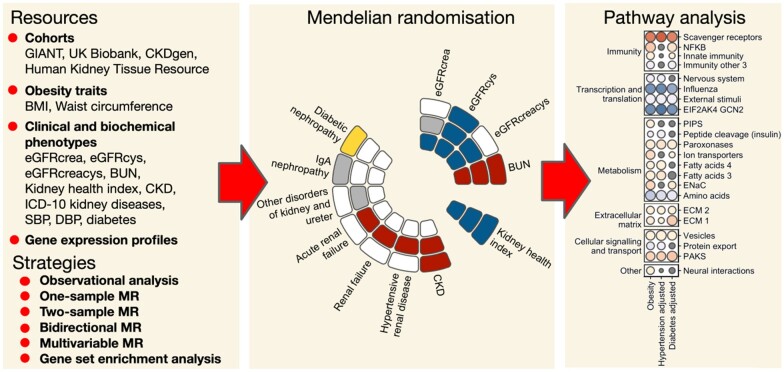
Obesity and kidney diseases are common complex disorders with an increasing clinical and economic impact on healthcare around the globe. Our objective was to examine if modifiable anthropometric obesity indices show putatively causal association with kidney health and disease and highlight biological mechanisms of potential relevance to the association between obesity and the kidney.
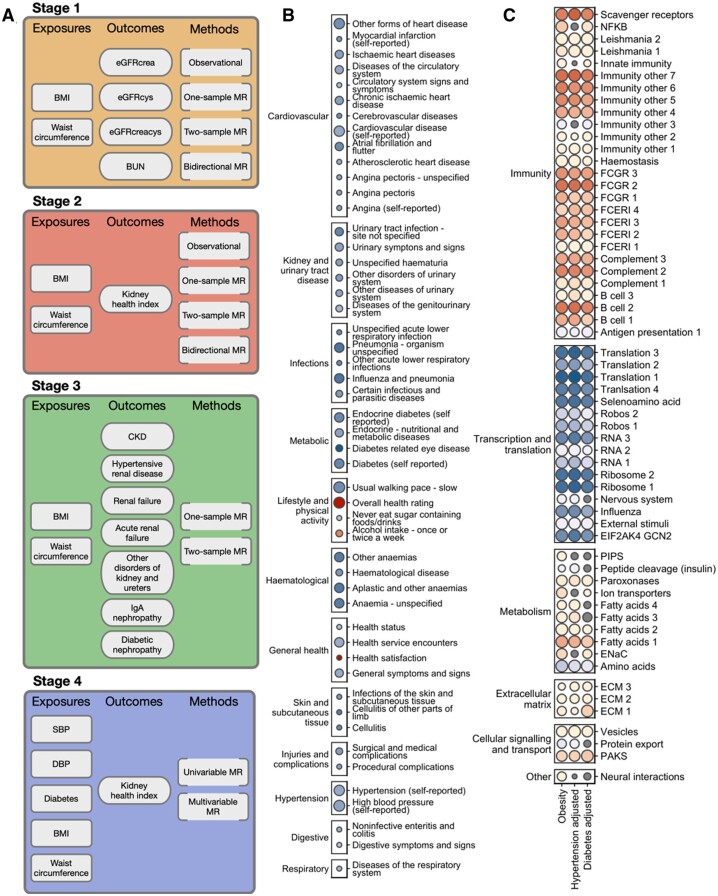
We performed observational, one-sample, two-sample Mendelian randomization (MR) and multivariable MR studies in ∼300 000 participants of white-British ancestry from UK Biobank and participants of predominantly European ancestry from genome-wide association studies. The MR analyses revealed that increasing values of genetically predicted body mass index and waist circumference were causally associated with biochemical indices of renal function, kidney health index (a composite renal outcome derived from blood biochemistry, urine analysis, and International Classification of Disease-based kidney disease diagnoses), and both acute and chronic kidney diseases of different aetiologies including hypertensive renal disease and diabetic nephropathy. Approximately 13-16% and 21-26% of the potentially causal effect of obesity indices on kidney health were mediated by blood pressure and type 2 diabetes, respectively. A total of 61 pathways mapping primarily onto transcriptional/translational regulation, innate and adaptive immunity, and extracellular matrix and metabolism were associated with obesity measures in gene set enrichment analysis in up to 467 kidney transcriptomes.
Our data show that a putatively causal association of obesity with renal health is largely independent of blood pressure and type 2 diabetes and uncover the signatures of obesity on the transcriptome of human kidney.
肥胖症和肾脏疾病是常见的复杂疾病,对全球医疗保健的临床和经济影响日益增加。我们的目的是研究可改变的人体测量肥胖指数是否与肾脏健康和疾病存在潜在的因果关系,并强调与肥胖和肾脏之间关联相关的潜在生物学机制。
我们在 UK Biobank 的约 30 万白种英国人以及主要为欧洲血统的全基因组关联研究参与者中进行了观察性、单样本、双样本孟德尔随机化(MR)和多变量 MR 研究。MR 分析表明,遗传预测的体重指数和腰围值的增加与肾功能的生化指标、肾脏健康指数(一种源自血液生化、尿液分析和基于国际疾病分类的肾脏疾病诊断的综合肾脏结局)以及不同病因的急性和慢性肾脏疾病(包括高血压性肾病和糖尿病肾病)存在因果关系。肥胖指数对肾脏健康的潜在因果影响中,约有 13-16%和 21-26%分别通过血压和 2 型糖尿病介导。在多达 467 个肾脏转录组的基因集富集分析中,有 61 条途径主要映射到转录/翻译调节、先天和适应性免疫以及细胞外基质和代谢,与肥胖测量值相关。
我们的数据表明,肥胖与肾脏健康之间的潜在因果关系在很大程度上独立于血压和 2 型糖尿病,并且揭示了肥胖对人类肾脏转录组的特征。