Division of Cardiovascular Sciences, Faculty of Biology, Medicine and Health, University of Manchester, Manchester, UK.
School of Health and Life Sciences, Federation University Australia, Ballarat, VIC, Australia.
Eur Heart J. 2020 Dec 21;41(48):4580-4588. doi: 10.1093/eurheartj/ehaa794.
Angiotensin-converting enzyme 2 (ACE2) is the cellular entry point for severe acute respiratory syndrome coronavirus (SARS-CoV-2)-the cause of coronavirus disease 2019 (COVID-19). However, the effect of renin-angiotensin system (RAS)-inhibition on ACE2 expression in human tissues of key relevance to blood pressure regulation and COVID-19 infection has not previously been reported.
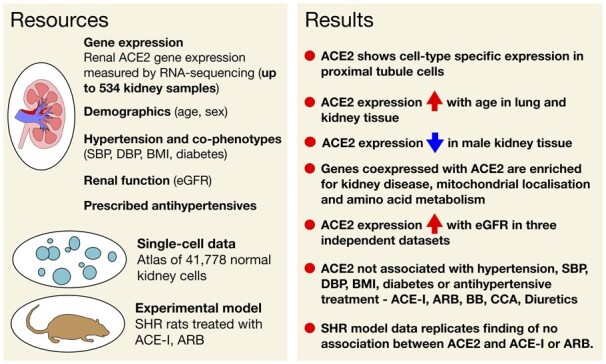
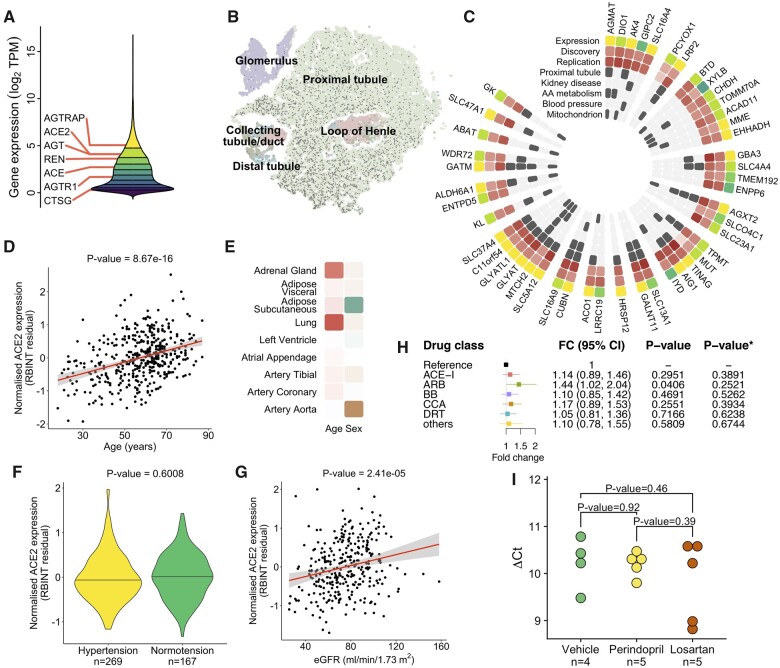
We examined how hypertension, its major metabolic co-phenotypes, and antihypertensive medications relate to ACE2 renal expression using information from up to 436 patients whose kidney transcriptomes were characterized by RNA-sequencing. We further validated some of the key observations in other human tissues and/or a controlled experimental model. Our data reveal increasing expression of ACE2 with age in both human lungs and the kidney. We show no association between renal expression of ACE2 and either hypertension or common types of RAS inhibiting drugs. We demonstrate that renal abundance of ACE2 is positively associated with a biochemical index of kidney function and show a strong enrichment for genes responsible for kidney health and disease in ACE2 co-expression analysis.
Our results indicate that neither hypertension nor antihypertensive treatment is likely to alter the expression of the key entry receptor for SARS-CoV-2 in the human kidney. Our data further suggest that in the absence of SARS-CoV-2 infection, kidney ACE2 is most likely nephro-protective but the age-related increase in its expression within lungs and kidneys may be relevant to the risk of SARS-CoV-2 infection.
血管紧张素转换酶 2(ACE2)是严重急性呼吸系统综合征冠状病毒(SARS-CoV-2)——即 2019 冠状病毒病(COVID-19)的细胞进入点。然而,肾素-血管紧张素系统(RAS)抑制对与血压调节和 COVID-19 感染相关的人类组织中 ACE2 表达的影响以前尚未报道过。
我们使用多达 436 名患者的肾脏转录组学特征的 RNA 测序信息,检查了高血压、其主要代谢共表型以及抗高血压药物如何与 ACE2 肾脏表达相关。我们进一步在其他人类组织和/或对照实验模型中验证了一些关键观察结果。我们的数据表明,在人类肺部和肾脏中,ACE2 的表达随着年龄的增长而增加。我们没有发现 ACE2 在肾脏中的表达与高血压或常见的 RAS 抑制药物之间存在任何关联。我们证明,ACE2 在肾脏中的丰度与肾功能的生化指标呈正相关,并在 ACE2 共表达分析中显示出与肾脏健康和疾病相关的基因的强烈富集。
我们的结果表明,高血压或抗高血压治疗都不太可能改变 SARS-CoV-2 在人类肾脏中的关键进入受体的表达。我们的数据进一步表明,在没有 SARS-CoV-2 感染的情况下,肾脏 ACE2 很可能具有肾保护作用,但肺部和肾脏中 ACE2 表达的年龄相关性增加可能与 SARS-CoV-2 感染的风险相关。