School of Nursing and Midwifery, Edith Cowan University, Joondalup, Western Australia, Australia.
J Clin Nurs. 2022 Dec;31(23-24):3402-3413. doi: 10.1111/jocn.16167. Epub 2021 Dec 10.
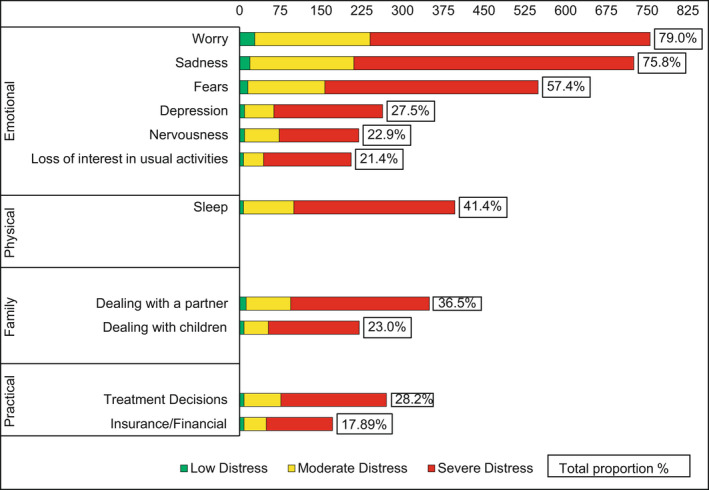
To (i) determine prevalence of distress among caregivers of people living with cancer, (ii) describe caregivers' most commonly reported problems and (iii) investigate which factors were associated with caregivers' distress.
The psychological distress associated with a cancer diagnosis jointly impacts those living with cancer and their caregivers(s). As the provision of clinical support moves towards a dyadic model, understanding the factors associated with caregivers' distress is increasingly important.
Cross-sectional study.
Distress screening data were analysed for 956 caregivers (family and friends) of cancer patients accessing the Cancer Council Western Australia information and support line between 1 January 2016 and 31 December 2018. These data included caregivers' demographics and reported problems and their level of distress. Information related to their care recipient's cancer diagnosis was also captured. Caregivers' reported problems and levels of distress were measured using the distress thermometer and accompanying problem list (PL) developed by the National Comprehensive Cancer Network. A partial-proportional logistic regression model was used to investigate which demographic factors and PL items were associated with increasing levels of caregiver distress. Pearlin's model of caregiving and stress process was used as a framework for discussion. The Strengthening the Reporting of Observational Studies in Epidemiology (STROBE) checklist was followed.
Nearly all caregivers (96.24%) recorded a clinically significant level of distress (≥4/10) and two thirds (66.74%) as severely distressed (≥7/10). Being female, self-reporting sadness, a loss of interest in usual activities, sleep problems or problems with a partner or children were all significantly associated with increased levels of distress.
Caregivers of people with cancer reporting emotional or familial problems may be at greater risk of moderate and severe distress.
Awareness and recognition of caregiver distress are vital, and referral pathways for caregivers are the important area of development.
(一)确定癌症患者照顾者的痛苦患病率,(二)描述照顾者最常报告的问题,(三)调查哪些因素与照顾者的痛苦有关。
癌症诊断引起的心理困扰共同影响癌症患者及其照顾者。随着临床支持向双重视角模式转变,理解与照顾者痛苦相关的因素变得越来越重要。
横断面研究。
对 2016 年 1 月 1 日至 2018 年 12 月 31 日期间,在西澳大利亚癌症协会信息和支持热线接受服务的 956 名癌症患者照顾者(家人和朋友)的痛苦筛查数据进行了分析。这些数据包括照顾者的人口统计学特征、报告的问题及其痛苦程度。还收集了与他们照顾对象的癌症诊断相关的信息。照顾者报告的问题和痛苦程度使用国家综合癌症网络开发的痛苦温度计和伴随的问题清单(PL)进行测量。采用部分比例逻辑回归模型,调查哪些人口统计学因素和 PL 项目与照顾者痛苦程度的增加有关。Pearlin 的照顾和压力过程模型被用作讨论的框架。本研究遵循了观察性研究的报告质量(STROBE)检查表。
几乎所有的照顾者(96.24%)都记录了一个具有临床意义的痛苦水平(≥4/10),有三分之二(66.74%)的照顾者痛苦程度严重(≥7/10)。女性、自我报告的悲伤、对日常活动的兴趣丧失、睡眠问题或与伴侣或孩子的问题,均与痛苦程度的增加显著相关。
报告有情绪或家庭问题的癌症患者照顾者可能面临更大的中度和重度痛苦风险。
认识和识别照顾者的痛苦至关重要,为照顾者提供转介途径是一个重要的发展方向。