Department of Clinical Science and Education Södersjukhuset, Karolinska Institutet, Stockholm, Sweden.
Department of Surgery, Södersjukhuset, Stockholm, Sweden.
Hernia. 2023 Feb;27(1):21-29. doi: 10.1007/s10029-021-02545-y. Epub 2021 Dec 11.
To analyse if postoperative complications constitute a predictor for the risk of developing long-term groin pain.
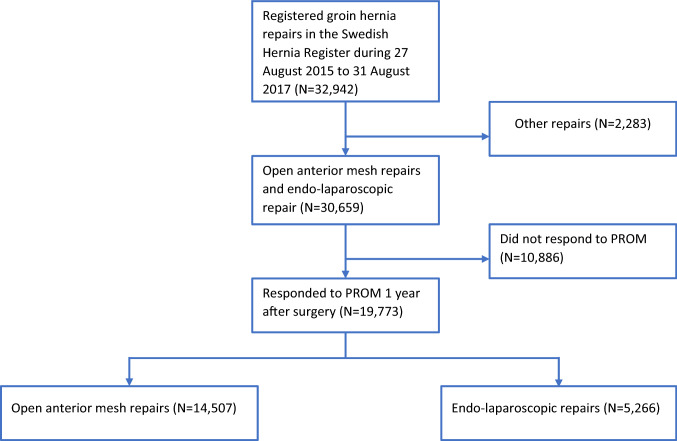
Population-based prospective cohort study of 30,659 patients operated for inguinal hernia 2015-2017 included in the Swedish Hernia Register. Registered post-operative complications were categorised into hematomas, surgical site infections, seromas, urinary tract complications, and acute post-operative pain. A questionnaire enquiring about groin pain was distributed to all patients 1 year after surgery. Multivariable logistic regression analysis was used to find any association between postoperative complications and reported level of pain 1 year after surgery.
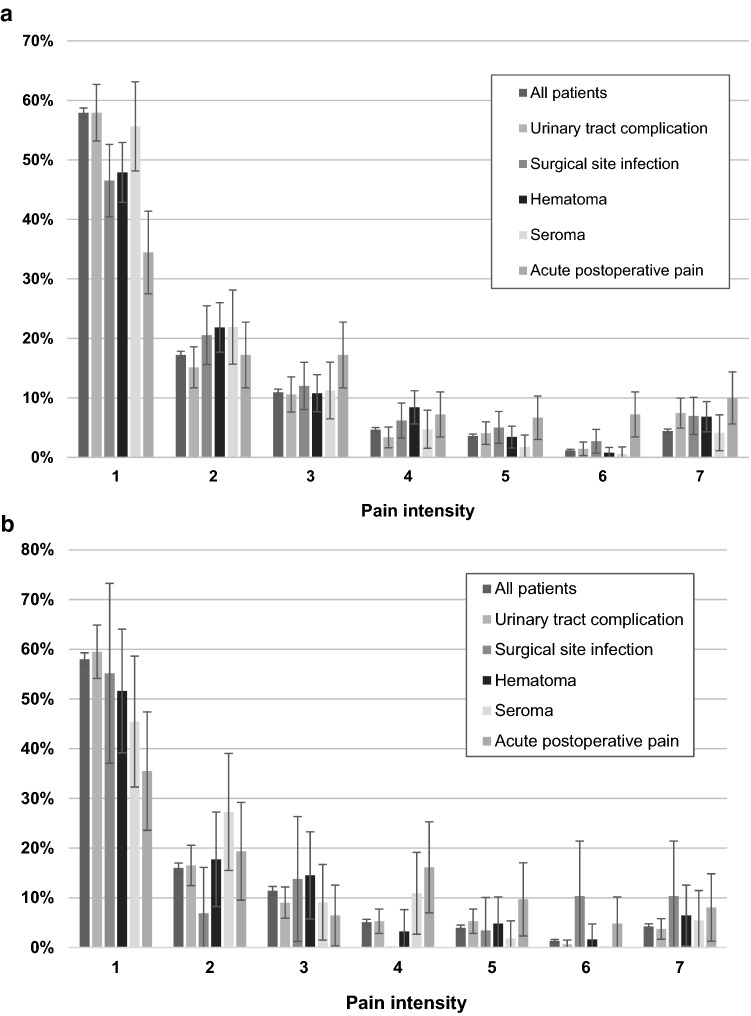
The response rate was 64.5%. In total 19,773 eligible participants responded to the questionnaire, whereof 73.4% had undergone open anterior mesh repair and 26.6% had undergone endo-laparoscopic mesh repair. Registered postoperative complications were: 750 hematomas (2.3%), 516 surgical site infections (1.6%), 395 seromas (1.2%), 1216 urinary tract complications (3.7%), and 520 hernia repairs with acute post-operative pain (1.6%). Among patients who had undergone open anterior mesh repair, an association between persistent pain and hematomas (OR 2.03, CI 1.30-3.18), surgical site infections (OR 2.18, CI 1.27-3.73) and acute post-operative pain (OR 7.46, CI 4.02-13.87) was seen. Analysis of patients with endo-laparoscopic repair showed an association between persistent pain and acute post-operative pain (OR 9.35, CI 3.18-27.48).
Acute postoperative pain was a strong predictor for persistent pain following both open anterior and endo-laparoscopic hernia repair. Surgical site infection and hematoma were predictors for persistent pain following open anterior hernia repair, although the rate of reported postoperative complications was low.
分析术后并发症是否是导致长期腹股沟疼痛风险的预测因素。
这是一项基于人群的前瞻性队列研究,纳入了 2015 年至 2017 年间在瑞典疝登记处接受腹股沟疝手术的 30659 名患者。将术后并发症分为血肿、手术部位感染、血清肿、尿路感染和急性术后疼痛。术后 1 年向所有患者发放了关于腹股沟疼痛的问卷。采用多变量逻辑回归分析来确定术后并发症与术后 1 年报告的疼痛程度之间的任何关联。
应答率为 64.5%。共有 19773 名符合条件的参与者回答了问卷,其中 73.4%接受了开放式前网片修补术,26.6%接受了内镜下网片修补术。登记的术后并发症包括:750 例血肿(2.3%)、516 例手术部位感染(1.6%)、395 例血清肿(1.2%)、1216 例尿路感染(3.7%)和 520 例急性术后疼痛的疝修补术(1.6%)。在接受开放式前网片修补术的患者中,持续性疼痛与血肿(OR 2.03,95%CI 1.30-3.18)、手术部位感染(OR 2.18,95%CI 1.27-3.73)和急性术后疼痛(OR 7.46,95%CI 4.02-13.87)之间存在关联。对接受内镜下修补术的患者进行分析显示,持续性疼痛与急性术后疼痛(OR 9.35,95%CI 3.18-27.48)之间存在关联。
急性术后疼痛是开放式前和内镜下疝修补术后持续性疼痛的一个强有力的预测因素。手术部位感染和血肿是开放式前疝修补术后持续性疼痛的预测因素,尽管报告的术后并发症发生率较低。