Department of Food Nutrition and Safety, School of Public Health, Dalian Medical University, Dalian, P.R. China.
Department of Radiation Oncology, The Second Hospital of Dalian Medical University, Dalian, P.R. China.
Bioengineered. 2021 Dec;12(2):12431-12446. doi: 10.1080/21655979.2021.2005747.
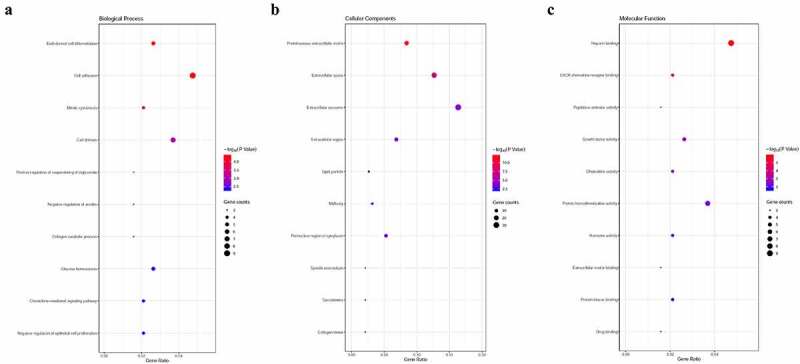
Breast cancer (BC), an extremely aggressive malignant tumor, causes a large number of deaths worldwide. In this study, we pooled profile datasets from three cohorts to illuminate the underlying key genes and pathways of BC. Expression profiles GSE42568, GSE45827, and GSE124646, including 244 BC tissues and 28 normal breast tissues, were integrated and analyzed. Differentially expressed genes (DEGs) were screened out based on these three datasets. Functional analysis including Gene Ontology (GO) and Kyoto Encyclopedia of Gene and Genome (KEGG) pathway were performed using The Database for Annotation, Visualization and Integrated Discovery (DAVID). Moreover, Cytoscape with Search Tool for the Retrieval of Interacting Genes (STRING) and Molecular Complex Detection (MCODE) plugin were utilized to visualize protein protein interaction (PPI) of these DEGs. The module with the highest connectivity of gene interactions was selected for further analysis. All of these hub genes had a significantly worse prognosis in BC by survival analysis. Additionally, four genes (CDK1, CDC20, AURKA, and MCM4) dramatically were enriched in oocyte meiosis and cell cycle pathways through re-analysis of DAVID. Moreover, the mRNA and protein levels of CDK1, CDC20, AURKA, and MCM4 were significantly increased in BC patients. In addition, knockdown of CDK1 and CDC20 by small interfering RNA remarkably suppressed cell migration and invasion in MCF-7 and MDA-MB-231 cells. In conclusion, our results suggested that CDK1, CDC20, AURKA, and MCM4 were reliable biomarkers of BC via bioinformatics analysis and experimental validation and may act as prospective targets for BC diagnosis and treatment.
乳腺癌(BC)是一种极具侵袭性的恶性肿瘤,导致了全球大量的死亡。在这项研究中,我们汇集了三个队列的特征数据集,以阐明 BC 的潜在关键基因和途径。整合并分析了三个数据集(GSE42568、GSE45827 和 GSE124646)的表达谱,包括 244 个 BC 组织和 28 个正常乳腺组织,筛选出差异表达基因(DEGs)。使用基因本体论(GO)和京都基因与基因组百科全书(KEGG)通路数据库进行功能分析。此外,使用 Cytoscape 结合搜索工具检索基因交互作用(STRING)和分子复合物检测(MCODE)插件可视化这些 DEGs 的蛋白质-蛋白质相互作用(PPI)。选择具有最高基因相互作用连接性的模块进行进一步分析。所有这些 hub 基因的生存分析均表明其在 BC 中的预后较差。此外,通过对 DAVID 的重新分析,发现四个基因(CDK1、CDC20、AURKA 和 MCM4)在卵母细胞减数分裂和细胞周期途径中显著富集。此外,BC 患者的 CDK1、CDC20、AURKA 和 MCM4 的 mRNA 和蛋白水平显著升高。此外,通过小干扰 RNA 敲低 CDK1 和 CDC20 可显著抑制 MCF-7 和 MDA-MB-231 细胞的迁移和侵袭。总之,通过生物信息学分析和实验验证,我们的研究结果表明 CDK1、CDC20、AURKA 和 MCM4 是可靠的 BC 标志物,可能成为 BC 诊断和治疗的潜在靶点。