The Department of Nephrology, Tongji Hospital, Tongji University School of Medicine, Shanghai, China.
BMC Nephrol. 2021 Dec 11;22(1):410. doi: 10.1186/s12882-021-02615-4.
Podocytic infolding glomerulopathy (PIG) is a rare pathological change which was characterized by the microspheres or microtubular structures in the thickened glomerular basement membrane (GBM). Only a few dozen cases have been reported worldwide so far. Here we present a case of PIG with systemic lupus erythematosus.
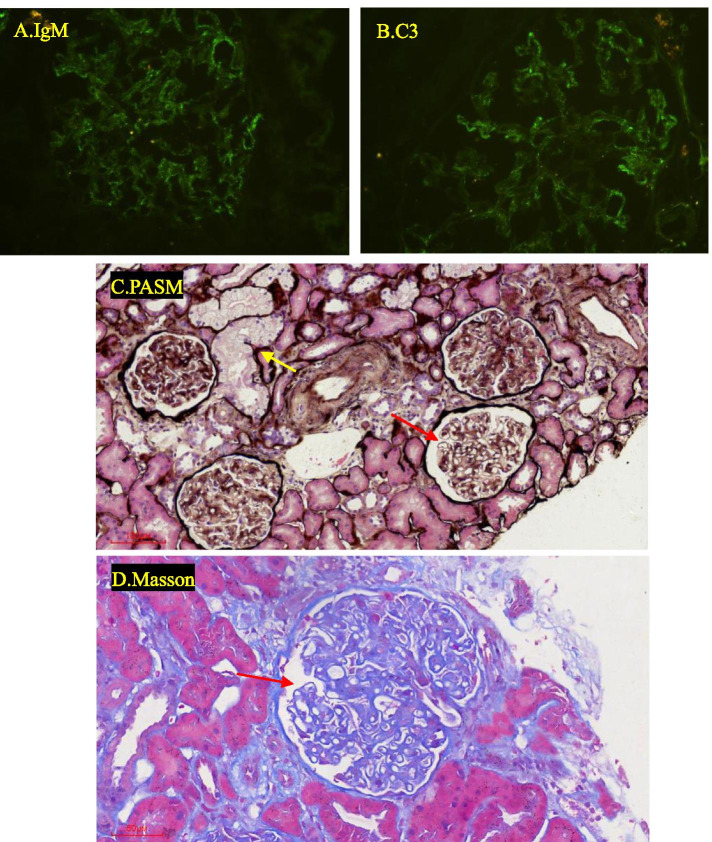
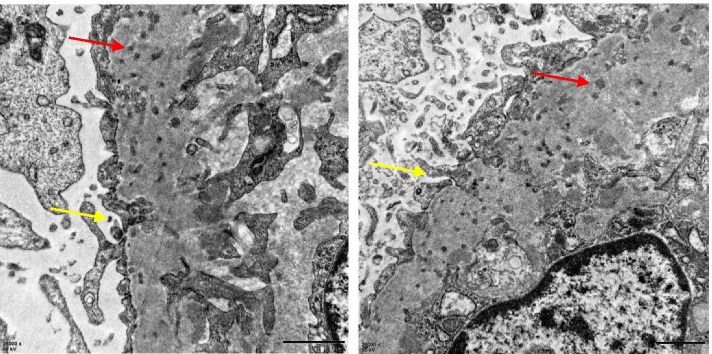
A 61-year-old Chinese female was diagnosed with systemic lupus erythematosus with clinical manifestations of proteinuria, pleural effusion, seroperitoneum, anemia, leukopenia, thrombocytopenia, antinuclear antibody positive, and hypocomplementemia. She also had benign ovarian tumor and Epstein-Barr virus infection. Renal biopsy immunofluorescent staining showed IgM and C3 were granularly deposited along the capillary wall instead of typical "full house" features. Electron microscopy showed lots of microspheres structures were seen in the thickened GBM.
We present a case of PIG in a patient with systemic lupus erythematosus. The mechanisms of PIG are unknown, but may be associated with connective tissue disease and podocyte injury.
足细胞内褶肾小球病(PIG)是一种罕见的病理改变,其特征是增厚的肾小球基底膜(GBM)中有微球体或微管状结构。迄今为止,全世界仅报道了几十例病例。在这里,我们报告一例伴有系统性红斑狼疮的 PIG 病例。
一名 61 岁的中国女性被诊断为系统性红斑狼疮,临床表现为蛋白尿、胸腔积液、腹腔积液、贫血、白细胞减少、血小板减少、抗核抗体阳性和补体降低。她还患有良性卵巢肿瘤和 EBV 感染。肾活检免疫荧光染色显示 IgM 和 C3 呈颗粒状沿毛细血管壁沉积,而非典型的“满堂红”特征。电子显微镜显示增厚的 GBM 中可见大量微球体结构。
我们报告了一例系统性红斑狼疮患者的 PIG 病例。PIG 的发病机制尚不清楚,但可能与结缔组织疾病和足细胞损伤有关。