Chang Lin-Lin, Xu Xia-Qing, Liu Xue-Ling, Guo Qian-Qian, Fan Yan-Nan, He Bao-Xia, Zhang Wen-Zhou
Department of Pharmacy, Affiliated Tumour Hospital of Zhengzhou University, Henan Cancer Hospital, 127# Dongming Rd, Zhengzhou, 450008, Henan, China.
Department of Clinical Pharmacy, Zhengzhou Central Hospital Affiliated To Zhengzhou University, Zhengzhou, China.
Cancer Cell Int. 2021 Dec 11;21(1):663. doi: 10.1186/s12935-021-02371-3.
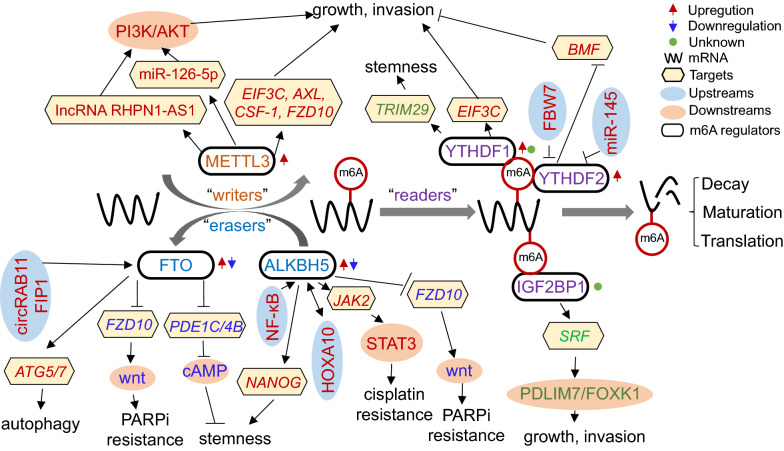
m6A (N6-methyladenosine) methylation, a well-known modification in tumour epigenetics, dynamically and reversibly fine tunes the entire process of RNA metabolism. Aberrant levels of m6A and its regulators, which can predict the survival and outcomes of cancer patients, are involved in tumorigenesis, metastasis and resistance. Ovarian cancer (OC) ranks first among gynaecological tumours in the causes of death. At first diagnosis, patients with OC are usually at advanced stages owing to a lack of early biomarkers and effective targets. After treatment, patients with OC often develop drug resistance. This article reviews the recent experimental advances in understanding the role of m6A modification in OC, raising the possibility to treat m6A modification and its regulators as promising diagnostic markers and therapeutic targets for OC.
m6A(N6-甲基腺苷)甲基化是肿瘤表观遗传学中一种著名的修饰,它动态且可逆地精细调节RNA代谢的全过程。m6A及其调控因子的异常水平与肿瘤发生、转移和耐药性有关,可预测癌症患者的生存和预后。卵巢癌(OC)在妇科肿瘤死因中排名第一。初诊时,由于缺乏早期生物标志物和有效靶点,OC患者通常处于晚期。治疗后,OC患者常出现耐药性。本文综述了近年来在理解m6A修饰在OC中的作用方面的实验进展,提出了将m6A修饰及其调控因子作为OC有前景的诊断标志物和治疗靶点的可能性。