Mary MacKillop Institute of Health Research, Australian Catholic University, Melbourne, VIC, Australia.
Physical Activity Laboratory, Baker Heart and Diabetes Institute, Melbourne, VIC, Australia.
Int J Behav Nutr Phys Act. 2021 Dec 13;18(1):159. doi: 10.1186/s12966-021-01191-y.
Sedentary behaviour (SB; time spent sitting) is associated with musculoskeletal pain (MSP) conditions; however, no prior systematic review has examined these associations according to SB domains. We synthesised evidence on occupational and non-occupational SB and MSP conditions.
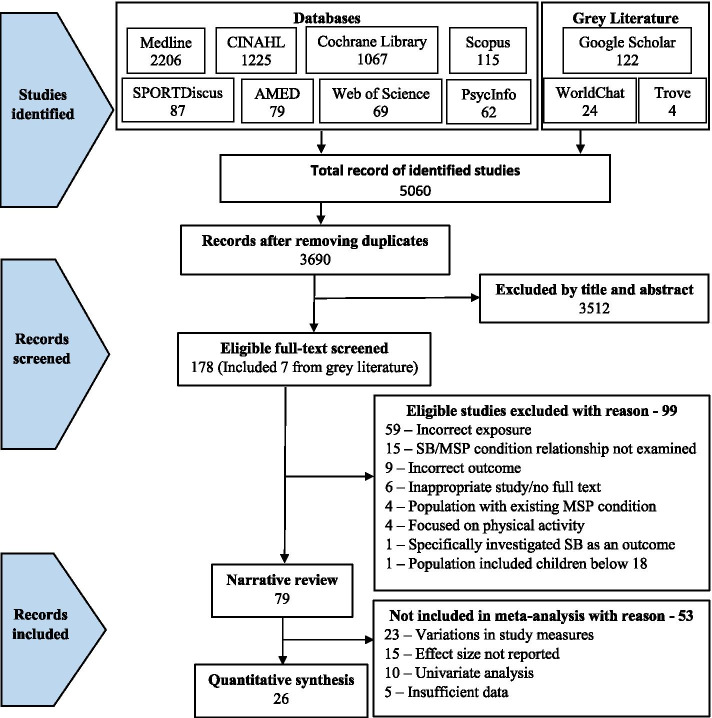
Guided by a PRISMA protocol, eight databases (MEDLINE, CINAHL, PsycINFO, Web of Science, Scopus, Cochrane Library, SPORTDiscus, and AMED) and three grey literature sources (Google Scholar, WorldChat, and Trove) were searched (January 1, 2000, to March 17, 2021) for original quantitative studies of adults ≥ 18 years. Clinical-condition studies were excluded. Studies' risk of bias was assessed using the QualSyst checklist. For meta-analyses, random effect inverse-variance pooled effect size was estimated; otherwise, best-evidence synthesis was used for narrative review.
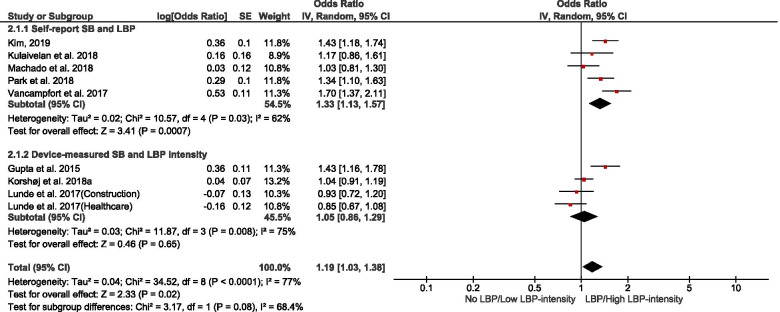
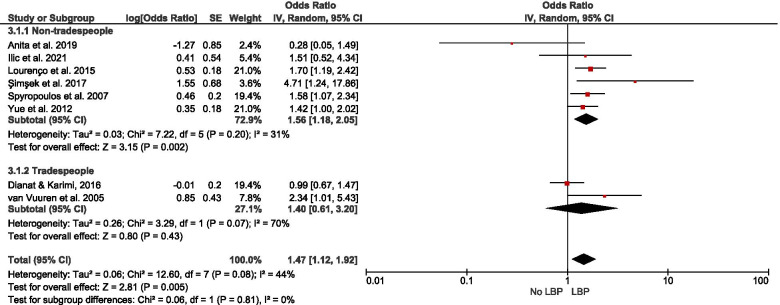
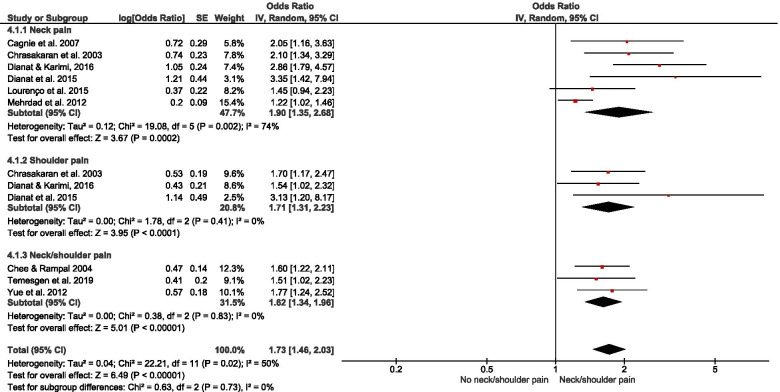
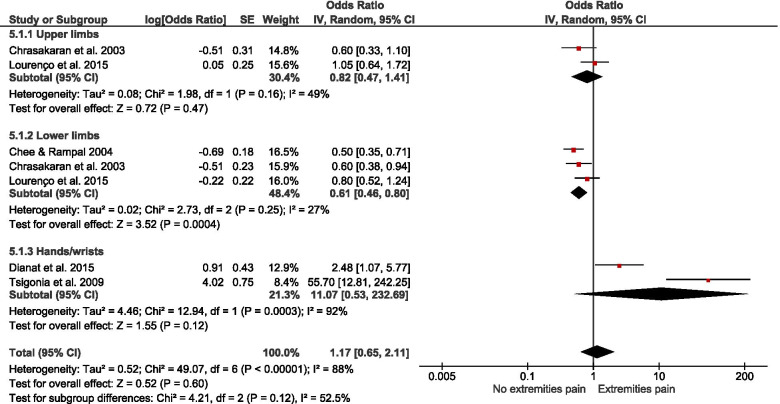
Of 178 potentially-eligible studies, 79 were included [24 general population; 55 occupational (incuding15 experimental/intervention)]; 56 studies were of high quality, with scores > 0.75. Data for 26 were meta-synthesised. For cross-sectional studies of non-occupational SB, meta-analysis showed full-day SB to be associated with low back pain [LBP - OR = 1.19(1.03 - 1.38)]. Narrative synthesis found full-day SB associations with knee pain, arthritis, and general MSP, but the evidence was insufficient on associations with neck/shoulder pain, hip pain, and upper extremities pain. Evidence of prospective associations of full-day SB with MSP conditions was insufficient. Also, there was insufficient evidence on both cross-sectional and prospective associations between leisure-time SB and MSP conditions. For occupational SB, cross-sectional studies meta-analysed indicated associations of self-reported workplace sitting with LBP [OR = 1.47(1.12 - 1.92)] and neck/shoulder pain [OR = 1.73(1.46 - 2.03)], but not with extremities pain [OR = 1.17(0.65 - 2.11)]. Best-evidence synthesis identified inconsistent findings on cross-sectional association and a probable negative prospective association of device-measured workplace sitting with LBP-intensity in tradespeople. There was cross-sectional evidence on the association of computer time with neck/shoulder pain, but insufficient evidence for LBP and general MSP. Experimental/intervention evidence indicated reduced LBP, neck/shoulder pain, and general MSP with reducing workplace sitting.
We found cross-sectional associations of occupational and non-occupational SB with MSP conditions, with occupational SB associations being occupation dependent, however, reverse causality bias cannot be ruled out. While prospective evidence was inconclusive, reducing workplace sitting was associated with reduced MSP conditions. Future studies should emphasise prospective analyses and examining potential interactions with chronic diseases.
PROSPERO ID # CRD42020166412 (Amended to limit the scope).
久坐行为(SB;坐着的时间)与肌肉骨骼疼痛(MSP)疾病有关;然而,以前没有系统的综述根据 SB 领域来检查这些关联。我们综合了职业和非职业 SB 与 MSP 疾病的证据。
根据 PRISMA 方案,我们在 8 个数据库(MEDLINE、CINAHL、PsycINFO、Web of Science、Scopus、Cochrane Library、SPORTDiscus 和 AMED)和 3 个灰色文献来源(Google Scholar、WorldChat 和 Trove)中搜索了原始定量研究(2000 年 1 月 1 日至 2021 年 3 月 17 日),研究对象为年龄≥18 岁的成年人。排除临床疾病研究。使用 QualSyst 清单评估研究的偏倚风险。对于荟萃分析,采用随机效应逆方差汇总效应大小进行估计;否则,采用最佳证据综合进行叙述性综述。
在 178 篇潜在合格的研究中,有 79 篇被纳入[24 篇为一般人群;55 篇为职业(包括 15 篇实验/干预)];56 项研究质量较高,得分>0.75。26 项研究的数据进行了荟萃分析。对于非职业 SB 的横断面研究,荟萃分析显示全天 SB 与腰痛[LBP-OR=1.19(1.03-1.38)]有关。叙述性综述发现全天 SB 与膝关节疼痛、关节炎和一般 MSP 有关,但与颈部/肩部疼痛、髋关节疼痛和上肢疼痛的关联证据不足。前瞻性研究也没有足够的证据表明全天 SB 与 MSP 疾病之间存在关联。此外,关于休闲时间 SB 与 MSP 疾病之间的横断面和前瞻性关联的证据也不足。对于职业 SB,对横断面研究的荟萃分析表明,自我报告的工作场所坐姿与腰痛[OR=1.47(1.12-1.92)]和颈部/肩部疼痛[OR=1.73(1.46-2.03)]有关,但与四肢疼痛[OR=1.17(0.65-2.11)]无关。最佳证据综合分析发现,关于交叉性关联的结果不一致,而设备测量的工作场所坐姿与体力劳动者的腰痛强度之间可能存在负前瞻性关联。有关于电脑时间与颈部/肩部疼痛的交叉性证据,但腰痛和一般 MSP 的证据不足。实验/干预证据表明,减少工作场所坐姿可减少腰痛、颈部/肩部疼痛和一般 MSP。
我们发现职业和非职业 SB 与 MSP 疾病之间存在横断面关联,职业 SB 关联与职业有关,但不能排除反向因果关系偏倚。虽然前瞻性证据尚无定论,但减少工作场所坐姿与减少 MSP 疾病有关。未来的研究应强调前瞻性分析,并检查与慢性疾病的潜在相互作用。
PROSPERO 编号 CRD42020166412(修订以限制范围)。