PROmoting FITness and Health through Physical Activity Research Group (PROFITH), Department of Physical Education and Sports, Faculty of Sport Sciences, Sport and Health University Research Institute (iMUDS), University of Granada, Granada, Spain.
Department of Systems Biomedicine and Pharmacology, Leiden Academic Centre for Drug Research (LACDR), Leiden University, Leiden, the Netherlands.
Obesity (Silver Spring). 2022 Jan;30(1):50-61. doi: 10.1002/oby.23282. Epub 2021 Dec 12.
Omega-6 and omega-3 oxylipins are known to play a role in inflammation and cardiometabolic diseases in preclinical models. The associations between plasma levels of omega-6 and omega-3 polyunsaturated fatty acid-derived oxylipins and body composition and cardiometabolic risk factors in young adults were assessed.
Body composition, brown adipose tissue, traditional serum cardiometabolic risk factors, inflammatory markers, and a panel of 83 oxylipins were analyzed in 133 young adults (age 22.1[SD 2.2] years, 67% women).
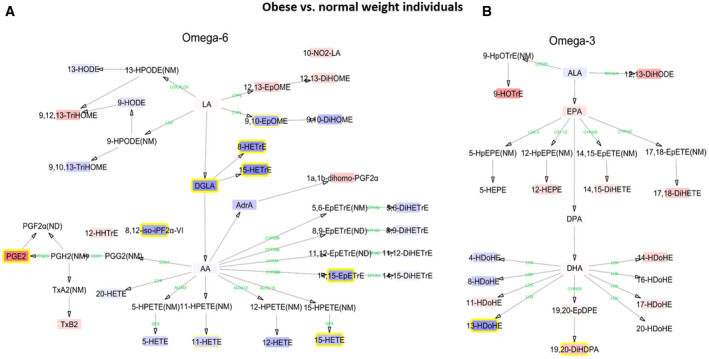
Plasma levels of four omega-6 oxylipins (15-HeTrE, 5-HETE, 14,15-EpETrE, and the oxidative stress-derived 8,12-iso-iPF -VI) correlated positively with adiposity, prevalence of metabolic syndrome, fatty liver index, and homeostatic model assessment of insulin resistance index and lipid parameters. By contrast, the plasma levels of three omega-3 oxylipins (14,15-DiHETE, 17,18-DiHETE, and 19,20-DiHDPA) were negatively correlated with adiposity, prevalence of metabolic syndrome, fatty liver index, homeostatic model assessment of insulin resistance index, and lipid parameters. The panel of seven oxylipins predicted adiposity better than traditional inflammatory markers such as interferon gamma or tumor necrosis factor-alpha. Pathway analyses revealed that individuals with obesity had higher plasma levels of omega-6 and lower plasma levels of omega-3 oxylipins than normal-weight individuals.
Plasma levels of seven omega-6 and omega-3 oxylipins may have utility as early markers of cardiometabolic risk in young adults.
已知 ω-6 和 ω-3 氧化脂类在临床前模型中发挥作用,参与炎症和心脏代谢疾病。本研究旨在评估年轻成年人血浆中 ω-6 和 ω-3 多不饱和脂肪酸衍生氧化脂类与身体成分和心脏代谢危险因素之间的关系。
对 133 名年轻成年人(年龄 22.1[SD 2.2]岁,67%为女性)的身体成分、棕色脂肪组织、传统血清心脏代谢危险因素、炎症标志物和 83 种氧化脂类的面板进行了分析。
四种 ω-6 氧化脂类(15-HeTrE、5-HETE、14,15-EpETrE 和氧化应激衍生的 8,12-iso-iPF -VI)的血浆水平与肥胖、代谢综合征患病率、脂肪肝指数、稳态模型评估的胰岛素抵抗指数和脂质参数呈正相关。相比之下,三种 ω-3 氧化脂类(14,15-DiHETE、17,18-DiHETE 和 19,20-DiHDPA)的血浆水平与肥胖、代谢综合征患病率、脂肪肝指数、稳态模型评估的胰岛素抵抗指数和脂质参数呈负相关。该氧化脂类面板比干扰素 γ或肿瘤坏死因子-α等传统炎症标志物更好地预测肥胖。通路分析显示,肥胖个体的 ω-6 氧化脂类水平较高,ω-3 氧化脂类水平较低。
七种 ω-6 和 ω-3 氧化脂类的血浆水平可能可作为年轻成年人心脏代谢风险的早期标志物。